


 1
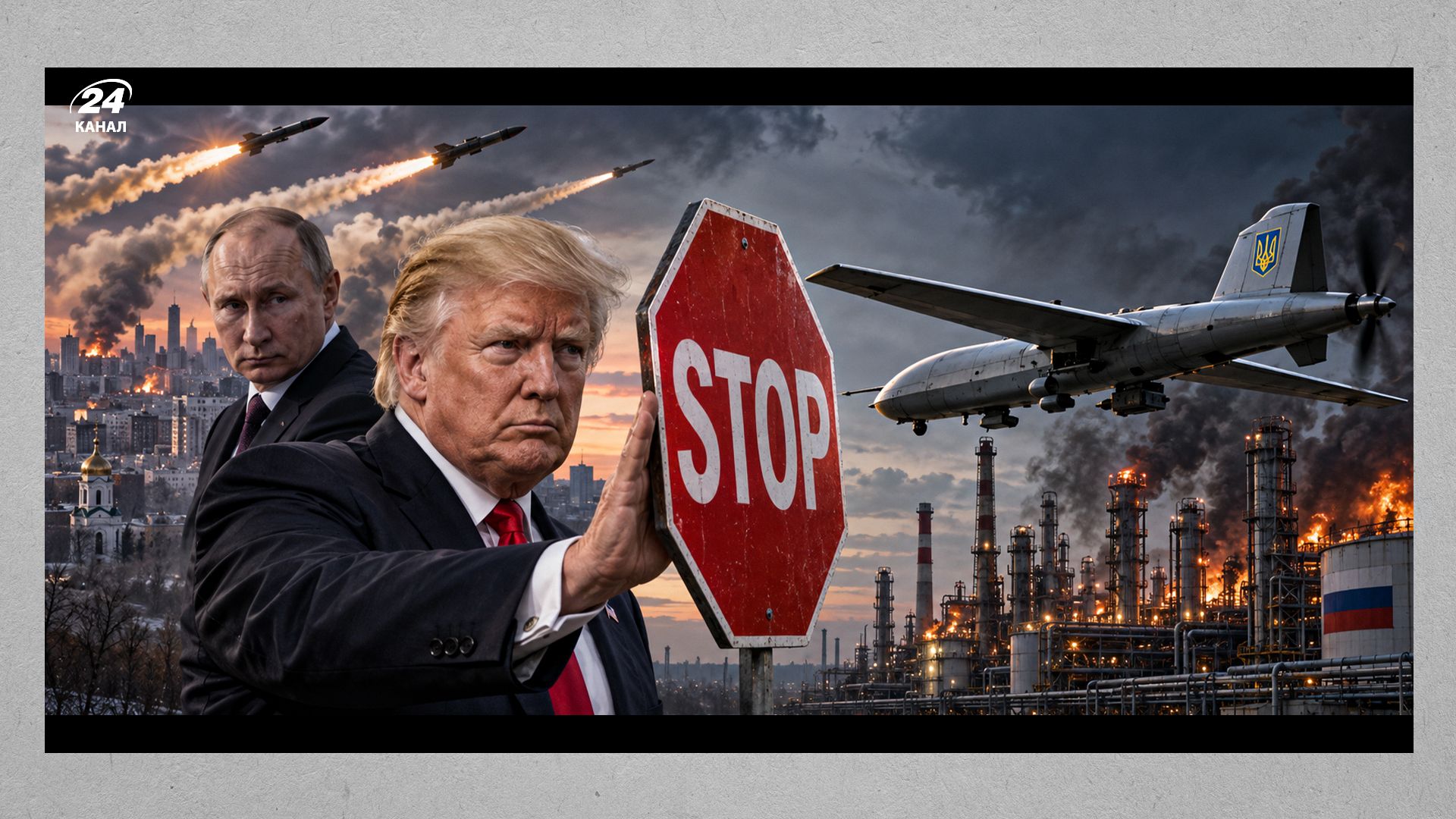
1 Donald Trump insists that Ukraine stop striking Russian oil refineries, even though Moscow continues to attack Ukraine’s energy infrastructure and residential areas. At the same time, strikes on Yandex data centers have created serious problems for Russia’s digital infrastructure, the consequences of which could affect not only business but also the Kremlin’s information influence abroad.
Political strategist Boris Tizengausen analyzed Washington’s demands and the contradictory statements regarding an energy ceasefire in an analytical review he authored for Channel 24. He paid particular attention to unexpected changes in the activity of pro-Russian accounts following the attacks on Russia’s digital infrastructure.
Trump wants Ukraine to be the first to stop strikes on oil refineries
Donald Trump is dissatisfied with Ukraine’s continued attacks on Russian oil refineries. According to Axios, the U.S. president wants Kyiv to first stop striking Russian oil refineries and only then negotiate with Moscow to halt attacks on Ukraine’s energy infrastructure.
However, Russia has not agreed to corresponding restrictions and continues to shell Ukraine. Under these circumstances, the course of action proposed by Washington raises questions, as Kyiv is expected to make concessions even before receiving any guarantees from the Kremlin.
Donald, are you joking? So you’re saying, Ukraine, don’t strike Russian oil refineries, and then somehow work something out with Putin. But Putin doesn’t want to negotiate. Essentially, Trump wants Ukraine to unilaterally stop striking Russian oil refineries,
” Tizengausen said indignantly.
Axios also reported, citing a White House official, on a possible agreement that would entail a cessation of attacks on oil refineries in both countries. Trump expects Ukraine to adhere to such an energy ceasefire, even though the proposed restrictions apply to infrastructure that is in very different conditions.
The Russian army dealt devastating blows to Ukrainian oil refining facilities at the very beginning of the full-scale invasion. Therefore, according to the political strategist, an exchange of commitments not to attack oil refineries does not create a level playing field for the parties.
Russia destroyed our oil refineries back in 2022. So it turns out that we’re simply not attacking Russian oil refineries. Is this some kind of joke? Trump couldn’t have been unaware that Russia destroyed our oil refineries back in 2022,
– the political strategist emphasized.
The pressure on Ukraine may not be limited to demands regarding Russian oil refining. The Financial Times reported that U.S. officials contacted representatives from Kyiv and European countries over the weekend and warned of the possible consequences of continued Ukrainian strikes on oil refineries.
This includes the risk of halting the exchange of intelligence and blocking the PURL mechanism, through which European countries purchase U.S. weapons for Ukraine. The publication described potential measures of pressure, rather than a decision that has already been made to halt the supply of weapons or intelligence.
Tensions surrounding the Ukrainian strikes intensified following Trump’s agreement with Putin regarding Russian diesel fuel. The U.S. president’s decision drew sharp criticism in the European media and in comments under White House posts. Tizengausen estimated that about 80% of the reactions were negative, based on his own observations.
At the same time, the purchase of Russian diesel fuel does not in itself guarantee lower prices for American consumers. The situation on the fuel market also depends on other factors, particularly the U.S.’s next steps regarding Iran. If Trump launches a new bombing campaign, prices, as the political strategist suggested, could spike again.
The Kremlin denied the truce announced by Trump
Despite the lack of a confirmed agreement, Donald Trump posted a statement on his social media account announcing the start of an energy truce between Ukraine and Russia. The U.S. president claimed that both sides had agreed and called for the ceasefire to be upheld.
However, neither Kyiv nor Moscow confirmed the announced ceasefire, and Russian officials directly denied the existence of such an agreement. A similar situation arose in September, when Trump’s statements about a cessation of attacks were initially refuted in Moscow and later in Ukraine as well.
Ananskikh, a representative of the Russian State Duma’s Energy Committee, also stated that the Russian side knew nothing about a new ceasefire. He suggested that the U.S. president might be making such statements in an attempt to curb rising oil prices.
“We all know that Trump often says things to keep oil prices from rising. So-called ‘verbal interventions.’ I don’t know how much of this corresponds to reality,” Ananskikh said. “This is an official representative of the Russian State Duma speaking this way about Trump,”
Tizengausen noted.
Meanwhile, Ukraine responded to another statement by the U.S. president, who called on Ukrainians to change the country’s political leadership. Volodymyr Zelenskyy proposed a condition under which elections could be held: Russia must agree to a full 60-day ceasefire.
The Ukrainian president emphasized that if this were to happen, the country would be ready to vote and would accept the will of its people. According to the political strategist, this proposal forces Moscow to decide whether it is ready to at least temporarily cease hostilities.
“If President Trump really wants elections to take place, pass this on to Putin. Give us two months of a complete ceasefire, and we’ll hold elections in Ukraine. And we’ll, of course, be ready to accept whatever choice our people make,” Zelenskyy said. A good move. Now the ball is in Putin’s court,
Tizengausen noted.
However, Moscow refuses to agree even to a short-term halt to the war. Tizengausen believes that Putin aims to use the negotiations to extract territorial concessions from Ukraine: first regarding the Donbas, and later he may put forward new demands concerning the Zaporizhzhia and Kherson regions.
Kremlin spokesman Dmitry Peskov stated that Russia is not interested in the proposed ceasefire and is only talking about a long-term peace. Russian Foreign Minister Sergey Lavrov also spoke out against a pause in hostilities, stating that Zelenskyy does not deserve a respite on the front lines.
Russian troops continued to attack Ukrainian cities. In Kharkiv, more than ten people were reported wounded after a new strike on a high-rise building, and explosions were heard again in Kyiv.
At the same time, the Russian Ministry of Foreign Affairs condemned the October 10 missile attack on King Khalid International Airport in Riyadh and called for an end to strikes on civilian targets. Tizengausen paid particular attention to this statement, as the Russian army continued to shell residential areas in Ukraine.
According to data cited in the review, on October 5, six people were killed and 59 others were injured – including three children – as a result of a guided airstrike on Kharkiv. In Pryluky on October 7, a missile strike on a five-story residential building claimed the lives of 22 people, including five children, and another 54 were injured.
On the same day in Kyiv, following a drone attack on the Obolon and Desnianskyi districts, four deaths and 12 injuries were reported. The following day, an airstrike on a street with public buses in Kramatorsk, according to official statistics, killed 33 people and injured 18 others. In Kyiv on October 8, four deaths and 19 injuries were also reported.
In Zaporizhzhia on October 10, Russian guided bombs struck residential neighborhoods. According to data cited by Tizengausen, 23 people were killed, including four children, and another 32 were injured. The political strategist contrasted this chronology of shelling with Russia’s calls to protect civilian targets and Washington’s intention to purchase diesel fuel from the Kremlin.
Strikes on “Yandex” could have caused Russia even greater damage
While Washington is demanding an end to Ukrainian attacks on Russian oil refineries, strikes on other Russian infrastructure have already caused serious problems. These include Yandex’s data centers, on which not only the company’s own digital services depend but also those of many businesses that use its technologies.
Damage to large data centers could affect access to corporate information, document management, and the operation of online platforms. Some data, as Tizengausen suggested, may have been lost irretrievably, although the exact extent of the damage and losses remains unknown.
The market has yet to fully grasp the full extent of the consequences of the destruction of Yandex’s data centers. It’s not just about the operability of their own services, but also about the services of many thousands of corporate clients. This is just the tip of the iceberg,
the political strategist explained.
A significant portion of the data centers in question are located in the European part of Russia. Banks and government agencies – including tax authorities – also rely on large-scale data storage and processing capabilities. Disruptions to these systems can affect far more users than isolated outages of ordinary websites.
According to Tizengausen, the potential consequences for the Russian economy could be more severe than disruptions to popular e-commerce platforms. He compared the potential losses to the problems faced by the online retailers Ozon and Wildberries, which depend on the uninterrupted operation of their digital systems.
A massive amount of information could have been destroyed there: databases and documents that cannot be recovered. From the perspective of a blow to the war economy, Ozon and Wildberries would seem like mere trifles,
– Tizengausen suggested.
Problems with Russia’s digital infrastructure, he believes, could affect not only businesses but also tools of information influence. Following the attacks on data centers, he noticed changes in the activity of accounts that had previously spread messages in support of political forces abroad favorable to Moscow.
The number of pro-Russian accounts decreased following the attacks on data centers
Following the attacks on Yandex’s data centers, Tizengausen observed a decrease in online activity among certain groups of accounts that supported right-wing political forces in Europe. In particular, this included pages promoting the positions of the German party “Alternative for Germany.”
According to his observations, similar changes also occurred in the Polish-Ukrainian segment of social media. There were fewer Polish-language accounts posting hostile messages against Ukrainians, as well as pages posing as Ukrainian and provoking conflicts with Poles.
Everything that Russia had been supporting with its massive bot farms has also disappeared. How unexpected, isn’t it? I understand that they will partially restore this now, but if the strikes continue, it will be a colossal problem for the Russians,
– says Tizengausen.
The political strategist attributes the observed decline in activity to problems with Russian digital infrastructure, though he did not provide evidence of a direct link between the strikes and the operation of bot farms. He speculates that Russia will gradually restore some of these networks, although further disruptions at major data centers could complicate their operations.
Tizengausen considers the potential impact of the attacks on the Kremlin’s information operations abroad to be particularly significant. In his view, this vulnerability in the Russian system was previously underestimated, with far more attention paid to conventional military and energy infrastructure.
“It seems to me that only now have people realized where Putin’s Achilles’ heel was hidden – he doesn’t even use the internet himself,”
the political strategist noted.
Russian officials have also acknowledged the severity of the damage to Russian data centers. Minister of Digital Development Maksut Shadayev called the attack on Yandex’s infrastructure “unprecedented in scale.”
According to the Russian newspaper “Kommersant,” restoring the damaged facilities could take up to half a year. Meanwhile, Yandex is gradually restoring its services and seeking additional capacity to host customer data.
The company announced agreements with Selectel, K2 Cloud, and VK Cloud to expedite the provision of cloud resources. Tizengausen reacted ironically to the fact that the Russian publication had disclosed the names of the companies to which Yandex plans to transfer part of its capacity.
The problems facing Russian digital services have also affected the actions of individual propagandists. Margarita Simonyan announced her switch from Yandex to Google, explaining that it was due to the Russian search engine’s constant demands that she confirm she was not a robot.
This willingness to use Western services contrasts with the anti-Western rhetoric of Russian propaganda. Tizengausen also noted that Russian public figures often condemn the West, even as they continue to use its technologies and other conveniences for their own comfort.
EU Prepares Tighter Visa Restrictions for Russians
The European Commission is considering tightening visa issuance rules for Russian citizens. According to Politico, citing officials from Poland, Sweden, and Estonia, a proposal to that effect could be presented early next year.
European countries fear new hybrid attacks, as well as the possible entry into the EU of individuals who participated in the war against Ukraine. The number of Russian citizens who continue to receive permits to travel to the Schengen Area is a source of additional concern.
Last year, according to the data cited, nearly 500,000 tourist visas were issued to Russians. At the same time, former Russian military personnel – particularly those who took direct part in combat operations on Ukrainian territory – may attempt to enter Europe.
“Someone who went to a foreign country to kill for money should not, at the very least, be allowed to enter your country. Who knows, maybe he also got money somewhere to come to your country and kill someone,”
said Tizengausen.
To impose individual entry bans, EU member states do not necessarily have to wait for a joint decision from Brussels. National authorities can already independently restrict entry for specific Russian citizens on security grounds, provided their identities have been established and there are sufficient grounds for doing so.
Estonia is already using this mechanism; in January, it banned the first 261 participants in the Russian aggression from entering the country. Individual restrictions allow decisions to be made regarding specific individuals without the need to impose uniform rules on all EU member states at once.
It is not necessary to wait for a joint decision by all European Union countries. National authorities can impose individual entry bans on security grounds. In other words, each country can make such a decision on its own,
– explained the political strategist.
Tizengausen advocates extending such restrictions not only to those directly involved in hostilities but also to representatives of Russian security agencies. Among them, he named employees of the FSB, the Russian National Guard, the prosecutor’s office, tax authorities, and judges, whose involvement in the activities of the Russian regime could pose risks to European countries.
Nearly 1,600 individuals and companies have been hit with EU sanctions
The European Union is also stepping up sanctions pressure on the Russian defense sector. According to data cited by Tizengausen, the 22nd sanctions package includes nearly 1,600 individuals and entities linked to Russia’s military-industrial complex.
The restrictions cover companies in various industries that support the production of weapons and military equipment. This includes not only major manufacturers but also suppliers of specific materials and components necessary for the Russian military’s operations.
Shipyards, aircraft manufacturers, electronics manufacturers, armored vehicle repair plants, aerospace companies, and suppliers of materials for machine tools, drones, and ballistic missiles. Even garment factories that supply the Russian army have also been hit by sanctions,
Tizengausen noted.
According to the information provided, the sanctions lists also include companies from third countries linked to the Russian defense industry. The combined annual revenue of the companies in question is approximately 20 billion, although the currency of this amount is not specified. About 265,000 people work in these industries.
Among the changes to the sanctions lists, some Russian oligarchs who had previously avoided restrictions are expected to be re-added. The final list should reveal exactly who will be affected by the new measures and how broadly they will impact companies linked to the Russian military-industrial complex.
The political consequences of Trump’s diesel deal with Putin also remain unclear. Tizengausen suggested that this decision could negatively affect the standing of the U.S. president and the Republican Party, while the extent of the problems facing Russia’s digital infrastructure following the attacks on “Yandex” has yet to be assessed.
Boris Tizengausen on the strikes against Russian oil refineries: watch the video