


Logistics has always played a key role in any military conflict. In Russia’s war against Ukraine, the challenge of supplying troops with everything they need has proven to be far more complex than in previous conflicts, precisely because of the advancement of drone technology. Drop-type and FPV drones, as well as other types of munitions capable of striking at close, medium, and long ranges, make it much easier to cut off the logistics routes of military formations.
At the same time, logistics has always been considered a top priority for development in the Russian army. Not because the generals felt it was necessary to keep their troops well-fed, but because of the need to ensure firepower superiority. The thousands of shells that the Kremlin’s invaders typically rain down on the enemy during any expansion require the coordinated efforts of numerous units, as well as roads, railways, and other infrastructure to ensure a continuous supply of fuel and ammunition.
Thanks to drones, supplying ammunition, shells, diesel fuel, food, and water to the front lines has become a highly challenging task. While the Russians deliver everything they need right up to the foxholes using regular vehicles, donkeys, or simply by hand – or even via underground routes – transporting ammunition and fuel to warehouses and other temporary storage sites is impossible without trains and trucks.
Why Ukraine attacked the Kerch Bridge again on November 16, 2023; why this is just the tip of the iceberg; and how the Defense Forces are systematically disrupting the aggressor’s logistics in the temporarily occupied south, as well as in Crimea, read about it in this report from 24 Channel.
popular videos
Transport corridors as the primary target for disrupting logistics
Before the Defense Forces were extensively equipped with “middle strike” drones, Ukraine’s defenders targeted entire warehouses and oil depots, and each strike on such facilities significantly weakened the enemy’s capabilities in a particular sector of the front. However, starting in the spring and summer of 2026, Ukraine shifted to intensifying strikes against the invaders’ logistics throughout the entire operational rear.
The primary targets were initially railway bridges and junction stations in the temporarily occupied territory, which made supplying Crimea and the captured parts of southern Donetsk, Zaporizhzhia, and Kherson regions extremely difficult. Constant strikes on enemy trucks – which the Russians were using to replace the railroad – completed the picture.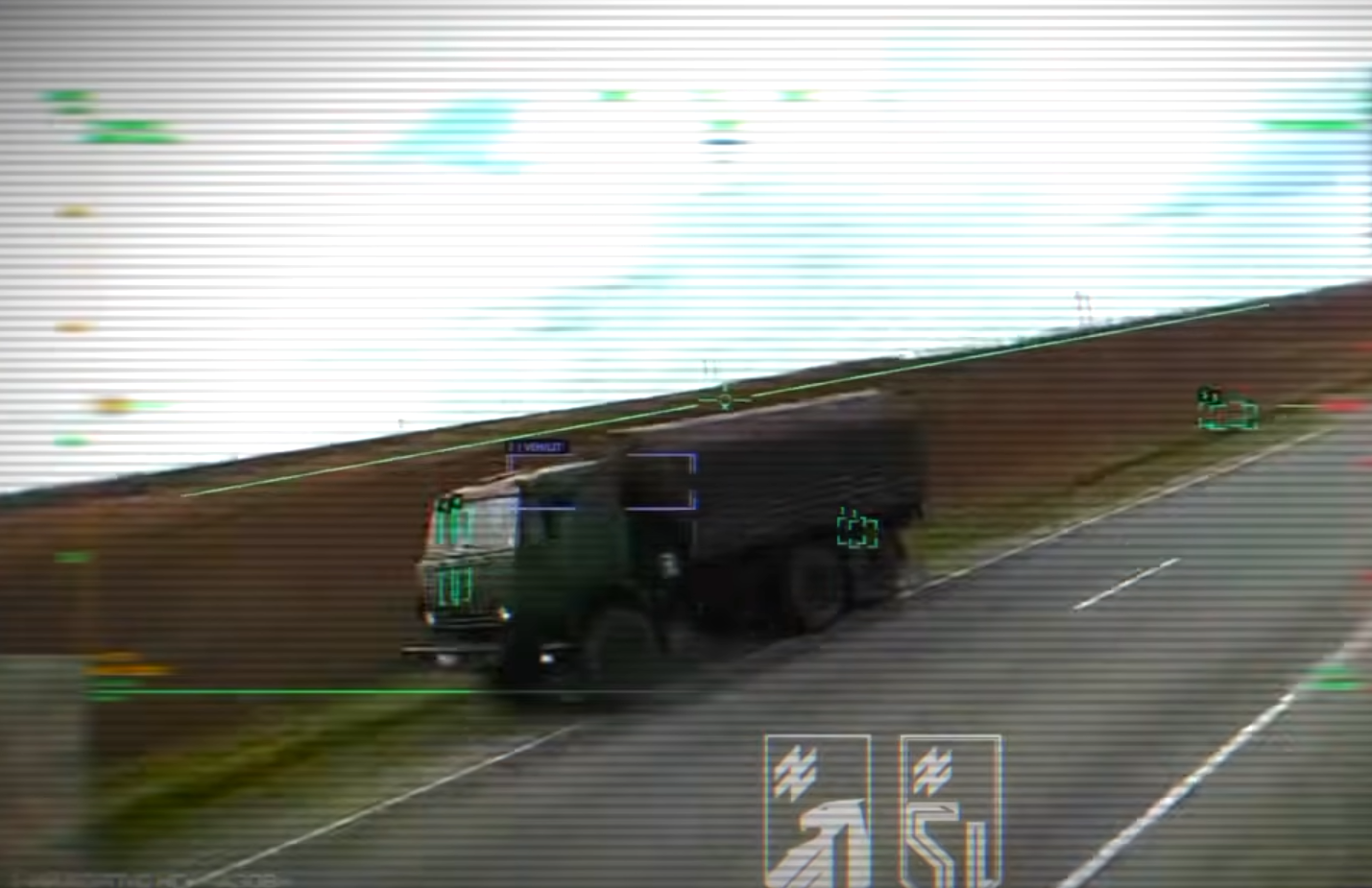
One second before a strike on a Russian truck on the highway near Mariupol. Summer 2026 / Screenshot from a video by the 1st Corps of the National Guard of Ukraine “Azov”
And while in the summer of 2026 Ukrainian drone operators were hunting down vehicles en masse, turning highways into death traps, October and November were marked by the Defense Forces’ transition to the next phase of disrupting logistics – the destruction of bridges along the Russian border or in the occupied East. Thus, over the past two months, at least six overpasses or bridges spanning the Mius and Don rivers were struck near Novoazovsk and in the Rostov region.
It is safe to say that Kyiv has moved from destroying isolated cargo shipments to systematically reducing the capacity of all logistical arteries. The so-called “Novorossiya” route plays a key role in this; it is the route the Russians used to supply hundreds of thousands of metric tons of ammunition, fuel, and food to the front lines and to Crimea.
This corridor, nearly 700 kilometers long and passing through Mariupol, Berdiansk, Melitopol, and other key cities in southern Ukraine, is of strategic importance to the invaders. Given that it is extremely difficult to transport (and remove) everything needed to supply the units via Crimea, overland access through the temporarily occupied territories has become very important for Moscow. However, whether the R-280 highway can serve as even a minimal lifeline for the invaders remains an open question.
If Ukraine consistently destroys bridges, prevents them from being rebuilt, and keeps the roads under fire control, the occupiers’ presence in the occupied territories will become extremely difficult.
Some bridges have been out of commission for a long time
It is currently difficult to say whether the strikes on Russian crossings are related to the fact that the aggressors have begun targeting bridges across the Dnipro River. However, while large structures like the Southern or Northern crossings can withstand far more than a strike from even several ballistic missiles, smaller bridges can easily be destroyed even by drones.
The Defense Forces struck the first two bridges on October 10 near Rostov-on-Don. A long-range drone first struck the a drawbridge over the Don River, and later another crashed into the Western Road-Rail Bridge.
Traffic on both structures was halted for a while, but experts quickly concluded that the bridges had not sustained any critical damage, so after repairs, trains and cars were allowed to resume passage.
In contrast, the attack on the bridge over the Mius River on November 8, near Natalivka, narrowed the logistical bottleneck for the Russians by at least half. The strike hit not only the roadbed but also the crawler construction cranes being used to widen the bridge from two to four lanes.
The occupiers had hoped that twice as much military equipment would be able to cross the bridge, but a Ukrainian drone instead reduced the structure’s capacity by 50%. It took the occupiers six days to restore traffic across the bridge, but only in the opposite direction.
A bridge in Guselnikove, part of the Novoazovsk municipal community, also sustained critical damage as a result of the strike. The key purpose of this strike was that the occupiers had been using the structure to bypass the main bridge across the Hruzkyi Yalanchik River following previous strikes. The closure of this crossing is expected to extend some Russian truck routes by 150 kilometers.
Similarly, significant damage occurred on November 15 in the Neklinovsky District of the Rostov Region, where Ukrainian defense forces struck an overpass above the railroad and a bridge across the Mius River. Neither of these crossings was a primary logistics route for the Russians; rather, they provided additional transport routes to bypass sections that had already been damaged. Thus, the Ukrainian side’s approach appears to be entirely systematic, rather than a situational response aimed at disrupting enemy supply routes.
This means that, provided consecutive strikes are carried out against critical infrastructure, the aggressors’ logistics in this sector will steadily deteriorate.
The Kerch Bridge – the Key to Supplying Crimea
Strikes on the land corridor to the occupied peninsula have severely limited the supply of essential goods to Crimea. Consequently, the importance of the bridge across the Kerch Strait – which the occupiers grandiosely call the “Crimean Bridge” – for supplying the peninsula has begun to grow.
This is despite the fact that the structure itself already sustained damage in 2022 and 2023, and pontoon crossings are not reliable routes of communication due to the very same drones and unmanned boats. This is precisely why Damage to the bridge on November 16 in 2026 appears to be a promising target.
Of course, it is hardly possible to destroy or critically damage the structure with a drone, but at least temporarily limiting its capacity is entirely possible. The extent of the damage to the bridge’s load-bearing components is currently unknown, but the fact that the occupiers had to suspend traffic across it – at least for a while – for safety reasons and to reduce the load on the structure indicates that this is a game both sides can play effectively.
The Crimean Bridge after the attack on the morning of November 16, 2026 / Photo – Exilenova+
There is currently no data on the Kerch Bridge’s operational status. However, the temporary strain on the entire supply system for the occupied south is enormous. Several thousand cars waiting in line to enter and exit Crimea, combined with the virtually paralyzed “Novorossiya” highway, are truly causing a logistical collapse.
To exert this kind of pressure, it is enough to simply strike the bridge systematically, rather than completely destroy it; therefore, if Kyiv’s goal is to cause Russia’s supply system to degrade as much as possible, it is enough to simply repeat the strikes continuously. Since every strike means that engineers must conduct inspections, and military and political leadership must organize temporary crossings and set up detour routes.
This increases the cost of goods, widens the gap in the supply of essential items, and, in general, deals a painful blow to the enemy. This is especially true as the effects of the strikes accumulate: one small bridge can be repaired, another can be bypassed, but when all possible routes can handle only a small percentage of the traffic flow, logistics begin to collapse. However, it all depends on how long the Defense Forces can sustain supply disruptions for the enemy in the south.
FAQ
If you find an error on this page, select it and press Ctrl + Enter