


Protests in Europe / Thibault Camus/AP
On October 24, mass demonstrations took place across Europe over the rising cost of living and social policies, drawing more than 800,000 people. In France, peaceful marches escalated into clashes with police and arrests.
According to EuroNews, France has seen the largest protests since the social movement began. Organizers estimated the number of participants at 800,000 nationwide, with 250,000 taking to the streets of Paris, while official authorities reported 410,000 demonstrators.
popular videos
What is known about this new wave of protests?
On October 24, security measures were stepped up in the Italian and French capitals, and in Paris, police used water cannons and tear gas against protesters.
According to the Paris Police Prefecture, the official route of the demonstration ran from Porte d’Italie to Porte de Vincennes.
Protests in France: Watch the video
Clashes between protesters and law enforcement also occurred in Lyon, Lille, Marseille, Montpellier, Nantes, Nice, and Toulouse. Interior Minister Laurent Nunez reported that at least 135 people were arrested nationwide and emphasized that law enforcement will not tolerate disturbances of public order.
One police officer was injured during the protest: watch the video
Use of water cannons and preventive police measures
In Lyon, special forces used tear gas to disperse a group of 150 people who were attempting to block a road near the city center, where demonstrations were banned. Meanwhile, in Lille and Nantes, protesters threw various objects at law enforcement officers, to which the police responded with water cannons.
Ahead of the weekend, the French government deployed approximately 70,000 police officers and gendarmes to ensure security. Many private businesses and stores closed or boarded up their windows, fearing a repeat of the riots and looting from the previous week.
Law enforcement also seized numerous items intended for use in violent acts in several cities, including Orléans, Rennes, and Tours. The police paid particular attention to Orléans, where the National Rally party convention was taking place, attended by Marine Le Pen and Jordan Bardella.
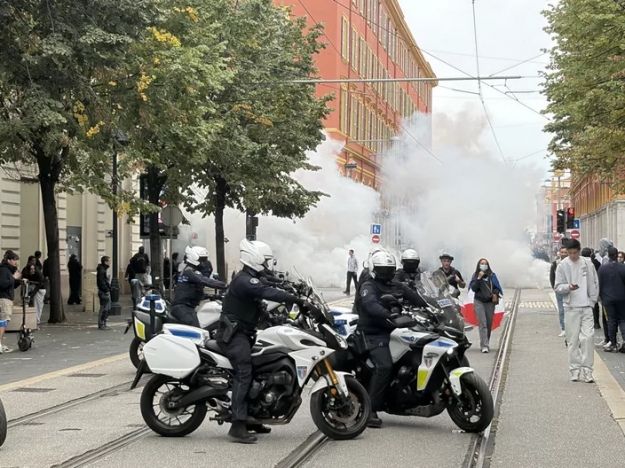
Protests in Nice / Le Figaro
What is the situation in Albania?
In Albania’s capital, Tirana, clashes broke out between protesters demanding the resignation of Prime Minister Edi Rama and the police.
Demonstrators threw stones and set trash cans on fire, while law enforcement used tear gas, water cannons, and rubber bullets. The protests, which have been ongoing for about two weeks, began over plans to build a luxury resort near a protected wetland area.
They subsequently evolved into a broader anti-government movement amid corruption investigations involving the prime minister’s allies. Students were joined by professors, teachers, and opposition politicians.
The unrest has been among the largest in Tirana in the past decade. Hundreds of people were injured, and 127 businesses suffered damages totaling 2.15 million euros.
Authorities accuse organized crime groups and foreign actors of exploiting the protests, and police are reviewing surveillance camera footage and social media posts to identify those involved in the violence.
Pensioner Protests in Madrid and Security Measures in Italy
Meanwhile, in Madrid, thousands of protesters took to the streets demanding an increase in state pensions and their indexation in line with the actual inflation rate. The march, organized by a pensioners’ movement with the support of labor unions – including the General Confederation of Labor (CGT) – proceeded from Atocha Station to Alcalá Street.
Protests in Spain: Watch the video
Protesters in Spain demanded that the minimum pension be brought in line with the minimum wage, that the gender gap in pension benefits be eliminated, and that penalties for early retirement be abolished for those with 35 years of service. They also called for protecting the public pension system from privatization.
Meanwhile, security measures were stepped up in Italy: 1,500 law enforcement officers were deployed in Rome and 1,800 in Milan, amid fears of a resurgence of the riots that took place on October 17 and 18.
Water cannons are being used against protesters in Bologna: watch the video
Overall, the protests in European countries reflect growing socioeconomic tensions and pressure on governments over the cost of living.
Incidentally, it was previously reported that Italian authorities are investigating whether Russia or other external forces could have been involved in the mass protests and clashes in the country. According to Bloomberg, officials have not ruled out the possibility that “ Foreign provocateurs may have helped fuel the unrest ” in European cities.
Related topics:
If you find an error on this page, select it and press Ctrl + Enter