



Two years ago, the appointment of Fox News host Pete Hegseth as U.S. Secretary of Defense shocked Washington and the entire world.
At the time, Donald Trump’s critics feared that a person with no experience in public administration and no outstanding cognitive abilities could turn the Pentagon into a playground for Trumpists’ political experiments.
Since then, Hegseth has weathered a series of high-profile scandals, personnel conflicts, and serious challenges in office, including a military intervention against Venezuela and two wars against Iran. The “war minister” also managed to alienate the U.S.’s European NATO allies and participate in what amounted to blackmailing Ukraine.
During his two years at the helm of the Pentagon, Hegseth has confirmed all the worst fears about him. Now, however, his political future is under threat due to the Republicans’ crushing defeat in the November 3 midterm elections.
The Democrats have regained control of Congress and are already preparing to scrutinize the Trump administration’s actions, and the Pentagon chief, as one of the most controversial figures, risks being the first to face congressional investigations and backlash. It is possible that Trump himself will try to make the “secretary of war” a scapegoat and, in order to reconcile with the Democrats, will sacrifice Hegseth – a move in keeping with the traditions of American politics.
What has Pete Hegseth been known for during his nearly two years at the helm of the Pentagon, what is known about his past, and whether he will be able to keep his job after the Republicans’ defeat – 24 Channel reports.
popular videos
Who Is Pete Hegseth
A week after his victory in the U.S. presidential election, Donald Trump announced on his Truth Social platform on November 12, 2024, that “ appointed him to the position of defense minister. It turned out to be the controversial TV host Pete Hegseth.”
“Pete is a man of character, intelligent, and a true American patriot. With Pete at the helm, America’s enemies must know – our military will be great again, and America will never give up,”
On January 24, 2025, the Senate officially confirmed Hegset’s nomination as U.S. Secretary of Defense. He replaced Lloyd Austin in that position.
Although two Republicans and all Democrats voted against Hegset, the Republican majority had enough votes.
Interestingly, during the final vote, an equal number of senators voted “for” and “against” the nomination. That is why Vice President J.D. Vance, who is formally the president of the U.S. Senate, had to be called upon to break the tie.
This was only the second time in U.S. history that this has happened – the first such instance also occurred during Trump’s term, but in 2017. At that time, Mike Pence supported the nomination of Education Secretary Betsy DeVos.
Pete Hagseth is an American television host for Fox News. He has been a political commentator since 2014. The TV host is a native of Minneapolis, Minnesota. He was born on June 6, 1980.
Pete Hagseth received his education at the prestigious Princeton University, where he earned a Bachelor of Arts degree, and later attended the equally prestigious Harvard University (both institutions are members of the so-called “Ivy League”), where he earned a master’s degree in public policy.
Since his college days, Pete Hagseth has taken an active interest in politics and participated in events organized by conservatives and the Republican Party, though he has never held a government position.
Pete Hagseth began building his career in 2003 when he joined Bear Stearns (until 2008, this company was one of the largest investment banks and players in the global financial markets). There, Hegset served as an equity market analyst.
At the same time, Hegset also began his military career. He initially served as an infantry officer in the Minnesota National Guard. As early as 2004, he was deployed to the Guantanamo Bay Naval Base (Cuba). There, he served as an infantry platoon commander and guarded the infamous prison. Following this tour of duty, he was awarded the Army Commendation Medal.
After Guantanamo, Hegset volunteered to serve in Iraq – in Baghdad and Samarra. There, he served as an infantry platoon commander and, later in Samarra, as a military-civilian administration officer. During his time in Iraq, Hegset was awarded the Bronze Star, the Combat Infantryman Badge, and a second Army Commendation Medal. He personally participated in combat and narrowly escaped death on several occasions.
In 2011, Hegset served in Afghanistan. He served as a senior counterinsurgency instructor at the Counterinsurgency Training Center in Kabul.
In 2014, Hegset made a drastic career change and began working for Fox News, where he hosted various shows and served as a political commentator.
In 2015, Pitt Hegset accidentally struck a drummer in the military band with an axe. At the time, the incident was dismissed as a curiosity, but experts now see great symbolism in it.
Prior to his nomination, Hegset lived in Tennessee; he is married to a woman named Jenny, and the couple is raising seven children. This rather unusual number of children can also be explained by Hagseth’s worldview and beliefs. He is a staunch conservative and religious fundamentalist. Hagseth is a follower of the conservative Protestant branch of Christianity. Pete Hegset demonstrates his faith in a rather unusual way – by tattooing his own body. Notably, he didn’t get these tattoos while serving in the military, but later, while working in television.
Hegset’s most famous tattoo is the Latin phrase “Deus Vult,” which can be translated as “God wills it.” This is believed to have been the Pope’s call to the future participants of the First Crusade. Over time, this phrase became one of the slogans of the Crusaders, and in our time, of the far right. In the U.S., “Deus Vult” is often interpreted as a potentially extremist rallying cry, which is why Pete Hegset himself faced repercussions at one point. In 2021, the leadership of the Washington National Guard removed Hagseth from security duties for President Joe Biden’s inauguration.
How Hagseth Met Trump
Since Fox News is traditionally loyal to the Republicans, Trump was a frequent guest on their shows. It was through these TV shows that Trump and Hagseth hit it off and, over time, became friends. Their friendship proved so strong that during Trump’s first presidential term, in 2016, Hegset served as Trump’s unofficial advisor.
It is believed that he was the one who convinced Trump to pardon three American soldiers accused or convicted of war crimes related to the shooting of civilians in Iraq.
In his final years on TV, Hegset established himself as a fanatical supporter of Trump. He consistently defended Trump’s controversial statements about NATO and the war in Ukraine.
How Pete Hegset Put Pressure on Ukraine
Even before his appointment as U.S. Secretary of Defense, Pete Hegset had already made numerous controversial statements about Ukraine and Russian aggression.
On the one hand, he called Vladimir Putin a war criminal, criticized the Joe Biden administration for the slow delivery of military aid to Kyiv, and advocated for the Ukrainians’ right to self-defense. On the other hand, he constantly emphasized that some distant war in Europe should not be a problem for Americans.
For example, in February 2022, on Fox News, Hagseth stated that the war in Ukraine is certainly important, but that it supposedly takes a back seat to the U.S.’s domestic problems – crime, inflation, and the spread of liberal ideas, or so-called “woke culture” – one of America’s main enemies according to MAGA supporters.
At the time, he opposed active U.S. intervention in the war, fearing that it could drive Putin into a corner and provoke an even greater escalation.
However, Hagseth’s true attitude toward Ukraine became evident shortly after his appointment as head of the Pentagon. On February 12, 2025, during his first speech at the “Ramstein” meeting, the U.S. secretary effectively called on Kyiv to abandon hopes of regaining all occupied territories.
“We, like you, want to see a sovereign and prosperous Ukraine. But we must start by acknowledging that Ukraine’s return to the borders that existed before 2014 is an unrealistic goal. Pursuing this illusory goal will only prolong the war and cause more suffering,” Hegset said.
The newly appointed Pentagon chief did not stop there. He also called Ukraine’s accession to NATO an unrealistic outcome of the peace process, ruled out the possibility of sending U.S. troops to guarantee future peace, and proposed shifting the primary responsibility for Ukraine’s security to European allies. In effect, even before substantive negotiations began, Washington had publicly outlined the concessions that, in its view, Kyiv should agree to.
It was not Hegset’s statements but his decision regarding U.S. military aid that proved far more serious. In May 2025, following an order from his office, the U.S. military canceled 11 shipments of ammunition and other weapons destined for Ukraine.
Moreover, according to journalists, Donald Trump was not even aware of this decision, and senior White House officials were unable to explain who exactly had halted the shipments. The U.S. Presidential Administration, however, insisted that Hagseth was following Trump’s instructions.
A similar incident occurred again on in July 2025. At that time, the Pentagon suspended the delivery of certain types of weapons to Ukraine, including missiles for Patriot systems, artillery shells, and precision-guided munitions. Officially, the U.S. explained this as necessary to check its own weapons stockpiles, but CNN reported that Hegset had not warned the White House about the halt in deliveries.
Ultimately, Trump had to publicly distance himself from the Pentagon’s decision. When journalists asked Trump who exactly had ordered the suspension of deliveries, he replied that he did not know – even though Pete Hagseth was sitting right next to him at the time.
In 2026, Pete Hagset once again took part in what amounted to blackmailing Ukraine, when the U.S. repeatedly sabotaged arms deliveries paid for by Europeans, and in the fall, the Pentagon suspended the provision of intelligence data to Ukraine – specifically, warnings about Russian ballistic missiles – and then participated in the “circus” surrounding the speed restrictions on Starlink/Starshield.
These “maneuvers” cost Ukraine dearly and sparked a highly publicized scandal in which Trump covered for his favorite. But that was before the November 3, 2026, election.
Now, however, the head of the Pentagon may end up being the main scapegoat in this story. The problem for Hegset himself is that the boundaries of such buck-passing in the White House are quite blurred. Consequently, following the Republicans’ defeat in the midterm elections and the launch of potential congressional investigations, it is the Pentagon chief who risks becoming one of the main targets of attacks by the Democrats. They will bring up the blackmailing of Ukraine, the highly unpopular war in Iran, and war crimes committed by the U.S. military – in particular, the strike on a girls’ school in Minab (southern Iran) and the extrajudicial killings in the Caribbean Sea.
Trump himself has so far publicly come to Hegset’s defense, but whether the president will continue to defend his secretary if it threatens his own political interests remains to be seen.
After all, during his tenure, Hegset has not displayed any overtly anti-Ukrainian sentiments, and his most controversial decisions generally aligned with the White House’s policy of pressuring Ukraine to advance the negotiation process with Russia. It seems he did not have a mind of his own but simply followed orders based on his understanding of what the “boss” wanted.
And although the Pentagon chief has repeatedly and publicly condemned Russian aggression, in practice he has become one of the main architects of Trump’s policy, which calls for reducing the U.S.’s direct responsibility for Ukraine’s security – and, by extension, that of all of Europe.
Secretary on Life Support: Why Democrats Are Calling for Hegset’s Head
After the Republican Party's crushing defeat in the midterm elections on November 3, 2026, Pete Hegset’s political future has been thrown into serious doubt. The Democrats won majorities in both houses of Congress and, as a result, gained the ability to tighten their grip on Donald Trump’s administration.
The Democrats built their campaign on criticizing Trump and his associates. Hegset, as the most controversial figure, likely bore the brunt of it. Interesting fact: During the final debates, the Democrats very aggressively attacked Republican senators, holding them specifically responsible for Hegset’s actions, since they were the ones who voted for his appointment.
And although the new Congress will not begin its work until January 2027, upcoming investigations into the Pentagon’s activities have already become a topic of discussion in Washington.
And quite a few questions have piled up for the Pentagon chief. Even when Trump announced in November 2024 his intention to appoint the former Fox News anchor as Secretary of Defense, U.S. officials expressed doubts about his professional abilities.
“Would you trust him to run Walmart (an American supermarket chain – 24 Channel)? After all, that’s exactly how many employees we have,” said a former Pentagon official in a comment to Politico.
In nearly two years on the job, Hagseth managed to carry out large-scale personnel purges that affected the highest ranks of the U.S. military leadership.
In February 2025, Trump, acting on his secretary’s recommendation, fired General Charles Brown, chairman of the Joint Chiefs of Staff, while Hegset simultaneously removed Admiral Lisa Franchetti, commander of naval operations, and James Slyfe, deputy chief of staff of the Air Force.
According to CBS News estimates, as of September 2026, at least 20 high-ranking military and civilian leaders had either left the Pentagon or been dismissed. As a result, the Pentagon’s leadership positions were filled not by professionals, but by loyalists.
Naturally, such an approach – with its almost blatant disregard for rules and regulations – was bound to lead to scandals and reputational damage. In March 2025, The Atlantic’s editor-in-chief, Jeffrey Goldberg, accidentally found himself in a private Signal chat where high-ranking officials in the Trump administration were discussing upcoming U.S. strikes on Yemen. It was Hegset himself who shared details of the military operation in the chat.
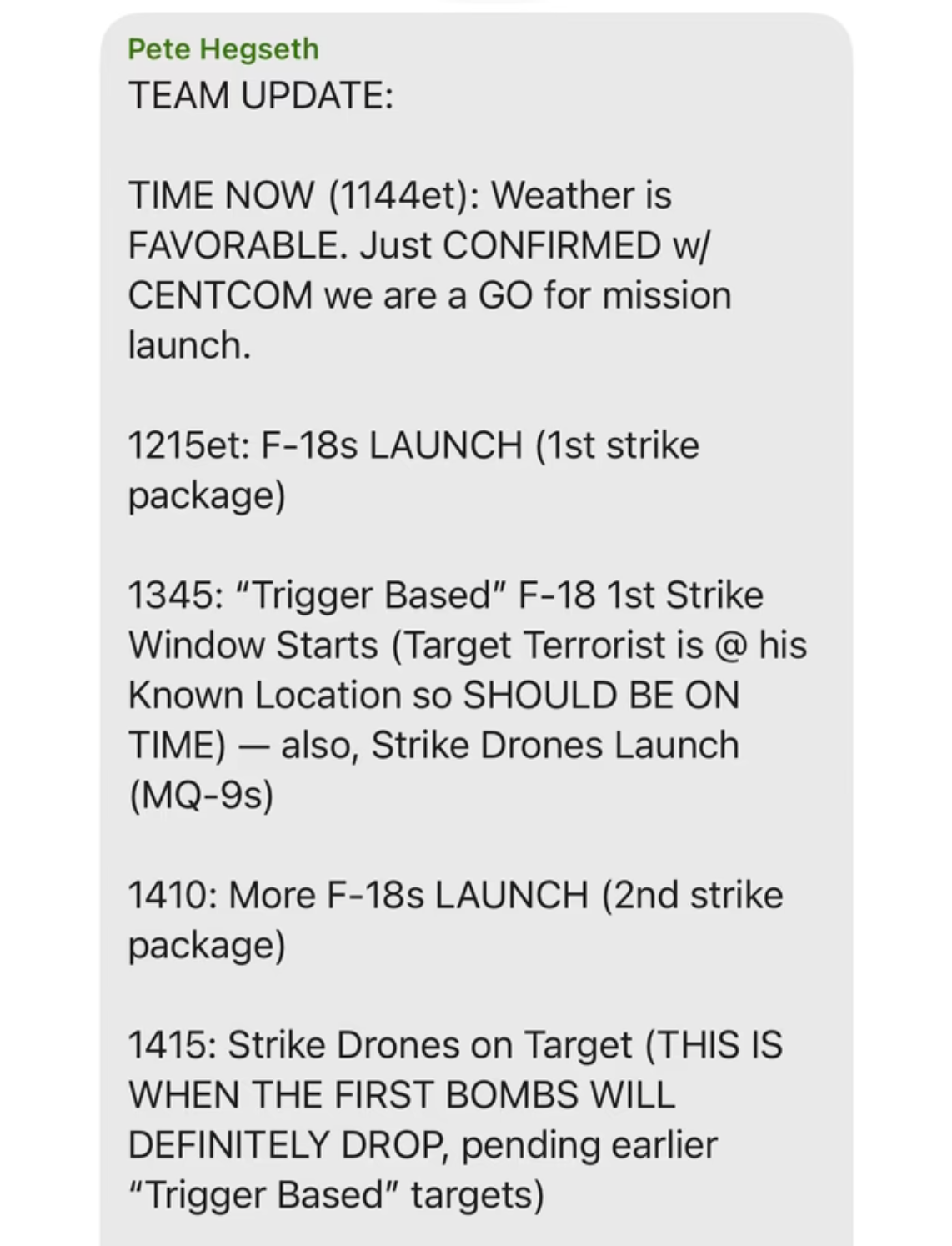
Screenshot of Hagseth’s message in the private Signal chat / The Atlantic
Later, the Pentagon’s inspector general confirmed that the secretary’s use of his personal phone to transmit such information directly violated security protocols and could have endangered the lives of American soldiers. Hegset himself, however, declared himself “fully justified,” citing his authority to declassify the relevant information. That said, the violations of Pentagon regulations remained.
But the greatest challenge for the Pentagon chief was his second war against Iran, which the U.S., together with Israel, launched on February 28, 2026. Despite the White House’s promises to crush the regime in Iran, the fighting dragged on for many months. During this time, the U.S. military expended a massive amount of ammunition, and the conflict itself caused a spike in oil prices, which in turn sparked outrage among American voters.
This was despite the fact that as early as August 2026, the U.S. military leadership had warned Hegset about the dangers of continuing the war against Iran. The generals cautioned that the depletion of resources could weaken the U.S.’s ability to respond to threats in other parts of the world.
At the same time, questions were increasingly being raised in Congress about the legality of this military campaign, its cost, and the Pentagon’s responsibility for civilian casualties – and it wasn’t just Democrats doing so.
In September 2026, Republican Thomas Massie even initiated impeachment proceedings against Hegset, accusing him of waging war against Iran without proper authorization from Congress. At that time, the Republican leadership in the House of Representatives managed to block the vote; however, following the Democrats’ victory, the comfortable environment for the Pentagon chief could change dramatically.
It is particularly telling that, even after the election, Donald Trump himself and Vice President J.D. Vance publicly acknowledged that the war with Iran was one of the main reasons for the Republicans’ defeat. And now the White House faces an awkward question: Who will be held accountable for a military campaign that failed to deliver the promised results but instead turned into a political disaster?
House Democratic Leader Hakeem Jeffries wonders why Hagset is still at the helm of the Pentagon?
We’ve seen this before: how could Hagseth end up like Donald Rumsfeld?
The United States went through a similar situation twenty years ago. In November 2006, the Republican Party, led by George W. Bush, also suffered a defeat in the midterm elections, largely due to Americans’ dissatisfaction with the protracted war in Iraq (where Hegset was serving at the time). And the very next day after the vote, the president announced the resignation of Defense Secretary Donald Rumsfeld – one of the chief architects of the 2003 U.S. campaign in Iraq.
However, Bush did not publicly blame his ally for all the setbacks. On the contrary, he thanked Rumsfeld for his service and explained the personnel decision as stemming from the need for a new approach to the war. However, the political outcome remained the same: the president remained in office, while the defense secretary – who had been associated with the unpopular military campaign – resigned.
And now Pete Hagseth risks finding himself in a similar situation. After all, despite Trump’s personal affection for his secretary, the U.S. president has already demonstrated a willingness to distance himself from Pentagon decisions that harm his personal reputation, as happened during the suspension of military aid to Ukraine.
And given the midterm election results and criticism of the war in Iran, the White House may be tempted to repeat the scenario of 2006. After all, Washington has already had a president who sacrificed his defense secretary to preserve his own reputation. And, much to Hegset’s regret, there is no guarantee that Donald Trump won’t decide to do the same at some point.
If you find an error on this page, select it and press Ctrl + Enter