
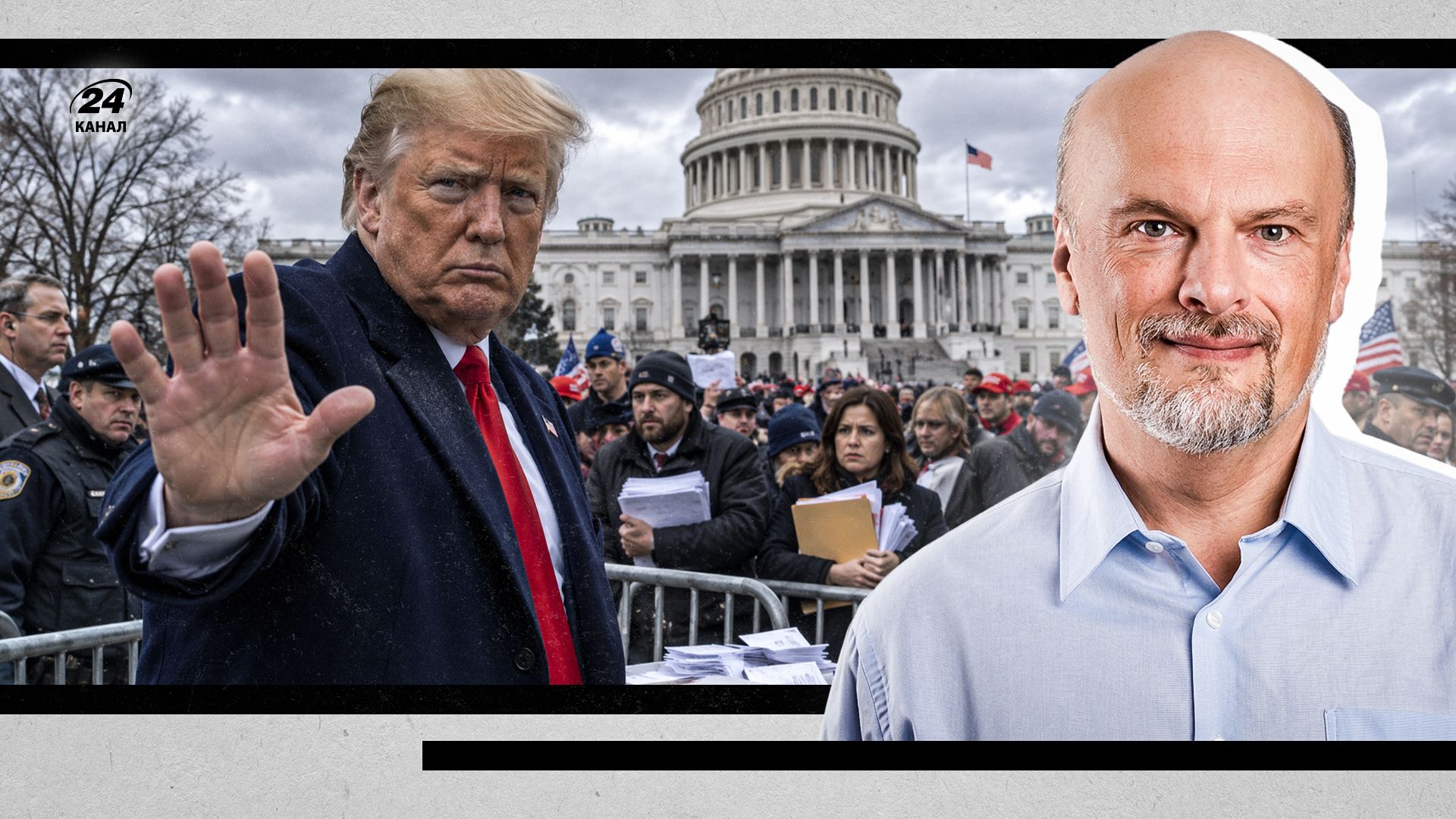


The US is approaching midterm elections in Congress, in which Republicans risk losing their majorities in both houses. Amidst the decline in popularity, Donald Trump is trying to explain high fuel prices by Ukrainian attacks on Russian refineries, but his policies are increasingly drawing criticism even from former supporters.
American political analyst Igor Eisenberg, in an exclusive interview with journalist Igor Yakovenko for Channel 24, explained why he considers Trump's personal interests to be the main motive for his policy towards Russia. The interlocutors also discussed the risk of non-recognition of the election results, the possible blocking of the work of the new Congress, and the scenario in which political confrontation in the United States could escalate into open violence.
US reaction to Trump's policies
Trump accuses Zelensky of not wanting to end the war, promotes a diesel deal with Russia, and effectively sides with Putin. At the same time, a significant portion of Americans and Congress support Ukraine. How is the US reacting to the president's decisions, including the possible violation of the 2022 sanctions law and the problems with Starlink?
There is certainly a reaction in the United States. Trump's decisions are widely covered in newspapers and discussed on television. Among the comments I have seen, there have been no attempts to explain his behavior by reasons unrelated to the president's personal desires.
At the same time, I don't follow all American TV channels. For example, I consider Newsmax to be a frankly far-right propaganda resource. Trump recently gave an interview to it, but I limited myself to reading the transcript.
Fox News also remains a pro-Trump channel, although it is more restrained compared to Newsmax. It may not condemn the president, but it reports the facts about his decisions.
If we talk about the American press in general, criticism comes from different political camps. Both the conservative The Wall Street Journal and the liberal The New York Times negatively assess what is happening now.
As for Congress, both houses are currently on a pre-election recess. This is standard practice, as elections will be held on November 3.
This break does not mean that legislators are simply resting. They are campaigning, meeting with voters, and participating in political events. Those running for a new term are especially active.
Therefore, the lack of Congressional meetings at this time should not be taken as evidence that American society is indifferent to the president's decisions.
Trump's world has no place for Ukraine
I don't entirely agree with the statement that Trump has sided with Putin. In my opinion, he is primarily on his own side. And his personal interests are largely related to money, to enriching himself, his family, and his closest friends.
But there is another important point. Trump has his own idea of how the world should be organized. In his coordinate system, this world should be divided between three strong leaders: himself, Putin, and Xi Jinping.
And in his opinion, Ukraine simply has no separate place in such a world. It should be within Russia's sphere of influence, and Putin has the right to do with it whatever he sees fit.
Moreover, Trump has never fundamentally deviated from this vision.
Many people, including Ukrainians, still hope that he can be convinced of something. That all that is needed is to correctly explain to the American president why a certain decision is wrong, and he will change his position.
But Trump is convinced that he is doing everything right. He sees the world differently than his predecessors.
For him, there are three strong men who should determine the future of the planet. Everyone else, in his opinion, should take into account their interests and not interfere with their negotiations.
This is not just about Ukraine. I think he is willing to consider a large part of Europe as Putin's sphere of influence if European states cannot stand up to him on their own.
At the same time, Trump is much more willing to engage with far-right European politicians. Perhaps he believes that it will be easier for him to build relationships with such governments, including with the Kremlin.
Therefore, I agree that there has never been a president like this in modern US history.
If we take the 20th and 21st centuries, American presidents, regardless of party affiliation, pursued a foreign policy that was based to one degree or another on the values of the United States.
It is primarily about human rights, liberal democracy, and a free market economy. American presidents believed that their country was interested in spreading these principles around the world.
Of course, their approaches differed. Some acted more decisively, some more cautiously, and sometimes American foreign policy made serious mistakes.
For example, in the 1930s, there was a strong isolationist sentiment in the United States. Many Americans did not want to get involved in international conflicts and believed that the country should focus on its own problems.
In my opinion, this was a big mistake, for which the United States later paid dearly. However, even then, America did not abandon its basic values.
After World War II, presidents from Harry Truman and Dwight Eisenhower to Ronald Reagan, Bill Clinton, Barack Obama, and Joe Biden may have had different foreign policy priorities. But the defense of democracy and freedom remained an important component of American policy.
This was especially noticeable during the Cold War, when the United States opposed communist totalitarianism.
These principles, in my opinion, are completely alien to Trump. He sees no need to support democratic states just because they share the same values as the United States.
This is also clearly visible in his attitude towards traditional allies. He has repeatedly criticized Canada, France, Spain, and European countries in general.
In his vision, Canada should be subordinate to the US, and Europe, I suppose, could be in the Russian sphere of influence. If European governments want to have good relations with him, he would prefer to see far-right forces close to him in power there.
Therefore, Trump's decisions regarding Ukraine do not seem surprising to me. They correspond to his vision of a world in which the interests of strong leaders are more important than the rights and sovereignty of other states.
Diesel deal won't save ratings
There is another motive for Trump's current actions. On the eve of the midterm elections for Congress, he needs to explain to Americans why prices continue to rise, although he promised the opposite during the presidential campaign.
Now he is trying to link the rise in fuel prices to Ukrainian attacks on Russian oil refineries. In my opinion, this is an attempt to shift responsibility for the problems of the American economy onto Ukraine.
But Americans are seeing that it's not just fuel that's getting more expensive. The prices of food, electricity, and many other goods and services are also rising.
I'll give you an example from my own life. My wife and I now spend about one and a half times more on groceries than we did before the 2024 presidential election. At the same time, we don't buy anything special, we even follow a diet.
The rise in energy prices affects almost everything. Agricultural products are becoming more expensive due to fuel costs. It costs more to deliver products to stores, and storing them requires electricity, which has also become more expensive.
It's October, summer is over, and air conditioners are no longer needed. Yet Americans' electricity bills are now as high as those that five years ago came mostly in winter or the hottest summer months.
People are extremely unhappy with this. And Trump is trying to find someone to blame so as not to be responsible for the results of his own policies.
However, convincing voters that Ukraine caused their economic problems will be very difficult.
Yesterday, I was driving home from work, stood in traffic for almost an hour, listening to the radio, and two economists were discussing the possible impact of Trump's diesel deal with Putin on the world market.
One of them gave a very apt comparison. Imagine a swimming pool full of water. Trump walks up to it, pours out another bucket, and says, "Look how much more water there is."
I see the situation with Russian diesel roughly the same way. The additional volumes are too small to significantly affect prices.
You mentioned the 2022 law that restricts trade with Russia. Trump, by the way, was quick to clarify that the United States will not buy Russian diesel fuel directly. According to him, Russia should put it on world markets.
That is, he is trying to show that he is not going to violate the relevant law.
But it doesn't make economic sense. Before Ukraine began systematically attacking Russian refineries, Russia exported about three million tons of diesel fuel every month.
Now it is about supplying 300 thousand tons in October. This is only 10% of the volumes that Russia previously exported to foreign markets in one month.
In my opinion, such a quantity is not capable of significantly affecting the cost of diesel either in the US or in the world.
There is already a lot of criticism in the American media that the president is trying to find at least some way to stop his falling popularity.
I expect the Republicans to suffer a very serious defeat on November 3. It is quite rare for a party that controls the White House and both houses of Congress to lose voter support so quickly.
So we're likely to hear a lot more of Trump's rhetoric before the election. He can continue to blame Ukraine for the US's economic problems, but he's unlikely to convince most Americans.
The results of a Fox News poll, which was reported the day before, were indicative. Trump's approval rating was 36%.
And this poll is not from CNN or MSNBC, which often criticize the president, but from Fox News, whose audience is largely made up of his supporters. It is the network that has traditionally had some of the highest ratings for Trump.
Therefore, I consider this result to be an extremely worrying signal for the president.
Yesterday I talked about this in my video blog, and one of the viewers wrote that such high support indicates a lack of awareness on the part of Americans.
I disagree with that explanation. In my opinion, a significant portion of Trump's most loyal supporters have strong far-right beliefs. They support him not because they don't understand his policies, but because they share those views.
My estimate is that there could be tens of millions of such people in the United States, at least 20 to 30 million. This is a phenomenon that cannot be ignored.
But there are also a large number of Americans without strong party preferences. They may vote either Republican or Democrat, focusing primarily on their own lives, jobs, and well-being.
These are the people who see that the promises of Trump and the Republicans have not come true. They were promised lower prices and better lives, and they got the opposite.
Therefore, I think that a significant portion of such voters will not support the Republican Party this time.
At the same time, one should not explain all support for Trump with popular conspiracy theories. For example, there are people who believe that he is supposedly a Russian agent under the pseudonym "Krasnov" and that this can explain all his actions.
But even if you remove Trump himself from this picture, there are millions of Americans who sincerely share his political views. Are they all also agents of Russian intelligence services?
Life is always more complicated than any conspiracy theory.
Trump may not recognize the election results
Even if the majority of Americans no longer support Trump, he will remain president for more than two years. Can his actions be limited? And will he try to hold on to power at all costs, including by force, after the Republicans are defeated?
I am practically certain that if the Republicans lose, Trump will try to escalate the political situation as much as possible. And I can assume in what sequence he will act.
If the Democrats win, especially if they win a majority in both houses of Congress, Trump, in my opinion, will refuse to recognize the election results.
He will again claim fraud, primarily in those districts and states where Democrats gain seats that previously belonged to Republicans.
He could then demand that the election commissions of Republican states not approve the results of the vote. And in those where Republicans control the state legislatures, he would try to get decisions to annul the election results.
After that, lawsuits could begin. Lawsuits will be filed at the state level and possibly all the way to the U.S. Supreme Court.
If these attempts fail, I suggest that Trump may move on to the next stage: trying to disrupt the start of the new Congress.
Following the November 3 elections, the new, 120th Congress is scheduled to convene on January 3. Newly elected lawmakers are expected to be sworn in and begin work.
In my opinion, Trump may be trying to prevent this so that the Democrats who defeated the Republicans do not get the opportunity to exercise their powers.
I don't even rule out attempts to repeat the events of January 6, 2021, when Trump supporters stormed the Capitol. This is one of the possible scenarios, not a decision he has already made.
At the same time, I think the Democrats understand the danger well. After the events of 2021, they are probably preparing much more seriously for possible attempts to block the results of the vote.
In 2020, few expected the political confrontation to end with a storming of the Capitol. Now that we have had such experience, a repeat of such a scenario is unlikely to catch Democrats by surprise.
I assume they are preparing certain measures but are not revealing them publicly. This is natural, because premature disclosure of plans could allow political opponents to find a way to thwart them.
But it is important to understand why the possible loss of Republican control of Congress is so dangerous for Trump.
It's not even that he will lose the ability to freely appoint the members of the administration he needs or push his own bills through Congress.
The biggest threat to him, in my opinion, is possible investigations.
If Democrats gain a majority even in the House of Representatives, its oversight and legal committees will be able to initiate investigations into the activities of the president, members of his family, and his inner circle.
I am convinced that one of the main subjects of such investigations will be possible corruption connections and conflicts of interest.
Of particular note are Steve Witkoff and Jared Kushner, who are involved in important international negotiations, even though they did not go through the usual Senate confirmation process for their respective government positions.
At the same time, they have their own business interests, which, in my opinion, may intersect with the issues on which they are negotiating.
Therefore, questions may arise in the new Congress about how much of these people's decisions correspond to the national interests of the United States, and how much are related to their private financial plans.
Investigations into Trump's contacts with Putin are also possible. For example, the presidents recently spoke for about an hour and a half, but the public knows the content of these talks only from statements from Trump himself and the official Russian side.
I think the American president is very afraid that the details of such conversations and agreements could become the subject of parliamentary hearings.
After all, they will be broadcast on television, and the materials will be discussed not only in the US, but also around the world.
It is this kind of publicity, in my opinion, that could pose a much greater threat to him than the Republicans' formal loss of the majority.
The American media is already making serious allegations of corruption against the current administration. And if Congress begins to investigate these reports, the issue of possible personal enrichment of the president and his entourage could receive much wider publicity.
In particular, questions may arise regarding the business activities of the Trump family, his cryptocurrency projects, and ties to business partners abroad.
I draw attention to the activities of Trump's two sons, their cooperation with the Witkoff family, as well as their ties to representatives of the United Arab Emirates.
A separate issue concerns the possible acquisition of foreign assets of the Russian Lukoil. These include gas stations, oil refineries, and other company facilities in various countries.
In my opinion, Trump's closest business circle may be interested in such assets, and the president himself may count on financial benefits from future agreements.
But these are all issues that require investigation. It is Congress that could determine what agreements actually exist, who is involved in them, and whether laws were broken.
Trump may be scared by the prospect of such details becoming public, so I expect he will try to use every available opportunity to prevent these inspections from starting.
At the same time, his former supporters are increasingly expressing disappointment. I recently saw a TV story from Georgia where a journalist spoke to Americans who had previously voted for Trump repeatedly.
Now they said they could no longer support him. Because the president's promises did not match what was happening in their daily lives.
How can they block the new Congress?
Changes are also taking place among Trump's Russian-speaking supporters. Andrei Larionov has already distanced himself from him, and now Lyubarsky has also reconsidered his previous position. But let's get back to the election: how exactly can Trump prevent the new Congress from convening on January 3?
One possible scenario is a repeat of the events of January 6, 2021. Trump may try to organize mass riots or even a new capture of the Capitol by a crowd of his supporters.
But he could also try to act through American parliamentary procedures. For example, agreeing with House Speaker Mike Johnson to create obstacles to recognizing the credentials of Democrats who defeated Republican candidates.
I am not saying that such actions would be legal. But even procedural disputes could create a serious crisis around the start of a new Congress.
And how do the credentials of newly elected deputies in the US get recognized? I was a deputy of the Russian State Duma of the first convocation, and there the results were approved by the election commission. The deputy received a mandate and came to parliament, and the speaker did not have to separately recognize his credentials. Is the procedure different in America?
Yes, in the United States it is a bit different. First of all, American elections are organized by individual states, and it is at the state level that their results are approved.
There is no single Central Election Commission in the United States that would perform such functions for the entire country.
Therefore, I assume that Trump will primarily try to influence the approval of the results in those districts where Democrats will defeat Republicans.
He may be able to get delays in some states and not in others. But it is not necessary to block the results across the country to create a political crisis.
It is enough for disputes to arise in a certain number of districts that will affect the composition of the new Congress and the balance of power between the parties.
If the election results are not approved, the newly elected legislator may face obstacles in participating in the work of parliament.
There is another procedural feature: Members of the House of Representatives must take an oath, after which they can fully exercise their powers.
But at the beginning of a new session, the House of Representatives must first elect a speaker. Until that happens, it cannot proceed with normal legislative business.
The US Congress has already faced difficulties in electing a speaker. After the 2022 elections, Republicans gained a small majority in the House of Representatives, but for a long time could not agree on a candidate for the leader.
There was a struggle within the Republican Party itself, and the Democrats did not support their opponents' candidates. Because of this, the start of the full work of the chamber was delayed.
Now let's imagine that similar difficulties arise not due to ordinary intra-party disputes, but in conditions of conscious political confrontation around the election results.
Then, delays in approving individual results, electing a speaker, and taking the oath could lead to a serious blockage of the House of Representatives.
There are also issues of organizing the work of the Capitol and ensuring its security. In a political crisis, even such decisions can matter.
I think the Democrats understand the dangers of such a scenario, so they are already preparing for possible attempts to prevent the start of the new Congress. But, of course, this is just my assumption, because they do not publicly disclose their plans.
The Senate also has a procedure for swearing in newly elected senators. The President of the Senate is ex officio Vice President J.D. Vance.
Therefore, I do not rule out that if the Democrats win, there may be attempts to delay the procedures, citing alleged fraud or the need for additional investigations.
For example, if Democrats gain additional seats in the Senate, but Republicans begin to challenge the results, disputes could arise over the admission of individual newly elected senators to work.
I don't know if there is any specific plan for such actions yet. But I believe that Trump and his entourage will look for any opportunity for political and procedural blockage if the election results turn out to be unfavorable for them.
So I expect not just a difficult period after the vote. In my opinion, a very tough fight could unfold between November 3 and January 3.
For Trump, this is essentially a matter of personal political survival. If Democrats gain control of at least the House of Representatives, they will be able to launch the investigations he fears most.
I am virtually certain that one of the first steps of the new oversight and legal committees will be to subpoena Jared Kushner, Steve Witkoff, and Trump's sons.
Ministers and some other officials may seek to challenge such demands by invoking executive privilege, which protects certain aspects of their communications with the president.
But such arguments may not be available to private individuals. Therefore, Kushner, Witkoff and members of the president's family may find themselves having to explain themselves to Congress.
And this is exactly what, in my opinion, Trump will try to avoid at all costs.
There is a broader consequence of the election: If Republicans retain their majorities in their respective chambers, they will continue to set the legislative agenda.
For example, the bill on support for Ukraine, which is currently in the Senate, is not being considered because the Republican leadership is not putting it to a vote.
If the political balance does not change, such bills may continue to remain unconsidered.
That is why these elections are so important not only for the United States, but also for Ukraine and other countries.
The risk of another assault on the Capitol
If Trump tries to block the election results, Democrats and their supporters will surely come out to defend their vote. Could this lead to mass riots or even civil war in the United States?
In my opinion, the events of January 6, 2021, were already an episode of open civil confrontation. And the problem is much deeper than one storming of the Capitol.
Back in January 2017, when Trump had just become president, famous American journalist Carl Bernstein said on CNN that the United States was effectively in a state of cold civil war.
Since then, the political division in the country has not disappeared. And now, in my opinion, it can lead to even more dangerous consequences.
I assume that Trump is capable of resorting to extreme measures if he decides that he cannot otherwise stop the work of the new Congress and the start of investigations.
And for him, the most important thing is not to even avoid impeachment.
Of course, if the Democrats gain a majority in the House of Representatives, they can initiate such a procedure. But to actually remove the president, 67 votes are needed in the Senate, and I doubt that they will be able to gather them.
Instead, public hearings could be a serious blow to Trump's reputation.
He has already survived two impeachments during his first presidential term. But now, in my opinion, there are much more questions about the activities of his administration, family members, and business circle.
And if the details of possible abuses are discussed during open sessions of Congress, millions of Americans will learn about them.
That is why I do not rule out that Trump may even try to organize a violent confrontation if he considers this a way to stop the investigation.
This does not mean that such a scenario will necessarily happen. But I believe it is possible unless there are strong enough political and institutional mechanisms to stop it.
In my opinion, these midterm elections could be the most important for the United States in a century. And it will be important not only to vote, but also to be able to defend the results.
If the system of checks and balances is not restored and Congress remains completely under the control of Trump's political power, I fear a further strengthening of authoritarian tendencies.
In this case, the Republican majority may begin to pass laws that will formally look like ordinary legal norms, but in fact will create opportunities for one party to hold power for a long time.
I call this the legalization of lawlessness. That is, a situation where legislation is used not to protect the rights of citizens, but to consolidate a political monopoly.
In the extreme case, this could lead to the establishment of a far-right authoritarian regime, where elections would remain formal, but the real possibility of changing power would be significantly limited.
We see a similar pattern in Russia, where the government also claims to be holding elections, even though political competition has been effectively eliminated. I'm not saying the United States is in this situation, but I think even moving in that direction is dangerous.
Therefore, the period between November 3 and January 3 could be very tense. And I expect that the struggle will continue not only around the results of the vote, but also around the real possibility of the new Congress to begin work.
At the same time, a slightly different development is also possible. If the Republicans suffer a serious defeat, some party representatives may begin to distance themselves from Trump.
They will see that his policies are leading them to lose voter support, and will try to save their own political future.
Some signs of this are already visible. I recently watched a Senate debate in Iowa, where one of the Republicans actually disputed Trump's claims about the reasons for high diesel prices.
Previously, this politician supported the continuation of the American war against Iran and voted against attempts to limit it. However, during the debate, she was forced to admit that the Ukrainian strikes on Russian refineries were not the reason for the increase in the price of diesel fuel in the United States.
Instead, she linked high prices to the war against Iran, the continuation of which she had previously supported.
This is a telling moment. Even Republicans who previously supported Trump's policies are now forced to say things that contradict his statements.
They understand that voters are increasingly distrusting the president's explanations. He may retain the support of the most loyal part of his electorate, but that is not enough to win the election.
Therefore, the results of November 3 could change not only the balance of power in Congress, but also Trump's position within the Republican Party itself.
I expect the coming months to be extremely challenging for American politics. And the decisive factor will be not only who Americans elect, but also whether the newly elected lawmakers can get started smoothly and exercise the powers that voters have given them.
Eisenberg on Trump's Russia policy: watch the video