

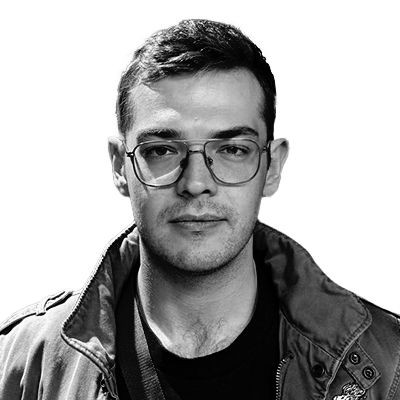

French far-left politician Jean-Luc Mélenchon has come up with yet another explanation for why Russia poses an increasing threat to Europe. Certainly not because of the ambitions of the country’s criminal leadership, headed by Vladimir Putin. That would be far too simple. According to Mélenchon, the issue lies in Ukraine’s strikes on Russian territory.
One of the candidates for the French presidency made this statement a few days ago. To be fair, he immediately clarified that he in no way justifies Moscow’s actions and even recognizes it as an aggressor. However, Mélenchon did not forget to reproach the victim of this aggression for being too active in its defense.
For the founder of “Unbowed France,” this is far from the first time that his rhetoric – praising everything good and condemning everything bad – has been accompanied by cynical accusations against Ukraine. Mélenchon has decades of political experience behind him, millions of active voters, and as many as three failed attempts to reach the Élysée Palace. In 2027, he will likely have his best chance yet to become president of France.
24 Channel presents the biography of Jean-Luc Mélenchon to explore what underpins his political influence in France, how a former establishment figure became a key rebel against the system, what his chances are of winning the upcoming presidential election, and why his “fight for justice” repeatedly aligns with the promotion of the Kremlin’s interests.
popular videos
A Rebel from the Establishment: Who Is Jean-Luc Mélenchon?
In fact, Jean-Luc Mélenchon’s political biography has one rather interesting feature: before declaring an uncompromising war on the French system, he managed to establish himself quite well within it.
Born in 1951 in Tangier, Morocco – which was still part of France at the time – the future leader of the radical left studied philosophy and literature, and began building his political career within the ranks of the French Socialist Party. As early as 1986, Mélenchon became a senator, and from 2000 to 2002, he served as a minister responsible for vocational education in Lionel Jospin’s government.
In other words, the French establishment and bureaucracy were never, for him, some distant, shadowy syndicate of conspirators working against the interests of the people. Mélenchon knew this system from the inside and had been a part of it himself for a long time.
But as time went on, Mélenchon became increasingly dissatisfied with his own party’s course. He accused the Socialists of yielding to economic liberalism and abandoning a genuine left-wing alternative. As early as 2008, he left the Socialist Party and founded his own “Left Party,” and shortly thereafter ran as the presidential candidate for the Left Front. And in 2016, he founded “Unbowed France” – essentially a personal left-wing movement inextricably linked to his own political persona and charisma.
His idea was to channel dissatisfaction with inequality and traditional French parties into a demand for a profound restructuring of the state. One of the central concepts was the “Sixth Republic,” which was intended to put an end to what Mélenchon calls a “presidential monarchy” due to the broad powers of the head of state.
However, as is typical of any far-left ideology, among equals there must always be those who are more equal than others. The same thing happened within his own movement when Mélenchon began to be accused of exerting excessive personal influence over party activities and of an authoritarian (almost Bonapartist) style of leadership. It got to the point where he barred his personal critics from participating in the 2024 elections.
Yet despite such setbacks, it is impossible to deny Jean-Luc Mélenchon’s popularity among French voters. He has indeed never won an election, but each subsequent result has been better than the previous one. In the 2012 presidential election, Mélenchon received 11.10% of the vote; in 2017, 19.58%; and in 2022, 21.95%. Despite his repeated defeats, he has proven capable of rallying the support of millions of French people, making him a rather dangerous opponent for potential rivals in future elections. As a reminder, those elections will take place in April 2027, and incumbent President Macron will not be running.
In fact, this is Mélenchon’s main political achievement. He has managed to create a stable force that the rest of the French political establishment must reckon with. But the key problem is that, along with social demands and promises of democratic renewal, voters are offered – as a bonus – a rather specific view of the world around them.
In this paradigm, France’s pursuit of independence on the international stage is an unquestionable value, whereas Ukraine’s efforts to break free from Russia’s orbit constantly require further clarification.
Ukraine Through Moscow’s Lens: How and Why Mélenchon Justifies Russia’s Actions
This selectivity on Mélenchon’s part became particularly evident as early as 2014. While Russia was seizing Ukrainian territories, Mélenchon explained its actions as a response to the threat of NATO expansion – an alliance of which his own country is a member – and persistently sought out “Nazis” and “coup plotters” within Ukraine’s post-revolutionary government.
Reflecting on Russia’s annexation of Crimea, Mélenchon attempted to justify Putin by invoking the debate over “preventing NATO’s expansion to Russia’s borders,” specifically the Alliance’s advance toward the Black Sea. Thus, in his reasoning, the Ukrainian peninsula became, above all, an object of Russian strategic interests. The French politician, of course, did not take into account the interests of anyone other than Moscow itself.
However, Mélenchon did not limit himself to these explanations alone. In September of that same year, justifying his vote against the European Parliament’s resolution on Ukraine, he wrote a telling post stating that he rejoiced in the “defeats of armed ‘Ukrainian’ neo-Nazi gangs.”
It was in precisely this terminology that the far-left French politician characterized the Ukrainian Defense Forces.
This confidence in his own understanding of the Kremlin’s intentions and motives remained with him right up until Russia’s full-scale invasion of Ukraine. As recently as February 21, 2022, Mélenchon claimed that Russia would not go to war over Ukraine but would wait for the country to fall on its own – “like ripe fruit.” However, it took only three days for his prediction to be put to the test, when missiles began flying toward Kyiv and other Ukrainian cities.
After that, Mélenchon had to backtrack somewhat, and by February 24, he was already explicitly calling Russia’s actions an act of aggression, condemning the invasion, and calling for a ceasefire and even the withdrawal of foreign troops from Ukraine. Therefore, it would be an exaggeration to claim that he simply supported a full-scale war. However, this acknowledgment of the obvious by no means signaled a willingness to rethink his entire framework for understanding the events surrounding Ukraine – a framework that for years had allowed him to find justifications for Moscow’s crimes.
Incidentally, Mélenchon’s main rival in the 2027 election, Marine Le Pen, has been doing exactly the same thing since February 24.
Even after the invasion, Mélenchon continued to repeat like a mantra that Russia allegedly could not accept NATO’s advance toward its borders. Thus, even while condemning Russian aggression, Mélenchon could not resist making remarks that directly or indirectly justified the Kremlin’s actions.
This political line later found a very practical application when, in March 2024, all 75 deputies of the “Unbowed France” faction voted against the government’s declaration regarding the Franco-Ukrainian security agreement and the situation in Ukraine.
The issue at hand was political approval of the policy of supporting Kyiv, specifically the ten-year agreement signed by Macron and Zelenskyy. It provided for long-term military aid, training for Ukrainian military personnel, and cooperation between defense industries; for 2024, France committed to providing up to 3 billion euros in additional military aid.
To put this in context, even members of the Socialist Party supported this declaration. Thus, this was a specific choice made by Mélenchon’s camp, rather than some kind of unified position among the French left.
In fact, this is where the line is drawn between condemning the war and supporting a country that is forced to defend itself. Mélenchon is capable of calling Russia an aggressor. The question is how he envisions resolving this conflict. After all, amid his calls for peace and his explanations of Russian interests, it is very difficult to find an answer to the key question: exactly how does he propose to stop the aggressor?
Peace on Russia’s Terms: How Mélenchon Envisions Ending the War in Ukraine
Jean-Luc Mélenchon’s own recipe for peace calls for a ceasefire as soon as possible, negotiations, and a future French policy independent of military blocs. In March 2025, he even specifically emphasized that it was impossible to negotiate peace without Ukrainian representatives; however, it soon became clear that he once again had grievances against the Ukrainian leadership.
In August of that same year, Mélenchon called Volodymyr Zelenskyy the “president of nothing,” citing the alleged end of his presidential term. In effect, the French politician echoed the Kremlin’s claim that the Ukrainian government is illegitimate. The fact that the Constitution provides for the president to remain in office until a successor takes office, and that the law prohibits holding elections during martial law, did not fit into this narrative. It is worth noting that Mélenchon has a background in the humanities.
At the same time, the position of his political camp has not always been so unambiguous. The program of the left-wing coalition “New Popular Front,” agreed upon in 2024 with the participation of “Unbowed France,” among others, explicitly provided for the supply of necessary weapons to Ukraine. However, as early as September 2026, Mélenchon himself once again began accusing Ukraine of exacerbating Russian threats. In other words, there are significant discrepancies within the coalition and in Mélenchon’s personal rhetoric.
And all of this is taking place against the backdrop of his fourth attempt to finally secure the presidency of France. Mélenchon hopes to mobilize supporters of his ideological concept of “New France” – a society that is significantly more socially just and open to citizens of diverse backgrounds. Mélenchon expects to rally other left-wing voters around him, as he is simply one of the strongest figures in their camp.
However, the results of previous campaigns do indeed demonstrate his ability to build support, though this by no means guarantees a future victory. The Ukraine issue further complicates efforts to build bridges with allies, as Mélenchon’s September statements were publicly criticized by both Green Party leader Marine Tondelier and pro-Ukrainian MEP and center-left politician Raphaël Glucksmann. It turns out that Mélenchon, who claims to want to unite the left, regularly gives them reasons to keep their distance from him.
Ultimately, Mélenchon’s story is one of successfully transforming dissatisfaction with the system into his own political influence. He has managed to offer millions of French people hope for change (albeit without a concrete plan of action), but his promises of justice are difficult to reconcile with justifications for a country that constantly hurls threats at France and all of Europe.
For Ukraine, the danger lies precisely in the fact that an influential contender for the leadership of one of Europe’s most powerful states, while acknowledging Russian aggression, repeatedly shifts the blame onto its victim. Even compared to another controversial presidential candidate – Marine Le Pen – Jean-Luc Mélenchon appears to be a far more populist and significantly more dangerous figure for this office and for future Franco-Ukrainian relations.
If you find an error on this page, select it and press Ctrl + Enter