




"You’ll pay for Volhynia!", "This isn’t our war", "Ukrainians are living off the Poles!" – these and similar anti-Ukrainian narratives, unfortunately, are now being heard more and more often in Poland. All of this is the result of a planned, long-standing information campaign, although its authors are eager to cover their tracks and pass it off as the spontaneous emotions of real people.
Olena Semenyaka, an analyst at the Institute for Cognitive Defense, investigated who is spreading anti-Ukrainian hysteria in Poland, how they’re doing it, and why. Channel 24 presents a text version of the report.
Read to the end to learn how Soviet propaganda previously shaped the image of Ukrainians as enemies in the minds of Poles. How and to whom does Kremlin money flow for anti-Ukrainian provocations in Poland? And why has the positive attitude toward Ukrainians in Poland plummeted several times over the past few years, while levels of xenophobia, chauvinism, and even anti-Semitism have risen?
An Old Wound and the “Soviets”
The history of Ukrainian-Polish relations in the first half of the 20th century is rife with many controversial events, set against the broader context of the aftermath of World War I and the revival of the Russian Empire in the form of the USSR. These are real tragedies that Ukrainian and Polish societies have the right and the duty to remember.
And precisely because this pain is real, it is the perfect weapon. It is a wound that can always be pressed upon. But most importantly: who is doing this, and for what purpose?
In 2019, the book *A Brief History of the UPA for Poles: Will Historians Reconcile Us?* by Kazimierz Wujcicki, a professor at the University of Warsaw and a lecturer at the Ukrainian Catholic University, was published. He devoted many years to researching how the image of Ukrainian nationalists was formed in the Polish public consciousness, and concluded that the anti-Ukrainian narrative centered on Volhynia was deliberately constructed by Soviet propaganda beginning in 1944.
In 1947, the Polish newspaper Życie Warszawy published an obituary for Soviet General Karol Świerczewski, who had served as deputy minister of national defense of Poland (which was already communist – Channel 24) and was killed in battle against the UPA. Consequently, the article dedicated to him portrays Ukrainian insurgents as “fascists” who allegedly “200,000 Poles were brutally massacred in Volhynia ” and “murdered women and children” in the Polish capital, alluding to the alleged involvement of Ukrainians in the suppression of the Warsaw Uprising.
And although there is absolutely no evidence of the UPA’s involvement in the suppression of the Warsaw Uprising, this story still made the front pages, serving as a prelude to the ethnic cleansing known as “Operation "Vistula".” It is worth recalling that at that time, Soviet-controlled Poland forcibly deported over 140,000 Ukrainians from their native lands. This was followed by other joint Polish-Soviet operations to deport Ukrainians from their homelands deep into the Soviet Union.
At the same time, Polish school curricula were also changing. In elementary school, students studied Wanda Żółkiewska’s book *Traces of a Lynx’s Claws*; in middle school, Jan Hergard’s *Glows in the Bieszczady*. Both works demonized the UPA and the Home Army – the Polish anti-communist underground. In this way, Moscow killed two birds with one stone: it persecuted Ukrainians and destroyed Poland’s own memory of resistance. In the 1960s, a new wave of events unfolded under the banner of Polish “national communism,” and the Volhynia tragedy once again found itself at the center of propaganda.
Moscow had been deliberately cultivating its own people in advance: in April 1943, the Central Committee of the All-Union Communist Party (Bolsheviks) issued a directive on recruiting Poles into Soviet partisan units in Volhynia. These people later became the backbone of the communist repressive apparatus in socialist Poland – an apparatus that struck equally hard against both the UPA and the Home Army.
In 1985, Edward Prus’s work *Heroes Under the Sign of the Trident: Konovalets – Bandera – Shukhevych* was published. In it, he portrays the UPA not merely as defeated “fascists,” but as a formidable force capable of revival. The book had a print run of 50,000 copies. That same book attacked Metropolitan Andrey Sheptytsky of the Ukrainian Greek Catholic Church, a passionate champion of the Ukrainian cause. At the turn of the 1980s and 1990s, a purely anti-Ukrainian narrative emerged: attempts to blame Ukrainians for the mass murder of Polish professors in Lviv in 1941, which was in fact committed by the Germans.
Kazimierz Wujcicki, in his aforementioned work, concludes that the Kremlin constructed an anti-Ukrainian discourse to divert attention from its own crimes. Initially, the “Soviets” destroyed archival records Testimony about Katyn and, instead, erected memorials To the victims of the Nazis in Khatyn, convincing Poles that their main enemy was a Ukrainian with an axe, rather than a Soviet executioner with a death list.
Polish researcher Jerzy Targalski, Ph.D., an advisor to the Polish Minister of Defense, spoke directly about this while commenting on the 2016 Polish resolution, which July 11 was declared a Day of Remembrance for the Victims of the "UPA Genocide":
It turns out that we have no anniversary commemorating the victims of the NKVD. The victims of the NKVD do not exist; they were spat upon. There are only victims of the UPA. What does this mean? A group interested solely in the issue of UPA victims has managed to impose its strategy. The victims of the NKVD have ceased to exist, even though they were killed precisely because they were Poles.
How the Kremlin Paid to Drive a Wedge Between Poland and Ukraine
Let’s return to the present. In 2010, pro-Russian Party of Regions MP Vadym Kolesnichenko, co-author of the controversial “language law,” organized a photo exhibition at the “Ukrainian House” in Kyiv with the provocative title “The Volhynia Massacre: Polish and Jewish Victims of the OUN-UPA.” It was effectively aimed at fanning the flames of hostility between the two nations.
In 2013, thatKolesnichenko, along with other deputies from the Party of Regions and the Communist Party of Ukraine, appealed to the Polish Sejm to recognize the Volhynia tragedy as genocide and to condemn the “criminal acts of Ukrainian nationalists.” In February 2014, Kolesnichenko supported the Russian occupation of Crimea in Sevastopol.
Thus, Vadym Kolesnichenko first stoked hostility between Ukraine and Poland, and then helped Russia occupy Crimea.
At the same time, in 2014, MP Oleg Tsarev – who has since been convicted in absentia of treason – attempted to shed light on the Volhynia issue during a broadcast on “Hromadske.” It turned out to be a pitiful effort, but the very fact is telling.
MP Tsarev fails a high school history test – watch the video:
These people (the Party of Regions, the “Opposition Bloc,” and Medvedchuk’s “Opposition Platform – For Life”) were Moscow’s proxies in Ukrainian politics. For them, the “Volhynia issue” was a tool for undermining Polish-Ukrainian relations. Of course, these agents of influence did not act on their own initiative.
As early as 2017, the international intelligence community InformNapalm wrote about these facts and published documents and correspondence showing how the Kremlin’s network operates in Poland.
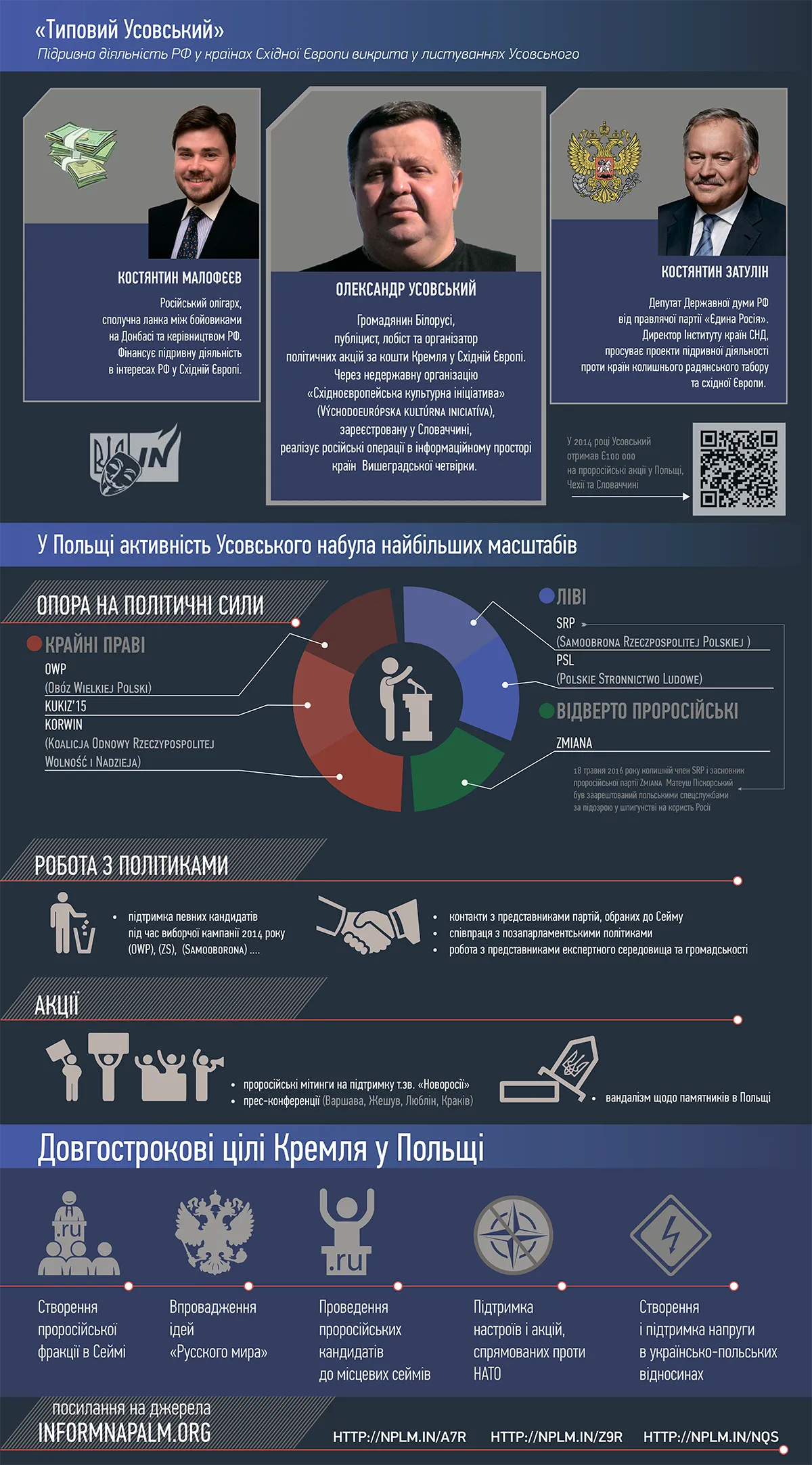
Scheme of interaction between Russians and their agents of influence in Poland / infographic – InformNapalm
A key figure is Belarusian citizen Oleksandr Usovsky. Officially, he is the head of the “Eastern European Cultural Initiative,” registered in Bratislava in 2013. According to InformNapalm’s documents, he is a “freelance agent” and the Kremlin’s “curator for Eastern Europe.”
Konstantin Malofeev – a Russian “Orthodox” oligarch, imperialist, and adherent of the so-called “Russian World” – handled the financing. Usovsky’s correspondence also mentions State Duma deputy Konstantin Zatulin and the “Ukrainian Choice” website – an organization run by Medvedchuk.
What exactly was this network doing in Poland? For several years, it systematically defaced and destroyed monuments to UPA soldiers and Ukrainian civilians on Polish soil. Each such act of vandalism received immediate coverage in Russian state media. As a result, the provocation in Poland and its promotion in Moscow operated as a single, coordinated operation.
Usovsky’s correspondence also contained specific plans with specific prices. According to the published documents, there were plans to enlist the then-leader of the Polish right-wing political party KORWiN, Janusz Korwin-Mikke, to organize several high-profile events at once. Specifically, these included a rally against “Ukrainian aggression in Donbas,” a “Volhynia” memorial march, and a rally calling for the recognition of Crimea as Russian territory.
Each event was estimated to cost 4,000–5,000 euros. A separate discussion club was organized to “stoke Polish-Ukrainian hostility.” The first seven weeks of operations cost 80,000 euros.
The most telling plan was to legally require Ukrainian migrant workers in Poland to acknowledge in writing, upon hiring, that the OUN and UPA were criminal organizations. And although it was never implemented, this plan existed in the correspondence between Russian intelligence services and their agents in Poland.
The disclosure of this correspondence revealed one more thing: that same Russian money was used to finance the future organizers of blockades of the Polish-Ukrainian border.
Mateusz Piskorski, the founder of the “Zmiana” party – which also holds a distinctly anti-Western stance – was arrested by Polish intelligence services in 2016 on charges of spying for Russia. His colleague, Janusz Niedzewiecki, was arrested in 2021 on the same charge. Niedzewiecki specialized in recruiting European politicians for election monitoring missions in the occupied Donbas and Crimea. In particular, through him, British MP Nathan Hill was invited to Ukraine; in 2025, Hill was sentenced to 10.5 years in prison for accepting bribes from organizations linked to Medvedchuk, a traitor to Ukraine.
So, on the one hand, Kolesnichenko was working in Kyiv, and on the other, Usovsky was working in Warsaw – and they were doing so simultaneously, on the same issues and for the same money.
How Anti-Ukrainian Rhetoric Became an Election Commodity
A “rallying cry” is taking hold – politicians are increasingly seeing the anti-Ukrainian card as an opportunity to win voters’ support. In this competition – to see who can hurt Ukrainians the most – there will always be someone who says, “Ukraine must be divided between Russia and Poland.” And in this way, they turn up the heat,” wrote Polish historian and publicist Jerzy Targalski, Ph.D. in Humanities, ten years ago.
Nothing has changed today. For example, in the recent presidential election in Poland, candidate Grzegorz Braun – a man who extinguished the candles of the menorah in the Polish Sejm with a fire extinguisher, tore Ukrainian flags down from buildings, smashed Ukrainian monuments with a sledgehammer, and publicly accused Warsaw and Vilnius of “inciting war” – received 6.34% of the vote (over 1.2 million voters), placing fourth.
Candidate Sławomir Mencen, whose central slogan was “Stop immigration!” and who criticized the government for allowing Ukrainians to “organize medical tourism at our expense,” received 14.5% of the vote, placing third.
Together, these two [openly anti-Ukrainian candidates] accounted for nearly 21% of the vote, representing one in five Polish voters.
Brown’s statements about the “Ukrainization of Poland” are regularly broadcast by the Russian state channel “Russia 1.” Local propagandist Olga Skabeeva presents them as proof that Poles themselves do not want to support Ukraine.
Their propaganda is directed against Ukraine, against the EU, against Lithuania, and against Israel – but never against Russia.
In general, anti-Ukrainian discourse in Poland is giving rise to a steady stream of new politicians, activists, and bloggers who prefer to gain easy popularity by capitalizing on this topic. Among them, one can also find Kremlin sympathizers.
For example, Sejm Vice Speaker Krzysztof Bosak once called on Poland to block Ukraine’s accession to the EU until Kyiv “renounces the cult of criminals and unblocks all exhumations” of victims of the Volhynia tragedy. Although as recently as two years ago, both Polish and Ukrainian authorities announced joint expeditions on this matter (these were carried out, and their findings refuted the official Polish narrative of hundreds of thousands of victims). In addition, Bosak proposed implementing a “ Visa requirements for Ukrainians ” and halting funding for Starlink satellite communications for Ukraine. As a reminder, The Polish government has made this commitment, and it is a tremendous help to the Defense Forces. For which all Ukrainians are grateful to Poland.
In 2026, exhumations of victims of the Polish-Ukrainian conflict took place not only on the territory of modern-day Ukraine but also in Poland. Their results refuted the simplistic claims of Polish propaganda:
Piotr Geshen, leader of the far-right parliamentary faction “Confederation of the Polish Crown,” attended a reception at the Russian Embassy on the occasion of Russia Day, where he spoke of the need to “normalize relations” with the aggressor state. He also said that “God the Creator placed the Polish and Russian peoples side by side, and we must do everything to ensure that this geographical proximity translates into close relations.” Russia's shelling of the Kyiv-Pechersk Lavra, a Christian holy site – the lawmaker’s rhetoric remained unchanged. He merely warned his compatriots against the “satanic chorus of godless, hateful anti-Russian sentiment.”
In a June 22 article for the media portal Myśl Polska, publicist and politician Przemysław Piasta called for the deportation of all “chauvinists, unable to declare their sources of income, and simply suspicious Ukrainians who may be working for Ukraine’s intelligence services.” Moreover, he called for the revitalization of Poland’s defense industry – not to aid this “ungrateful ally,” but to prepare for war against it. After all, according to Piasty, since Ukrainians see Poles as the enemy, Poland cannot afford to fight on two fronts and it is time for it to seek closer ties with Russia.
In other words, there is a whole group of politicians, bloggers, and media outlets in Poland that focus on the Volhynia issue, stoke interethnic tensions, criticize aid to Ukraine, and write about the “Ukrainization of Poland” and attacks by refugees on Poles. Regarding Russia’s invasion of Ukraine, they add, “This is not our war.” Unfortunately, they can no longer be dismissed as mere fringe figures, as they have a large audience and consistently garner more than just a fraction of a percent in elections.
Economics and Common Sense Against Anti-Ukrainian Propaganda
Russian methods, as always, are extremely cynical. They bluntly try to impose outright lies and manipulation on their audiences. For example, the “Ukrainians are eating Polish bread” campaign can be debunked with simple math.
According to data from the Polish National Bank, in 2024, Ukrainians paid approximately 15 billion zlotys in direct taxes and social contributions to the Polish budget. Payments for their children under the “800+” program totaled less than three billion. In other words, Ukrainians contributed 12 billion more to Poland than they received.
But the campaign about the “refugee burden” continues. According to the CBOS polling center, in 2026 there was a deterioration in Poles’ attitudes not only toward Ukrainians but also toward most of their neighbors, as well as toward Israel and the United States. This is yet another figure that illustrates the scale and danger of what is happening: Ukrainophobia has become a symptom of a deeper process. Alongside the rise in hostility toward Ukrainians, the level of xenophobia in Polish society as a whole is increasing.
At the same time, according to a survey conducted by the “Rating” sociological group in April 2026, 58% of Ukrainians would support the participation of the Ukrainian Armed Forces in the defense of Poland in the event of an attack on that country.
Although support for Ukraine in Poland is declining, there is no doubt that there are supporters of Ukraine and of normal neighborly relations between Warsaw and Kyiv in Poland. And there are many of them. This gives us hope to assert that, despite the influence of Russian propaganda, Poland stands with us.
This year’s polls, commissioned by Rzeczpospolita, show that 52.2% of Poles believe the country should continue to provide military aid to Ukraine. Polish politicians and world-renowned figures also regularly express their support for Kyiv.
For example, on June 15, 2026 – the day Russia bombed the Pechersk Lavra in Kyiv – the local PEN Club issued a statement:
Almost every day in Poland, acts of verbal and physical aggression occur, directed against Ukrainians and Polish citizens who support Ukraine. This happens on the streets and in the Sejm. We have acted in the spirit of the Meroshevsky and Gedroyc doctrine, according to which there can be no free Poland without a free Ukraine. Today, we are on the wrong path.
Polish Foreign Minister Radosław Sikorski reminded: Order of the White Eagle – the very same website that President Navrotsky rashly took away from Zelenskyy – is still available at Gerhard Schröder, Putin's friend.
Deputy Minister of Science Andrzej Sheptytsky – the great-grandson of Metropolitan Andrey Sheptytsky’s brother – publicly compared the struggle of the UPA and the Polish anti-communist underground against the Soviet Union.
Who is sowing anti-Ukrainian hysteria in Poland, and on whose orders? Watch the video:
Why is Russia stoking hostility between Ukrainians and Poles?
Russian forces and their agents of influence are deliberately stoking hostility between Poles and Ukrainians. Why is Moscow doing this?
- First, when Ukrainians are portrayed as the main enemy of Poles, the memory of Russian crimes “somehow” fades away.
At the same time, against the backdrop of cultivating hatred toward Ukrainians, a number of Polish radicals are making seemingly paradoxical calls for the normalization of relations with Russia. By helping to spread anti-Ukrainian narratives in Poland, the Russians are complicating Ukraine’s logistics routes and jeopardizing Ukraine’s accession to the EU and NATO. This is happening precisely because of their influence on public sentiment in Polish society.
- Second, by targeting audiences in other countries, Russian intelligence services exploit Polish-Ukrainian tensions to damage the international reputations of both countries.
- Third, by targeting a Ukrainian audience, the Russians are creating an image of unfriendly Poles. They are sending Ukrainians the message that they are not welcome in either Poland or Europe – a traditional narrative used in Russian influence operations.
In this way, Russia is undermining the united front that should be standing together against the one true enemy – namely, the Kremlin itself.