


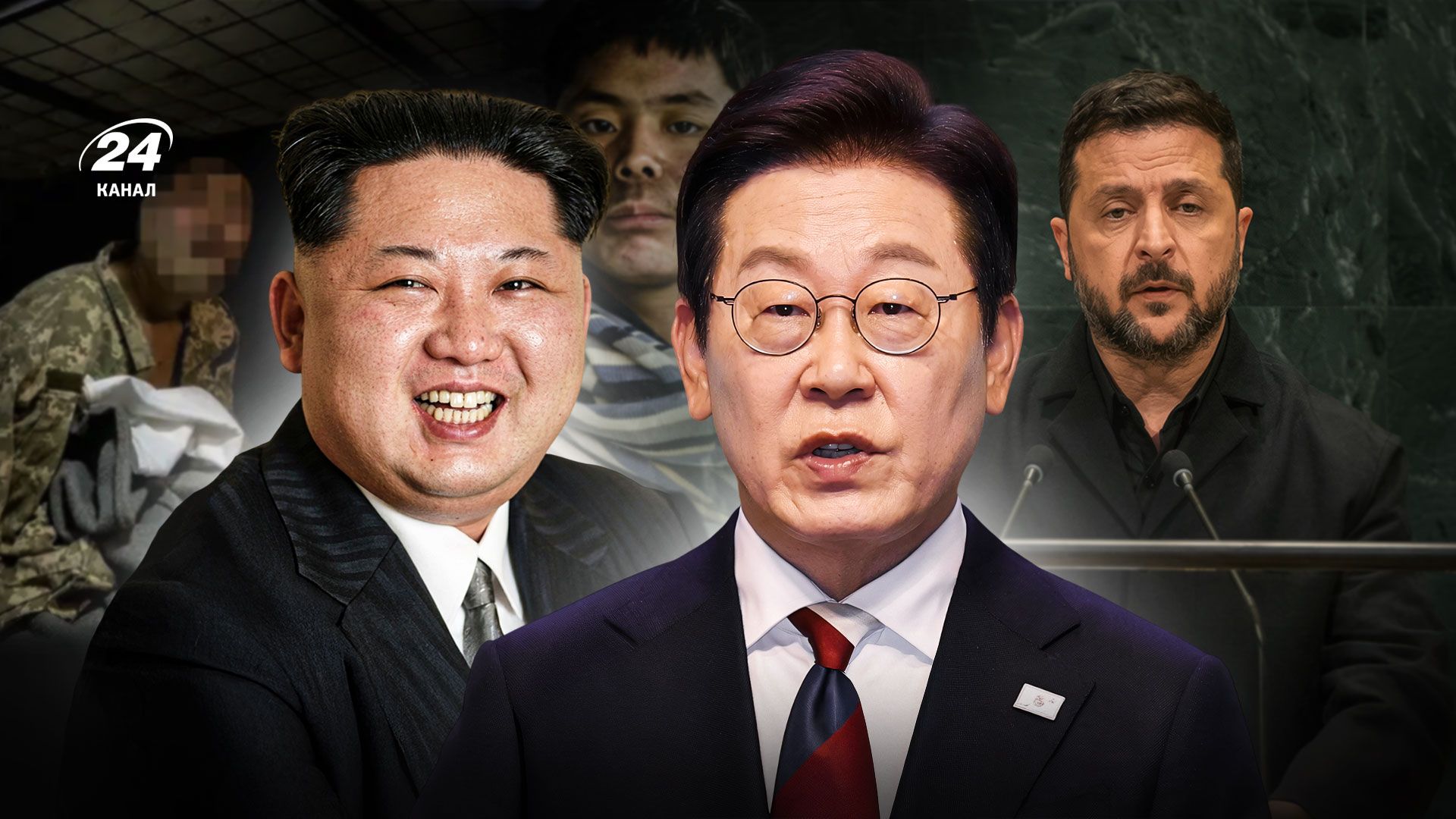


During his address to the UN General Assembly on September 23, Ukrainian President Volodymyr Zelenskyy publicly announced that Kyiv had handed over two captured North Korean soldiers to South Korea.
Most listeners missed this point because Zelenskyy was discussing more important and global issues at the time. But not the South Korean representatives.
Just a few hours later, South Korean President Lee Jae-myung unexpectedly claimed that Ukraine had allegedly violated an agreement not to disclose this information. According to him, given the sensitive nature of national security issues and the situation on the Korean Peninsula, the transfer of the prisoners should have been kept secret…
On October 8, it became known that South Korea was recalling its ambassador from Kyiv amid a scandal that had actually arisen from nothing.
Channel 24 analyzed the key details of the sudden but highly publicized diplomatic scandal surrounding the North Korean prisoners handed over to Seoul and why South Korea radically changed its rhetoric.
The South Korean President’s Blunt “Attacks”
The scandal did indeed turn out to be a major one. Following Zelenskyy’s speech at the UN, South Korean President Lee Jae-myung did not hold back in his remarks directed at the Ukrainian president. The leader of South Korea did not limit himself to a diplomatic note or a traditional protest.
He immediately resorted to personal attacks and claimed that the Ukrainian president had allegedly disclosed highly sensitive information for his own benefit.
The repatriation of North Korean prisoners of war is an extremely sensitive issue with serious implications for diplomacy, national security, and the situation on the Korean Peninsula. Those who, regardless of the state of inter-Korean relations, potential human casualties, or harm to national interests – would prefer to make a loud announcement about the repatriation to the whole world in order to take credit for it – our government’s decision not to disclose this information likely seems incomprehensible. One cannot be so cruel and irresponsible when it comes to such vital issues as human lives and national security,
– Lee Jae-myung mercilessly criticizes Ukraine.
Lee Jae-myung did not stop there and called the opposition and all South Koreans who criticize his decision “murderers or traitors,” while describing the Ukrainian side’s decision as “incomprehensible”:
People who endanger others’ lives and national security for their own petty personal gain are called murderers or traitors. It is wrong to criticize reasonable measures to maintain confidentiality. I do not know the reasons behind the Ukrainian side’s decision to violate the non-disclosure agreement and disclose the information, but this is deeply regrettable. I sincerely pray that these wars, which result in the deaths and injuries of so many people, will end quickly.
Interestingly, while the President of the Republic of Korea was raging, his foreign minister apparently knew nothing about it, as he was holding a very peaceful meeting with his Ukrainian counterpart, Andriy Sybiga.
The meeting between the two diplomats in New York:
Why Lee Jae-myung Got So Angry
Here, it is necessary to explain the context. Lee Jae-myung became president in June 2025. These were early elections, and they took place against the backdrop of a massive political crisis.
His predecessor – President Yoon Seok-yol – decided to play the Trump card and attempted to stage a coup d’état in the country in late 2024, in order to usurp power and eradicate the influence of the “leftist camp,” which he had accused – not without reason – of harboring an excessive fondness for North Korea and of cooperating with China. In fact, Mr. Lee Jae-myung belonged to that very camp. But the president’s plan failed – the military mutiny collapsed.
Currently, Yoon Seok-yol, along with his wife and some of his associates, is behind bars, and the political pendulum has swung in favor of his opponents in the elections. Lee Jae-myung’s election has not yet resolved the crisis and, in some respects, has even deepened the social divide.

The former president of South Korea fostered good relations with Ukraine / Photo – Office of the President
In this situation, the issue of the war in distant Ukraine is not the main concern for the Republic of Korea, but it is a rather painful one. Although Yoon Suk-yeol did not promise Ukraine military aid, he built relations with Kyiv and constantly hinted that a definitive “no” had not been said. The South Korean leader even visited Kyiv and was received very warmly.
Of course, this really gets under the skin of the current president, who lacks spectacular geopolitical moves and stylish photos with world leaders. Instead, he’s dealing with a crisis at home and an aggressive Kim, with whom he promised a great friendship. Likewise, not everything is okay with China. Beijing is playing its own game and is unwilling to play along with a leader who is ideologically close but still a foreigner. Because despite his sympathies for leftist ideas and his gasoline deals with Russia, Lee Jae-myung remains the president of a country that is an ally of the U.S., Japan, and Taiwan.
An Open Secret
After the threatening statements and accusations, it was time to figure out what had actually happened. And here, Seoul began to backtrack. Korean officials were forced to dodge direct questions and, in comments to the Western press, acknowledged that Kyiv had indeed warned Seoul, but explained that the message was allegedly vague.
According to them, it was merely a matter of the possibility that this topic would be mentioned. In response, the South Korean side informed Ukraine that the fact of these individuals’ repatriation to South Korea was supposedly not to be made public. At the same time, no one was particularly hiding this fact, and even if the information was classified, it was an open secret in Kyiv, Seoul, Pyongyang, and Beijing.
The North Korean soldiers captured by the Ukrainian Armed Forces became hostages in the South Korean president’s political game:
In June 2026, the Minister of Foreign Affairs of the Republic of Korea, Mr. Cho Hyun, calmly spoke about the return of Koreans captured in Ukraine to their homeland.
On June 23, the South Korean government expressed its willingness to accept all DPRK soldiers who had fought on the side of the Russian Federation against Ukraine and had been taken prisoner, and on June 30 of that same year, Cho Hyun personally met with Ukrainian Foreign Minister Andriy Sybiga to discuss this (and other matters). At that time, Ukraine’s position was well-received and did not cause any scandal.
We discussed the common challenges arising from the deepening cooperation between Moscow and Pyongyang. We paid special attention to the issue of North Korean prisoners of war. We have a clear understanding of the next steps in accordance with the norms of international humanitarian law,
– Andriy Sibiga arrived in Seoul on June 30, 2026, to persuade South Korea to provide more active support for Ukraine.
Ukrainian Foreign Minister Andriy Sibiga reports on his visit to Seoul:
I was pleased to meet with @FMChoHyun in Seoul.
Our talks reaffirmed the strong and growing cooperation between Ukraine and the Republic of Korea.
We discussed ways to develop political dialogue at the highest level, expand economic and business ties, and engage Korean businesses… pic.twitter.com/PDbxt20KEh– Andrii Sybiha (@andrii_sybiha) June 30, 2026
However, the Republic of Korea’s government decided to maintain a stance of deep offense until the very end – though it did adjust its position slightly.
On September 27, Song Ki-hong, the President’s Senior Secretary for Public Relations, stated that an agreement not to disclose information about the transfer of two North Korean prisoners of war to South Korea did indeed exist. The presidential administration expressed deep regret over Ukraine’s unilateral disclosure of the information and its subsequent “false claim that there was no non-disclosure agreement.”
A representative of the administration added that the country is considering taking additional measures on this issue if necessary. Seoul noted that this allegedly “seriously undermines” mutual trust and damages friendly relations between the countries. Furthermore, the Office of the President of South Korea stated that it was the Ukrainian side that allegedly insisted on the confidentiality of the prisoner transfer.
On Monday, September 28, the South Korean Ministry of Foreign Affairs officially summoned Andriy Veshkin, the chargé d’affaires of Ukraine. First Deputy Foreign Minister Park Yoon-joo conveyed Seoul’s firm stance to Veshkin, asking Kyiv to provide an official explanation and an apology.
The Ukrainian diplomat replied that he would convey South Korea’s position to Kyiv. Subsequently, the Ukrainian Ministry of Foreign Affairs expressed its regret over this situation, which did not satisfy Seoul. Therefore, on October 8, the Ministry of Foreign Affairs of the Republic of Korea announced that it was recalling its ambassador from Kyiv. In diplomatic terms, this represents a radical level of dissatisfaction, close to an actual severing of relations – more precisely, the final stop on that path.
Meanwhile, the incident involving the ambassador is unfolding against the backdrop of revelations about South Korea’s schemes to circumvent sanctions against Russia and provide assistance to the aggressor state. The Guardian exposed the Koreans' schemes. At the same time, Seoul continues to deny everything, while Kyiv has claimed to have direct evidence of criminal collusion.
Seoul is clearly flexing its muscles, refusing to take the time difference into account and angrily complaining that it has yet to receive an official response from Kyiv regarding the allegations. But it would be wise for diplomats to also consider a “Plan B” and come up with a response to Kyiv’s claims regarding cooperation with the Russians and the lack of a substantive reaction to Moscow’s use of North Korean mercenaries in the war against Ukraine.
Legally, Seoul does not recognize North Korea as a separate, independent state; therefore, it considers North Korean citizens not to be subjects of the Kim regime, but its own. That is why President Lee Jae-myung has essentially thrown a tantrum over the fact that Ukraine acted entirely in accordance with the laws of the Republic of Korea – the very laws he swore to uphold in his oath of office a year ago.
Lee Jae-myung has lost face
Was there or wasn’t there a non-disclosure agreement? Did Seoul misinterpret Kyiv’s previous diplomatic notes? Or did Kyiv fail to convey the intended message to the South Korean side at the UN clearly enough? This is not particularly significant compared to what lies behind such an excessive and clearly hysterical reaction from the South Korean leader and his direct accusations against Volodymyr Zelenskyy.
The answer to this question “lies in the details,” specifically in the opposition’s statements. For it was the opposition that blew this story out of proportion and forced the president to respond.
Lawmaker Ahn Cheol-soo was one of the first to ask why the South Korean government itself had not announced the transfer of prisoners:
Is Zelenskyy the president of the Republic of Korea? Why should South Korean citizens learn about the arrival of North Korean soldiers in South Korea through a speech by the Ukrainian president at the UN? Why did President Lee conceal this? If, out of deference to North Korea, we cannot even independently announce the return of prisoners of war – then we are no longer a sovereign state.
Similarly, Jeong Chong-sik, the leader of the conservative opposition faction, criticized the government for concealing the fact that the prisoners had returned:
Why did the government conceal the fact that, through international cooperation, it brought North Korean prisoners of war back to Korea? Were you really so afraid of offending Kim Jong-un’s sensibilities?
Choi In-seok, deputy spokesperson for the People Power Party’s parliamentary caucus, stated that the government is overly concerned about how North Korea will react to this:
If you are the president of the Republic of Korea, you must first and foremost look out for the national interests and security of the Republic of Korea, rather than watching for North Korea’s reaction. Don’t look over your shoulder at North Korea; act on principle!
Attack Ukraine, grovel before Kim
South Korean President Lee Jae-myung is not without reason “afraid” of Kim Jong-un’s negative reaction to the return of North Korean troops to South Korea via Ukraine.
He advocates a policy of reconciliation with the North and preventing war at any cost. According to Lee Jae-myung, Kim should not be provoked – then everything will be fine; we must coexist peacefully and treat one another with respect and mutual understanding. So, this is yet another attempt to appease an aggressor who is blackmailing the entire region with his missile capabilities and the world at large with nuclear weapons.
Lee Jae-myung became famous for this very phrase. This is how one could describe his foreign policy course: “No matter how high the price of peace may be, peace is still cheaper than war.” It’s beautiful and elegant – and it doesn’t work when your opponent is the Kim dynasty.
In January 2026, Lee met with Xi Jinping and asked China to act as a mediator in relations between North and South Korea:
For quite some time, we have effectively been conducting military offensive operations against North Korea. North Korea was likely extremely concerned. To engage in dialogue with a partner, we must understand the other side’s position.
However, Kim Jong-un has not taken any steps to meet South Korea halfway, so for now, this approach is being carried out unilaterally. The only demonstrations of strength and deterrence against the country are the joint U.S.-South Korea military exercises held annually and the deployment of U.S. troops on South Korean soil. At the same time, Donald Trump ordered a significant reduction in these exercises this year and proposed holding another meeting with Kim Jong-un, although he may have already forgotten about his own idea.
Thus, the South Korean president’s hysteria was not driven by concern for the lives and health of the captives or the safety of their families – which the South Korean intelligence services certainly took care of – but rather by the loss of “face” on the domestic stage. Another, no less important reason is the fear of Kim.
As a reminder, the distance from Seoul to the North Korean border is just over 30 kilometers. That’s close enough for conventional artillery, not to mention drones and missiles. Because of this, the Republic of Korea is forced to constantly live with an “elephant in the room,” and its political leadership (remember, this is a democracy where power changes through regular elections) must choose between bellicose and conciliatory rhetoric toward its northern neighbors. At the same time, the neighbors themselves are often simply indifferent to all this. They have their own agenda.
So the fear of Seoul’s political establishment is understandable. But Lee Jae-myung was driven not only by that fear but also by a political calculation that it might be possible to reach an understanding with the dictator in North Korea, provided they didn’t provoke him or take a “hardline” approach.
Of course, this is a fantasy (just like, for example, Trump’s idea of “peace in 24 hours” or a new summit with Kim). In fact, reality itself confirms this, because right now this logic works only in the opposite direction: Kim isn’t making concessions, isn’t taking reciprocal steps, and continues to launch ballistic missiles (notably in September) in order to keep blackmailing the entire region and the United States.

And in what way is he wrong? / Photo – Office of the President of Ukraine
Seoul is the one that should apologize for the baseless accusations against the President of Ukraine that the South Korean leader has been throwing around. This would be fully in line with the South Korean president’s policy on the need to resolve all conflicts through dialogue and mutual understanding.
Seoul must also answer President Zelenskyy’s question for itself. It was posed at the UN and was, in fact, rhetorical. Commenting on the handover of Korean soldiers, the Ukrainian leader noted that one of them had attempted suicide to avoid being taken prisoner:
That’s how they raise people in the North. They take away their freedom. They take away their right to choose. And they drum into their heads that they must die, no matter what. Do you really want to give such a force even more time to learn how to wage war?
It seems the authorities in the Republic of Korea don’t know the answer.