


Russia seeks not only to seize new territories in Ukraine but also to gain control over critically important resources. However, Ukrainian strikes against Russian rear areas are weakening the occupiers’ capabilities, and Europe is looking for ways to protect itself without constantly relying on the U.S.
Petro Andriushchenko, head of the Center for the Study of the Occupation, explained in an exclusive interview with Channel 24 why Vladimir Putin will not stop at the current line of demarcation, why Russia needs to advance toward water sources, and how effective Ukrainian drone attacks are.
Why doesn’t Ukraine strike oil refineries every day?
No miracle happened. Putin didn’t listen to Trump and continued bombing Ukraine. Why has Ukraine suspended strikes on Russian oil refineries, despite Russia’s massive attacks and new threats to Kyiv and the region?
To be honest, I don’t think it’s a fact that we aren’t striking oil refineries. It’s a fact that we haven’t struck them yet. But if you look at the history of our strikes, they didn’t happen every day either.
Compared to September and August, in the first twelve days we attacked Russia with a much larger number of drones than before.
We’re monitoring where air defense systems are active, where they aren’t, where we’re hitting our targets, and where we’re missing. And every morning, that “ministry of murder” reports on how many drones they’ve shot down – but they don’t specify which oil refineries or bridges were targeted.
So, in terms of numbers – even if we go by their own reports – in the first incomplete thirteen days, our drone count was much higher than even in September. In other words, our activity, despite Trump’s talk, isn’t slowing down.
By the way, it’s interesting to note that on the night of October 11–12, just as Trump announced the energy ceasefire, the number of drones in Russian territory dropped. But by this very night, it had already returned to its usual level.
In fact, our strikes – just like the strikes on oil refineries – come in waves if you track them and observe how they unfold. This is most likely due to a number of reasons: the need to stockpile drones, and the need to analyze the situation in terms of past and future strikes.
As for the weather conditions, I think everyone can see them. So, on the one hand, it’s probably too early to say that we’re not striking oil refineries. On the other hand, I think we’ve decided not to pull the tiger’s whiskers, as the saying goes.
And the fact that Putin is getting his way is undeniable. You know, according to polls, the overwhelming majority of Britons are convinced that Putin is manipulating Trump and getting everything he wants. Nobody trusts Trump.
I’m convinced that if you asked most European countries right now, that’s pretty much how they’d feel.
The British have always been the United States’ greatest natural allies. In fact, Britain is the only country that supported the United States in the last two wars, even when all the other NATO countries were against it.
That’s why this poll is quite revealing: citizens of a country that once considered the United States its greatest partner and ally now believe that this partner is being run, to some extent, by Russia – a sort of Soviet Union.
It’s clear that we still have quite a long period ahead of us; we’ll need to hold out for nearly three weeks against this “nonsense” that will be coming from one side.
On the other hand, I hope that we will finally start striking back. If not at oil refineries, then at least at bridges. Because here I see that there really are certain developments, quite positive ones.
Petro Andriushchenko: Watch the video
When will Ukrainian ballistics truly change the rules of the game?
When will Ukrainian ballistics be able to strike Russian territory, and how will that change the situation in the war?
It’s not so much the availability of missiles as the pace of their production that will change the situation. There are objective factors here that are worth considering. Opinions on Fire Point may vary – we all understand that. Let’s set that aside for now.
The fact is that one of the very best products – one that scaled up quickly in its time and changed the situation, particularly regarding Middle Strike – is theFire Point product, and everyone knows this. All of our people were satisfied with it, as were the units that worked with it. It scaled up, and that truly changed the game.
Then others caught up, then the strategy changed, the tactics changed. But the fact remains. That is, a single product was able, so to speak, to change the overall situation along the front line – what we’re seeing.
The same will be true of ballistics. Of course, ballistics alone won’t lead us to victory. Of course, it won’t reach the Mausoleum, as some dream it will.
But it will truly make a difference. Why? Because even at the range it’s effective, ballistics will be quite helpful.
I can give a recent example that we documented not long ago. It’s an attack on one of the bridges in Rostov. There’s a drawbridge there – it lifts up, and a ship passes underneath. It’s very important.
Consequences of the strike on the Rostov Bridge / Atesh
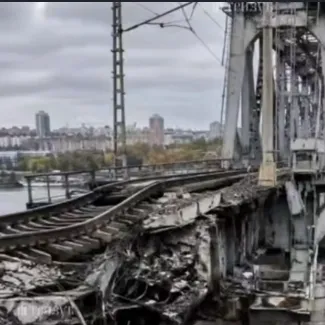
It’s essentially the number one bridge supplying the Russian military contingent in the Donetsk region and throughout the entire occupied territory; it provides a link to Crimea and impacts maritime traffic, which the Russians are gradually trying to restore there.
And they didn’t strike the bridge itself – judging by all accounts, they struck the mechanism that raises the bridge, which makes perfect sense. Because if you disable it, the bridge won’t work either.
This is where ballistics could help us, and we could halt Russian rail logistics much faster, more simply, and more easily. Because this is truly a game-changer.
Of course, everyone is discussing this, and there are many hypotheses about what to do, how to strike, and where to strike. But the more we have of our own weapons – ones that strike and fly so fast that the Russians can’t counter them – the better.
How can we not mention the nighttime strike on Kyiv that was discussed – because the S-400s were firing, and the air raid sirens actually began wailing almost simultaneously with the strike. We all know how this happens. There’s no betrayal here, but a fact is a fact.
So, I really hope the Russians start to feel the same thing, with the same consequences. The only thing is, we’re not striking residential homes or high-rise buildings – we’re specifically targeting oil refineries. And that will really simplify the situation for us.
No matter how you look at it, this isn’t some “wunderwaffe,” it’s not a V-2, and it’s not a weapon of victory. It’s something that will genuinely help us change the situation – both with Russia’s economy and on the front lines – if we use it correctly.
U.S. intelligence, “Trump’s antics,” and what Europe really thinks
Will Trump risk cutting off U.S. intelligence from Ukraine, and how critical is Europe’s support?
As far as I recall, last year, then-intelligence chief Kirill Budanov spoke at length and answered these questions. And it turned out then that most of the intelligence we receive directly from the United States is, in principle, purchased with partnership funds.
But we are the beneficiaries of these direct purchases, so it’s a bit difficult to stop them. I don’t think the situation has changed drastically in this regard. That’s one side of the coin.
And then he said that it wouldn’t be that critical if they stopped sharing some of it. On the other hand, I wouldn’t get too carried away, because we won’t receive European intelligence unless the United States gives permission.
We receive intelligence not only from the United States but also from various NATO countries – I won’t name them here – and they already provide it to us with U.S. permission. So this, too, will be, to put it mildly, somewhat unpleasant.
Why is Trump talking about intelligence this way? There’s already been a huge backlash among his own supporters following his conversations with Putin and the threats being directed at us. Not everyone in the MAGA movement is part of the pro-Trump fringe. There are people there who are fully on our side. There are people who have always supported us.
And here I’d even refer back to House Speaker Johnson, who explicitly said that the diesel fuel issue is a problem with the Strait of Hormuz, not Ukraine.
So there are still, at the very least, a few voices that Trump and his team need to appeal to. On the other hand, I think they’re still afraid that they might end up with a lost Senate.
And this could lead to further unpleasant developments related to the impeachment process. If they secure sixty seats, they could effectively block Trump’s decisions.
That’s why they’re forced to tone down their rhetoric on Ukraine in some areas so as not to lose votes. But I’m convinced that over the next three weeks, we’re in for a whole hell of a lot of surprises – I have no idea what he might say.
We’ll see what else he’ll threaten us with. Still, the situation is getting worse because the Russians have gained access to the inner circle, so to speak – and not just to Trump. They’ve gained access to his negotiators. Dmitriev, for one, is constantly there, peddling stories of fantastic potential profits to them.
On the other hand, Europe is growing stronger. Let’s not forget that Kirill Dmitriev, on Putin’s behalf, proposed not only to divide Ukraine but also to build the Nord Stream pipeline to Germany – a country that nobody asked whether it needed the Nord Stream or intended to use it.
So there are some very bad things for us in these developments, but at the same time, they’re happening alongside some very good things – specifically for us. That’s why the world is so strange – and truly gray.
Why won’t Putin stop at Donbas, and what does water have to do with it?
Is Donbas really Putin’s main goal, or will even territorial concessions fail to stop Russia from further aggression?
The tactics of terror show that they have nothing to advance with, nowhere to go, and no way to move forward. In essence, if we analyze it, it’s very telling that yesterday this “Flying Fat Bomber” declared that we must not agree to an energy ceasefire, because our only advantage today is striking civilians, the energy infrastructure, Kyiv, and Ukraine.
And this, at least to some extent, forces Ukrainians to consider that they need to talk to us.
If they’re saying such blunt things, then it’s really a fact. They’re no longer holding back on anything. Will Putin stop at Donbas? No, he won’t.
Of course, on the one hand, everyone is absolutely right: he simply wants to destroy the Ukrainian nation. The genocidal policy isn’t going anywhere. But for Europeans and our foreign partners, this is starting to sound a bit familiar.
Let’s be honest – they’re a bit tired of this topic. But there are other issues we should be focusing on.
What are we talking about? For example,the water crisis in Donbas, especially in the Donetsk region. It’s impossible to restore normal water supply in the Donetsk region without control over the Siverskyi Donets River in the Kharkiv region and the canal that connects the Kalmius and Dnipro rivers and runs through the Dnipropetrovsk region.
So you can control Donetsk, Mariupol, Volnovakha, Horlivka, Makiivka, Pokrovsk, and even Sviatohirsk, but there’s nothing to give the people there to drink.
The more territory you control, the more water you need, and there’s less and less of it. This means that, from a technical standpoint, Russia has no choice but to move toward the sources of this water. And this is very important.
This is a purely pragmatic issue, unrelated to any ideology. There is no solution to the water crisis in the Donetsk region. The Russians, for their part, tried to run a water pipeline directly from the Don River. They’ve now put this Sergei Ivanov behind bars – he used to be Shoigu’s deputy. He was rightfully imprisoned. I hope he never gets out.
But that’s not the point. The point is that scientists say there isn’t enough water in the Don River – even accounting for the needs of all the river’s users – to supply the Donetsk region and compensate for the resulting losses.
These technical matters are very easy to explain to our partners. This isn’t about some ideological principles that Kushner, Witkoff, or even Trump don’t understand.
So where are they – where’s the ideology, where are the values, and so on? This is a purely practical matter: let Putin explain how they intend to supply water to the residents of, say, the Donetsk region, if we end the war along the current line of contact. “No way” – that’s the correct answer.
Hope for endless rain? Well, that’s nonsense. They could still draw water from the Sea of Azov, but it has become so salty that even jellyfish can survive there only under certain conditions. This means that, as of today, it’s not even possible to desalinate it enough to use as drinking water.
That’s why these issues are important. And this isn’t the only nuance related to the regions. On the other hand, it’s very interesting to look at Russian maps.
We recently had a debate about Russian maps. They do not show the Zaporizhzhia, Donetsk, and Kherson regions within our administrative borders. They are drawn according to where the line of contact currently runs.
This is because the Russian Constitution does not clearly define the borders of these regions, which they have incorporated into their territory. A lot of questions actually arise, but we have to deal with this. All these peace plans will keep coming up again and again. The Russians understand that they’ve gained access to the issue and will exploit it to the fullest.
We’ll probably discuss this, but in reality, there’s nothing to discuss there, because these talks lead nowhere. It’s always the same old story. As for sources of information, let me remind you that Reuters is simply a mouthpiece for the Kremlin. And it’s impossible to say that they have any inside information that doesn’t come from the Federal Security Service.
They haven’t exactly made a name for themselves in American sources either. The Washington Post writes about this, and I trust their sources, since it’s an analytical op-ed, not a journalistic editorial. It’s simply the reflections of someone who writes and possesses certain information.
On the other hand, if you look at all these conditions, it’s all been done before. It happened just recently, and before that, not long ago either: both before the Oval Office meeting and after Anchorage. And it will happen again. Putin won’t come up with anything new in terms of such conditions.
Even if we simply imagine that we’ve now agreed to these conditions – especially given that there are those in Ukraine who’ve woken up to the idea of ending the war on any terms – there’s still one condition they keep coming back to.
It concerns the need to first resolve the issue that sparked the war and led to the so-called “special military operation.” Everyone understands that this issue is the very existence of the Ukrainian nation in one form or another – something Russia cannot allow.
This is not a question of Kyiv’s dependence or of turning Ukraine into part of some Belarusian model. No, the issue is that we are simply supposed to cease to exist. And something tells me that we will never agree to these terms. That is why this tug-of-war will continue until the Russian army deteriorates to an appropriate level along with the economy. Or perhaps one of the generals will eventually take the plunge, kill Putin, stage a coup, and carve out a safe zone for himself.
The War Against Europe and Putin’s Plans
Putin is simply losing everything, and as I see it, he couldn’t care less about any of these territories – because he never really needed them in the first place – and this is truly a genocide against our people. Moreover, the Foreign Intelligence Service reports that he has plans to wage war against Europe by 2045. Has Europe already figured this out?
I think even sooner. They may go to war; there are various scenarios, including the activities of enemy agents. How do we root them out? Europe is already working on this little by little, but more needs to be done.
At least Europe is waking up again. I understand that we all want things to happen faster, but it’s not working out yet. Let’s hope it will.
We could do with fewer of these kinds of repeats. I’m not talking about the AfD, Le Pen’s supporters, or Orbán right now. We need – so to speak – allies like the Poles, so that they come to their senses and the far right doesn’t gain ground there – those who believe that Putin is better than a Ukrainian, better than Bandera.
It’s a bit of a story in itself. It will certainly shake up Europe, but the result will actually be strong. Europe has never been as resolute in its decisions as it is now. That’s an absolute plus for us. It gives us faith and hope.
And the funniest thing about all this is that the Russians are constantly making a fuss about NATO. They say the main thing is that Ukraine shouldn’t be in NATO. But I don’t see much desire among Ukrainians to join it. And looking at the situation in Europe, I see that they’re also very cautious about NATO there. Who knows – maybe it will all end with the creation of a new European Union, this time without the United States.
Europe has been shaken by what Trump is doing. The boundaries have blurred. There are no clear lines. Article 5 of the NATO Treaty – surely even a first-grader knows by now that it doesn’t work?
And even a fifth-grader knows about the Budapest Memorandum and who’s friends with whom and who’s the guarantor. There are already concrete plans in Europe: countries are increasing their military budgets, development efforts, and contacts with us.
Now our units are traveling to train foreign partners. They used to train us, but now we gratefully share our own experience.
European countries are increasing their military budgets not just to meet the 5 percent NATO spending target. They’re developing systems similar to the Patriot, strengthening their air defense, and expanding drone programs. Everyone understands that the U.S. is no longer a reliable partner.
Such trust cannot be quickly restored, and I don’t even know what Trump’s successor would have to do to regain it. That is why Europe is moving toward military autonomy. This involves missile programs, air defense, drones, and eventually – satellite technology and space.
The plan for 2030 is to be prepared for a parting of ways with the U.S., so that the absence of an American military presence does not deal a critical blow to Europe. What does this indicate?
At the end of the 20th and the beginning of the 21st centuries, civilized nations worked to overcome colonialism and isolationism, building a shared geopolitical space. Now, however, old policies have returned, reviving isolationism and colonial policies. Russia, in particular, is waging a thoroughly colonial war against Ukraine.
And there is a silver lining here. Europe is being forced to become more autonomous, but not to break up into separate countries, as Putin would like. It would be to his advantage if there were no unified Europe, and if Britain, France, Germany, and other states acted independently.
But so far, trends point to the opposite: Europe is uniting in the face of common challenges, regardless of whether countries are members of the European Union. This offers hope for the formation of a new military, trade, and economic alliance. I hope that we will yet witness a new European Renaissance. And that is wonderful, because Europe has deep civilizational traditions and strong institutions. And who, if not us, should be part of this Europe?