


Jan Marsalek, a former top executive at the German company Wirecard – one of the world’s most wanted fraudsters, who has been hiding in Russia for years and collaborating with its intelligence services – may have been involved in the overthrow of the government of an entire European country.
According to The Telegraph, Jan Marsalek claimed in correspondence that he helped orchestrate the resignation of Austrian Chancellor Sebastian Kurz in 2021.
However, even without this story, the Austrian’s life story reads more like the plot of a spy thriller. He is involved in one of the biggest financial scandals in German history, the collapse of Wirecard with a nearly two-billion-euro hole in its books, ties to Russian intelligence, and the organization of espionage operations in Europe.
24 Channel explains who Jan Marsalek is, how he went from being a successful businessman to a Kremlin agent, and how his activities relate to the war against Ukraine.
popular videos
From Successful Businessman to Fraudster: What Jan Marsalek Is Accused Of
Just ten years ago, the name Jan Marsalek was hardly known to the general public. A man without a college degree was making a meteoric rise in the German financial sector – it seemed like a success story that could serve as an example for many. However, it would later turn out that behind the young businessman’s glittering career lay fraud involving billions, dubious acquaintances, and ties to Russian intelligence agencies.
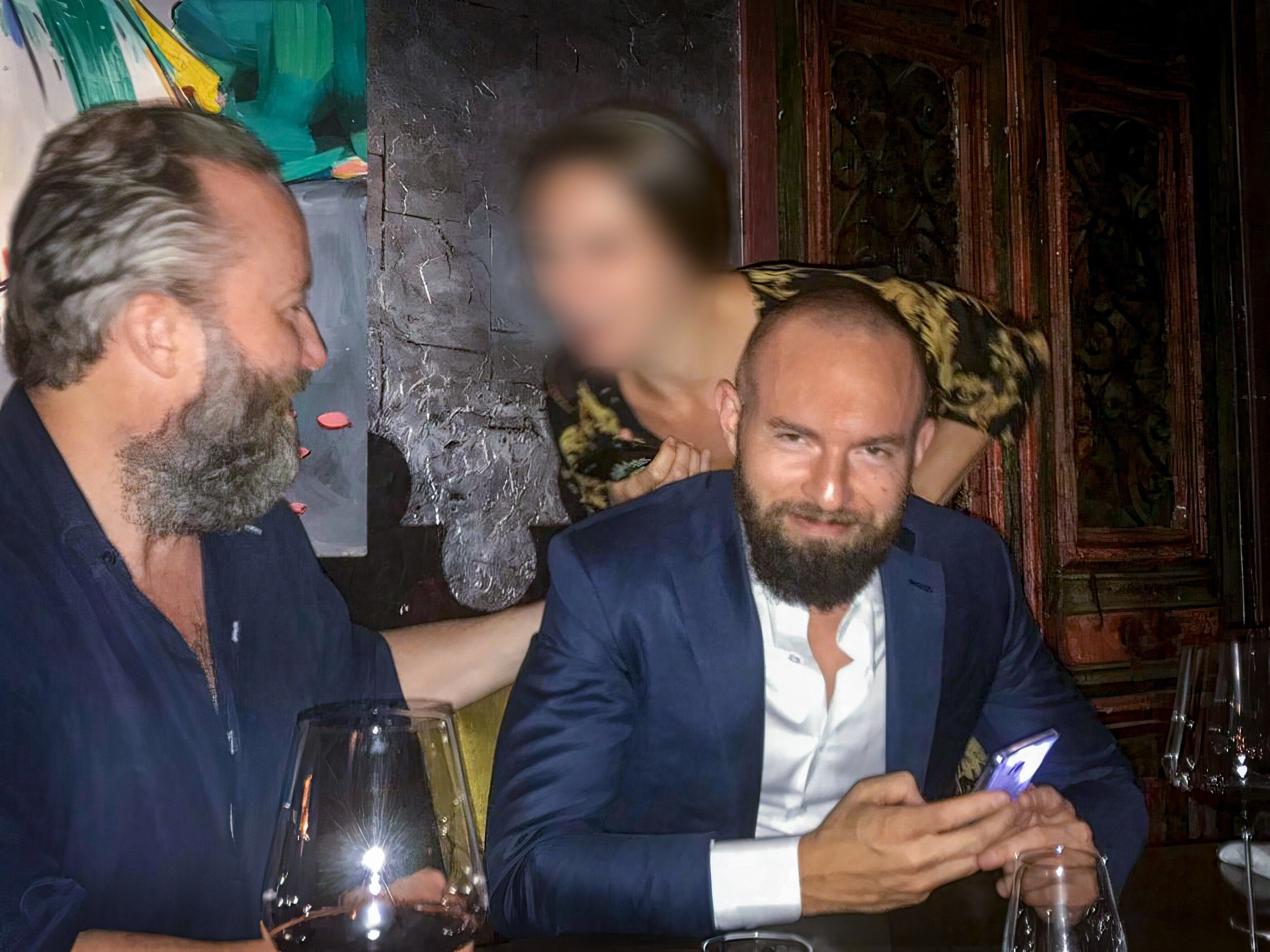
Jan Marsalek during a business meeting in the UAE / Photo – Privéfoto
In 2000, when Marsalek was just 20 years old, he joined the small payment company Wirecard, and within ten years, he “rose to success alongside the company.” Marsalek joined the company’s board, becoming one of the youngest top executives in major German business. Meanwhile, Wirecard itself was gradually transforming into a true tech giant.
Wirecard handled electronic payments, collaborated with international banks, and processed millions of transactions. At the height of its success, the company’s market capitalization reached approximately 28 billion euros, and Wirecard itself was considered one of the symbols of Germany’s economic future.
And at the very center of this financial empire was Marsalek. As chief operating officer, he was responsible for the company’s international business, particularly its operations in Asia. It was there, as it later turned out, that one of the largest financial scams in modern German history was being concealed.
In June 2020, auditors reported that the 1.9 billion euros that Wirecard allegedly held in bank accounts in the Philippines appeared never to have existed at all. It turned out that for years, the company may have been inflating its revenue and concealing financial problems through fictitious transactions.
Within a matter of days, the former darling of major investors went bankrupt overnight, CEO Markus Braun was arrested, and his right-hand man, Jan Marsalek, suddenly disappeared.
His escape turned out to be no less remarkable than the financial scandal itself. At first, Marsalek convinced his colleagues that he had traveled to the Philippines to search for the missing billions. However, investigators later determined that the details of this trip had been fabricated, just like the money itself. In reality , on June 19, 2020, the businessman flew from Austria to Minsk on a private jet, after which he vanished without a trace. German law enforcement authorities issued an international arrest warrant for him on suspicion of large-scale fraud and embezzlement.
However, a simple embezzlement, even on such a scale, would hardly have attracted much attention were it not for some juicy details of this story. Jan Marsalek didn’t just flee to Minsk – he ended up in Russia, where he continued to hide from investigators.
Moreover, the fraudster did not choose his destination at random – as investigative journalists discovered, Jan Marsalek had been actively collaborating with Russian intelligence agencies long before Wirecard’s bankruptcy. So it’s reasonable to assume that the successful German fintech company was far from his only place of work over the years. Or perhaps it was merely a cover for his real line of work.
A Fraudster in the Service of the Kremlin: How Marsalek’s Spy Network Operated
It turns out that Jan Marsalek led a double life for years, and his activities were by no means limited to financial fraud and managing Wirecard. As Bellingcat journalists discovered , in just ten years, the businessman visited Russia more than 60 times, sometimes flying into Moscow for literally just a few hours. These trips became suspiciously more frequent after 2014, when Marsalek was already holding one of the top positions at Wirecard and the Kremlin had launched a war against Ukraine.
Subsequently, a joint investigation by Der Spiegel, The Insider, and several other media outlets revealed that Marsalek had maintained close ties with Russian intelligence agencies – in particular, the GRU military intelligence service – since at least 2014(GRU is the old “classic name”; today, this notorious intelligence agency is called the Main Directorate of the General Staff of the Armed Forces of the Russian Federation – 24 Channel). Moreover, his capabilities were significantly broader than those of an ordinary informant. Thanks to his money and influential connections, he had access to Austrian political circles and even to individual local intelligence officers.
In particular, through former Austrian intelligence officers Martin Weiss and Egisto Ott, Marsalek was able to obtain classified information. According to the investigation, Ott passed on confidential information from police databases, the work phone numbers of high-ranking officials, and even a special secure laptop to the Russians. In May 2026, an Austrian court sentenced him to four years and one month in prison for espionage and other crimes.
Marsalek’s political connections proved to be no less suspicious. He wielded significant influence: in 2018, Marsalek even presented his own proposals on migration policy to the Austrian Ministry of the Interior, which was then headed by a representative of the “Herbert Kikle of the far-right Freedom Party (FPÖ).” Moreover, Marsalek was also in active contact with other influential representatives of this political party, known as a Russian agent of influence in Austria.
Moreover, it appears that Marsalek may even have been involved with the “the resignation of Austrian Chancellor Sebastian Kurz in October 2021.” As reported by The Telegraph, in correspondence with the head of his spy network, Orlin Rusev, the businessman boasted thatthey had allegedly helped topple the Austrian government.
According to Marsalek, his people were involved in the seizure of Thomas Schmid’s phone, one of Kurz’s closest associates. Schmid’s correspondence later became key evidence in the corruption scandal that led to the chancellor’s resignation.
However, there is currently no independent evidence of Jan Marsalek’s involvement in this affair. Moreover, law enforcement officials seized Schmid’s phone back in 2019, while Marsalek himself boasted about his “successes” only after Kurz’s resignation. Therefore , it cannot be ruled out that he was simply trying to exaggerate his own role in Austria’s political events.
But perhaps most revealing was Jan Marsalek’s involvement in a spy ring in the United Kingdom. Marsalek had an entire network of agents at his disposal, which he personally coordinated to monitor Russian opposition figures, journalists, and other individuals of interest to the Kremlin. One of the main targets was investigative journalist Hristo Grozev, known for exposing the operations of Russian intelligence services. Moreover, the agents did not limit themselves to routine surveillance – in their correspondence, they discussed the possibility of kidnapping or even killing the journalist.
This network remained active until February 2023, when British intelligence agencies and police finally uncovered it and arrested its members. During searches, law enforcement officers seized hundreds of cell phones, dozens of forged passports, hidden cameras, listening devices, and other espionage equipment.
In March 2025 , a British court found three members of the network guilty; three others had previously confessed to espionage. By May, all six had received prison sentences ranging from five to nearly eleven years. As the British prosecution later confirmed, it was Marsalek who acted as the intermediary between these agents and the Russian intelligence services.
But Jan Marsalek turned out to be either much luckier or simply a more skilled agent. While his accomplices were behind bars, he himself continued to hide out in Moscow. According to an investigation by *Der Standard*, he used at least six false identities, including documents in the name of a certain Alexander Nelidov.
Moreover, his last passport was a completely genuine Russian document issued to a non-existent person. This is a particularly interesting detail, since documents with fictitious names are also used by intelligence agency operatives for undercover work. Thanks to these documents, Marsalek was able to move freely throughout Russia, register new companies, and even visit the occupied territories of Ukraine without revealing his real name.
It is also noteworthy that Marsalek’s activities were not limited to spying on European countries or Russian opposition figures. After the full-scale invasion of Ukraine began, his agents were given new assignments directly related to the war.
Sabotage Activities Against Ukraine: What Marsalek Was Up To After 2022
It is important to understand that for Ukraine, Jan Marsalek’s activities are far from an abstract threat. After all, following the start of the full-scale Russian invasion, his spy network began carrying out missions that directly targeted the Ukrainian military and Western aid to our country. Moreover, some of these operations could have had very real consequences for the situation on the front lines.
For example, in the fall of 2022, Marsalek’s agents began monitoring a U.S. military base near Stuttgart, Germany. As Reuters reported, the Russians suspected that Ukrainian military personnel were undergoing training there to prepare for deployment to Patriot air defense systems.
Russian spies planned to use special equipment to intercept the identification data from the Ukrainians’ cell phones. This could have subsequently allowed Russian intelligence to track their movements after they returned homeand, over time, even pinpoint the locations of air defense systems. However, the perpetrators were unable to carry out the operation to completion due to the arrests of network members in February 2023.
Surveilling Ukrainian military personnel was far from the only mission related to the Russian-Ukrainian war. In May 2025, details emerged from Marsalek’s correspondence with Orlin Rusev, in which they discussed the purchase of drones for Russia, arms shipments to Africa, and the diamond trade. However, it remains unknown whether Marsalek actually managed to organize the delivery of drones to the Russian army.
But even if these plans remained only in correspondence, Marsalek’s agents did carry out information sabotage against Ukraine. As early as May 2022, he instructed his subordinates to organize a campaign to discredit Ukrainians in Berlin and Vienna. To this end, the spies posted provocative stickers and painted graffiti featuring far-right symbols, particularly those associated with “Azov.” The goal was quite simple – to create the impression that “Ukrainian supporters of Nazism” had flooded European cities, thereby undermining support for Ukraine among the local population.
And while his agents were engaged in espionage and disinformation in Europe, Marsalek himself apparently decided to personally join the Russian aggression against Ukraine. In September 2025, The Insider reported that the fugitive fraudster had visited the temporarily occupied Crimea and Mariupol at least five times. Moreover, according to investigators, he was accompanied by Russian special forces during these trips, and Marsalek himself allegedly even took part in combat missions. However, his direct participation in combat operations has never been confirmed.
Ultimately, the story of Jan Marsalek shows how even an international financial criminal wanted on suspicion of large-scale fraud can become a useful tool for the Kremlin. A man who, just a few years ago, ran one of Germany’s largest technology companies is now implicated in investigations into Russian espionage operations, the persecution of journalists, and activities against Ukraine.
The problem is that with such strong protection from the Russian state – which provides Marsalek with everything he needs, from documents to connections – it is extremely difficult to arrest him. While German law enforcement continues to search for the former businessman, he himself seems to be quite comfortable in Moscow under the protection of Russian intelligence agencies.
And this, perhaps, best characterizes the priorities of modern Russia, because while other countries are trying to attract talented scientists and technology specialists, the Kremlin is eager to make use of fraudsters, criminals, and traitors to the state. After all, instead of developing its own country, the Russian government continues to invest in espionage, sabotage, and the destabilization of other states.
FAQ
If you find an error on this page, select it and press Ctrl + Enter