

Jared Kushner, the president’s son-in-law and one of the key U.S. negotiators, gave a major interview on November 25, 2026, to the MD Meets podcast about the progress of negotiations to resolve the war in Ukraine and, at the same time, lavished praise on Russian dictator Vladimir Putin.
During the conversation, Kushner called Putin a “grandmaster of politics,” expressed firm conviction in Putin’s desire for peace, and characterized the war itself as a proxy conflict between Europe and Russia.
However, what is far more concerning is that in his assessments, the American negotiator repeatedly echoed the Kremlin’s arguments, at times even contradicting Donald Trump’s own previous statements.
24 Channel analyzed Kushner’s interview to understand how he explains the reasons for Russian aggression, whom he blames for stalling peace talks, and what kind of peace Washington is actually seeking.
popular videos
Putin – a “grandmaster of politics”: Why Kushner Speaks the Language of Russian Propaganda
Even if we assume that Jared Kushner himself is not a staunch supporter of the Kremlin’s propaganda narratives (who is he, anyway? Read more in our in-depth profile) and is sincerely trying to resolve the war issue somewhere “in the middle,” that is, through compromises on both sides – his constant visits to the Kremlin and extremely rare visits to Kyiv speak volumes.
A series of pseudo-historical lectures lasting several hours by Vladimir Putin is clearly having a negative impact on American negotiators’ perception of reality, and this very interview with Jared Kushner is quite telling evidence of that.
Particularly striking is the section of the interview in which Kushner shared his personal impressions of his interactions with Russian leadership. In particular, the American negotiator referred to Putin’s special representative, Kirill Dmitriev – with whom he had worked during the 2020 oil crisis – as his “wonderful friend.” According to Kushner, Dmitriev is an active advocate for peace and closer ties between Russia and the West.
But that wouldn’t be much of a problem if Kushner hadn’t been just as generous with his compliments toward the Russian dictator himself.
No matter what people think of his actions, he is a political grandmaster and a historical figure. He comes well-prepared, is thoughtful, takes extensive notes while we talk, and articulates his positions very precisely. “He has a deep understanding of these issues and holds firm views on them. Steve and I believe that he wants peace and wants to change Russia’s relationship with America to see if there’s a chance to start with a clean slate,” Jared Kushner stated.
However, as Oleg Lisny, president of the Policy Analysis Center, put it on 24 Channel, Kushner’s enthusiasm for Putin is less a sign of the Russian dictator’s “genius” and more an indication that the American negotiators themselves are poorly prepared for these meetings.

Oleg Lisny
President of the Policy Analysis Center
If he’s so impressed by Putin’s thorough preparation, then why are they so poorly prepared for these meetings? Why does Putin always outmaneuver them? A skilled “operative” always wins, even against a skilled businessman. Putin is a historical figure – I won’t argue with that – but Hitler is a historical figure too. And Stalin is a historical figure. But that doesn’t make things any easier for the victims of these historical figures.
There’s more. In explaining the reasons for the deterioration of U.S.-Russian relations, Kushner essentially echoed Putin's own complaints against the administrations of George W. Bush and Barack Obama. As for Joe Biden, the American negotiator went even further, effectively accusing him not only of stoking anti-Russian sentiment in the U.S. but also of provoking the war in Ukraine.
During Trump’s first presidential term, we were investigated for alleged collusion with Russia. The accusations turned out to be completely false. This fueled a lot of anti-Russian sentiment. We endured two and a half terrible years when the world was lied to and manipulated… Then we began to find ways to cooperate with the Russians. The COVID pandemic began, and Trump’s presidential term ended. During his presidency, Biden invited Ukraine to join NATO. That statement was made, then the war began, and it continues to this day,” Kushner accused the former president.
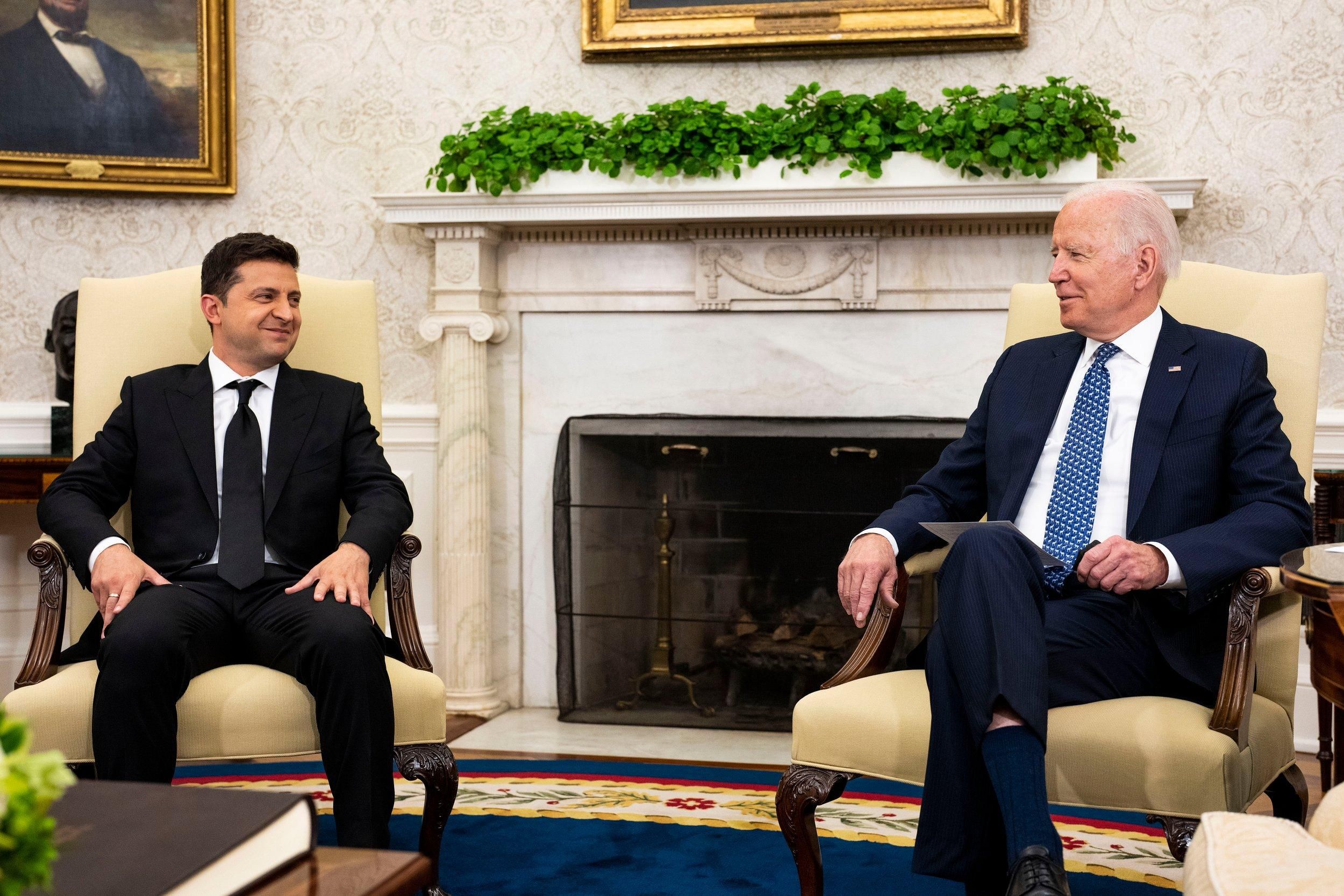
A meeting between Volodymyr Zelenskyy and Joe Biden in 2021 / Photo – Getty Images
In reality, however, Ukraine never received a single official invitation to join NATO during Biden’s presidency. At the Alliance summit in June 2021, the allies merely reaffirmed the decision of the 2008 Bucharest Summit regarding Ukraine’s future membership. Moreover, when Russia occupied Crimea and launched the war in Donbas in 2014, our country had a non-aligned status, and prior to the start of Russian aggression, support for the very idea of joining the Alliance was extremely low.
But, of course, after so many hours of personal conversation with Putin, Kushner could not help but offer a sort of “historical digression.”
The American negotiator thus attempted to explain certain Russian concerns regarding Ukraine.
“If you look at the last thousand years of Russian history, Russia has been attacked, perhaps, once a century, and each time the attackers came through the corridor that is now Ukraine,” says Kushner.
That said, Jared Kushner would have been better off consulting Wikipedia or asking an AI rather than blindly relying on the Russian dictator's delusions. One need only recall Napoleon's campaign deep into the Russian Empire in 1812 – which took place through the territory of modern-day Belarus – to cast doubt on this claim.
And when discussing NATO’s eastward expansion – which supposedly frightens Russia the most – Kushner for some reason ignores the reasons why the countries of Central and Eastern Europe were, in principle, so eager to join the Alliance.
But while Kushner’s willingness to listen to the Kremlin’s arguments could still be explained by the nature of his position, it is much harder to explain his willingness to to repeat Russia's accusations against Ukraine – claims that the Americans themselves had previously refuted.
Ukraine is sabotaging the negotiations, and Europe is waging a proxy war: how Kushner links diplomatic failures
Perhaps one of Jared Kushner’s most controversial statements was his assessment of the progress of peace negotiations at the end of 2025.
According to the American negotiator, as early as last November, Putin had allegedly almost agreed to a ceasefire and to finally conclude an agreement – but "Vicious Ukrainians" suddenly attacked his residence.
In late December, the Ukrainians attacked Putin’s residence, and I think that set him back. By the end of February, we had made some progress, but at that point, it seemed there was nowhere else to go. Both sides wanted to see what they could achieve on the battlefield. From February through September, we were in constant contact, but both sides showed little flexibility, and we saw almost no opportunity to bridge the gap between our positions,” Kushner said.
Undoubtedly, no one in Ukraine would have been particularly upset if drones had actually flown toward Putin’s palace, but at the time, the American publication The Wall Street Journal, citing sources in the CIA, reported that neither Putin himself nor his residence were targets of the Ukrainian attack. Moreover, as early as January 4, 2026, even Donald Trump himself publicly stated that he did not believe the Russian version of events.
Trump’s statement regarding the fake “assassination attempt” on Putin – watch the video:
So, nearly a year after this incident, the American negotiator continues to publicly promote the Kremlin’s version of events, which contradicts both the conclusions of U.S. intelligence and the words of his own president – the very president who appointed Kushner to negotiate peace.
Kushner’s arguments regarding Vladimir Putin’s peacefulness proved no less peculiar. He cited Putin’s alleged restraint in the war with Ukraine as evidence, for despite tens of thousands of civilian casualties, destroyed children’s hospitals, and constant attacks on infrastructure – which Kushner also specifically highlighted, calling them “horrific” – Russia has not yet destroyed the world with nuclear weapons.
In fact, Kushner identifies this as a form of “ "mercy ” on the part of the Russian dictator. At the same time, the American negotiator did not forget to shift all the blame onto Europe, right in that same part of his response.
So far, the war has largely remained confined to Ukraine, but in reality, it has become a proxy war in which Europe is financing and arming Ukraine in its confrontation with Russia. It would only take a minor miscalculation for the war to escalate sharply. So far, Putin has shown restraint. He has agreed not to use nuclear weapons and has assured us that he has no such intention,” Kushner emphasized.
In other words, according to this logic, the Russian dictator – who has been waging a full-scale war against a neighboring state for nearly five years – deserves praise at least for not destroying the world with nuclear weapons. Analyst Oleg Lisny also refutes Kushner’s argument about a proxy war in Europe, since Putin has in fact been waging hybrid aggression against European Union countries for years.
Oleg Lisny
President of the Policy Analysis Center
Accusing Europe of provocations is like saying that a pretty girl in a short dress is provoking a maniac. Whose missiles are flying over Poland? Who is setting fire to railroads in Germany and planning terrorist attacks? It’s Russia, not Europe.
And Kushner’s very argument about Europe waging a proxy war against Russia is quite peculiar. After all, Europeans began arming Ukraine on a massive scale precisely as a result of the Russian invasion, not the other way around (his father-in-law, incidentally, repeats this all the time when talking about his role at the start of the full-scale invasion).
At the same time, military aid to Russia from Iran and even the direct participation of North Korean troops in the war somehow do not prompt Kushner to speak of a proxy war by these states against Ukraine.
Interestingly, Kushner himself acknowledges that, despite all the efforts of American negotiators, Putin is not interested in an immediate ceasefire. However, Trump’s son-in-law explains this by citing the Russian dictator’s fears that a temporary truce will not lead to the establishment of a lasting peace.
We asked Putin the same question about a ceasefire. From his words, we concluded – and this is our interpretation – that he doubts he will be able to achieve a postwar settlement that would prevent a new war if he stops fighting first. “I think this worries both him and us,” says Jared Kushner, explaining the Kremlin’s motivation.
It is worth recalling that as early as March 11, 2025, following negotiations in Saudi Arabia, Ukraine agreed to the U.S. proposal for a full 30-day ceasefire. And in the end, it was Russia, represented by “peacemaker” Putin, that ultimately refused to implement this idea.
Kushner’s reaction to a journalist’s remark about the Trump administration increasing pressure on Ukraine and on Volodymyr Zelenskyy personally was also interesting. The American negotiator rejected such accusations and stated that the United States is Ukraine’s largest “donor” in this war.
Kushner isn’t even bothered by the fact that just a few days after the well-known argument in the Oval Office on February 28, 2025, the Trump administration suspended military aid to Ukraine and the exchange of intelligence. Moreover, since Trump himself took office, Europe has shouldered nearly all the financial costs of supporting Ukraine.
So a rather strange picture emerges: when Ukraine tries to defend its own interests, it supposedly creates difficulties for the negotiation process, but when Russia refuses to stop killing people on the front lines and in the rear – even for a few weeks – Kushner tries to be understanding and somehow explain Putin’s motives.
An Alliance with Russia at Ukraine’s Expense: What the U.S. Is Actually Seeking in the Negotiations
If you strip away all the media noise caused by Jared Kushner’s highly controversial statements, the U.S. representative’s motivation for praising Vladimir Putin becomes much clearer. After all, during the interview, Trump’s son-in-law spoke quite candidly about how he sees the future of U.S.-Russian relations and why this is so important to the current U.S. administration.
According to Kushner, one of Donald Trump’s main goals during his second presidential term is to build relations with China, and in this context, the American negotiator sees a very concrete benefit in drawing closer to Moscow.
“During World War II, the United States and Russia fought on the same side… I think America has a lot to gain if we achieve peace, Russia takes a more neutral stance toward us, and we are able to cooperate,” says Kushner
It’s also worth remembering that Jared Kushner himself, like his colleague Steve Witkoff, entered politics from the business world. And both seem genuinely convinced that the prospect of making money may prove more attractive to Russia than continuing the war.
For example, as reported by the American media, Kushner had previously actively proposed involving American companies in Russian oil projects and titanium production once the war ends. However, U.S. negotiators have recently moved away from the idea of enticing the Kremlin with business deals.
Political analyst Oleg Lisny also questions Putin’s desire to profit from joint projects with the Americans, since the Russian dictator’s motivation clearly lies in a realm that American negotiators are simply unable to comprehend.
Oleg Lisny
President of the Policy Analysis Center
Crisis managers from the business world cannot resolve the issue of war if they want to profit from it. Putin doesn’t want to make money; he’s no longer interested in money. He wants to go down in history and restore the Soviet Union. If we fail to understand this nature of the situation, the negotiations will be ineffective.
However, American business interest in Russian assets has not gone away. As early as November 25 , American billionaire Todd Boehly agreed to acquire the foreign assets of Russia’s Lukoil, valued at $16 billion. Moreover, as Reuters discovered, as recently as last week, the consortium of buyers included long-time business partners of Kushner himself.
This, of course, does not mean that Trump’s son-in-law is conducting peace negotiations for his own financial gain. However, it is quite telling just how closely diplomacy, geopolitics, and business are intertwined within the U.S. president’s inner circle.
To be fair, it’s worth noting that Kushner himself, at least publicly, advocates for preserving Ukraine’s sovereignty, its accession to the European Union, and providing security guarantees to our country. In fact, it was he who previously proposed making these guarantees analogous to Article 5 of the NATO Charter. However, it is by no means certain that his understanding of sufficient security guarantees aligns with Ukraine’s, particularly regarding concrete commitments to defend Ukraine in the event of a renewed invasion.
When NATO was founded in 1949, Europe essentially asked the United States whether it would come to its defense in the event of an attack. They agreed that an attack on one is an attack on all, and that the members would come to the defense of the attacked party in whatever way they deemed necessary. The use of force is one option. The wording of Article 5 is the gold standard. If you can secure such a guarantee from other countries without joining NATO, that would be a significant step forward. “I think Ukraine is asking for more specifics, but we cannot offer it more specific wording than what is in place among NATO members,” the U.S. negotiator explained, elaborating on the nuances of the wording.
Ultimately, for Ukraine, ending the war is a matter of survival, while for the current U.S. administration, it is also an opportunity to improve relations with Russia, weaken its ties with China, and open up new opportunities for American business. And the greatest danger lies in the fact that Washington, it seems, wants the Ukrainians themselves to foot the bill for the implementation of U.S. plans.
FAQ
If you find an error on this page, select it and press Ctrl + Enter