


Russia continues its massive strikes on Ukrainian cities and energy infrastructure, increasingly targeting western regions. During the latest shelling of Kyiv, Ukraine reportedly did not receive intelligence from the U.S. about the first wave of ballistic missiles, although Washington denies that the exchange of information has ceased.
Military observer and analyst Denis Popovich, in an interview with Iryna Uzlova on Channel 24’s YouTube channel, explained the dangers of potential restrictions on U.S. military support. He also analyzed the new tactics of Russian attacks, issues with the Starshield system, and the reasons why the Kremlin is strengthening defenses around Moscow and Valdai while leaving other key targets vulnerable to Ukrainian strikes.
Without U.S. intelligence, there is less time to respond
Volodymyr Zelenskyy and Air Force representative Yuriy Ignat reported a lack of U.S. intelligence during the first wave of the latest ballistic missile attack on Kyiv. At the same time, U.S. Secretary of State Marco Rubio denied that the exchange of information between Washington and Ukraine had ceased.
Previously, U.S. warnings about missile launches continued to arrive, but recent reports make it unclear how reliably this mechanism is functioning. The Ukrainian side has virtually no influence over the decisions of its partners, on whom the transmission of such information depends.
Denis Popovich does not rule out that possible disruptions may have a political basis. In his view, the Trump administration may be using Ukraine’s dependence on U.S. intelligence capabilities to exert pressure on Kyiv.
It seems as though intelligence data appears and then disappears. It’s hard to explain anything here. The Ukrainian side can do little in this situation, since the information is provided by the Americans. In my view, this is part of the pressure that the U.S. administration is exerting on Ukraine to get us to agree to the demands made of us. They are obviously linked to Vladimir Putin’s demands,
Popovich speculated.
There is currently no confirmation that Washington has decided to deliberately restrict the transfer of intelligence data. At the same time, receiving this information in a timely manner is of particular importance during ballistic missile attacks, when only a few minutes may elapse between the launch of a missile and its impact.
U.S. intelligence capabilities allow for tracking the movement of Russian launchers and detecting a missile launch in the initial stage of flight. Thanks to this, the Ukrainian side can receive information about the threat even before the aerial target enters the range of its own radar systems.
Strikes from Russia’s Bryansk region remain particularly dangerous. From there, a ballistic missile can reach Kyiv in about two to three minutes, so even a slight delay in receiving a warning significantly reduces the window for response.
It’s one thing when we see missiles in the Bryansk region as they take off, but it’s quite another when they’re already in Ukrainian airspace. In fact, there’s half as much time to react. And sometimes there won’t be any time at all. If the enemy launches an S-400 missile, the alarm might not sound at all, might sound too late, or might sound at the same time as the explosions,
– explained the military analyst.
A timely warning gives people at least a minimal chance to protect themselves. Some residents may have time to reach a shelter, while those who are far from a shelter have a chance to move to a hallway, a stairwell, or another safer place inside the building.
Of course, such protection does not guarantee survival in the event of a direct missile strike on a building. However, a few extra minutes can make all the difference for people facing the threat of a ballistic strike.
Early detection also remains crucial for Ukraine’s air defense. However, timely information about a launch does not guarantee the missile’s destruction if the necessary munitions for interception are not available.
The shortage of Patriot systems complicates defense against ballistic missiles
Russia regularly combines ballistic missile strikes with attacks by drones and other aerial targets. Ukrainian air defense crews must respond to multiple threats simultaneously, and during rapid ballistic missile launches, there is extremely little time to make decisions.
Even modern air defense systems depend on having sufficient ammunition. Under conditions of intense shelling, the shortage of interceptor missiles becomes no less of a serious problem than the reduced time available to detect aerial targets.
Let’s not forget that we aren’t shooting down these missiles not because our air defense is poor, but because we don’t have interceptors. This is another topic for discussion,
Popovich emphasized.
If Ukraine receives only 12 interceptor missiles per month, assuming two missiles are used against a single ballistic target, that quantity would be sufficient for only six interceptions. This shows how quickly even a new batch of ammunition can be depleted during massive strikes.
Under such circumstances, early warning data remains particularly important for the civilian population. Even when it is not possible to shoot down all missiles, a timely air raid alert allows people to at least try to protect themselves.
The problem with the supply of interceptors is not solely due to Washington’s policies. The United States needs missiles for its own arsenals, particularly following military operations in the Middle East, and its production capacity does not allow it to quickly meet the demand of all its partners.
At the same time, the U.S. administration independently determines how much of the already manufactured weaponry to keep for its own military and how much to allocate to Ukraine and other allies.
This is a matter of priorities. The Americans may say that they want to replenish their stockpiles and, until they do so, will not sell anything to anyone. That is their right. But if Ukraine and the security of the European continent were the priority, they could reallocate the missiles and make them available to us,
the analyst noted.
However, even a change in the approach to ammunition distribution will not instantly eliminate the shortage. Current production capacity is estimated at approximately 650 missiles per year, while the needs of the U.S. military and its allies are significantly greater.
Therefore, Ukraine depends on two factors simultaneously: its partners’ decisions regarding the transfer of available stockpiles and the ability to ramp up production. Without a sufficient number of interceptors, even the most advanced early-warning system is incapable of providing full protection against ballistic strikes.
Russia is attempting to cripple Ukraine’s rear
The latest waves of heavy shelling have once again led to the destruction of civilian infrastructure. In Kyiv, damaged facilities included residential buildings, medical facilities, subway stations, restaurants, and even animal enclosures.
Ukraine’s energy sector also remains under attack. According to reports on the aftermath of the attacks, 28 substations and other critical energy facilities were hit, posing additional risks to a stable power supply.
Valery Gerasimov, Chief of the Russian General Staff, announced the start of another campaign of massive strikes. However, the shelling of Ukrainian cities and energy infrastructure has not actually ceased, and the current changes primarily concern the scale and geography of the attacks.
I don’t understand why Gerasimov said they were launching this campaign. They hadn’t finished the previous one to begin with. This campaign is comprehensive and strategic. It is aimed at influencing the civilian population of Ukraine – and, as we can see, the population of the entire country,
Popovich explained.
The intensification of strikes on the western regions has become particularly noticeable. While Kyiv is regularly subjected to ballistic missile and drone attacks, the Russians are now increasingly targeting areas in Volyn, Rivne, and Lviv regions.
Kovel, Lutsk, Rivne, and some small towns that had not previously experienced such intense shelling are now under attack. The enemy is attempting to spread its aerial terror over a much larger area, not limiting itself to the capital and regions near the front lines.
Lviv has repeatedly been targeted by Russian missiles and drones in the past. However, such intensity of attacks is less common for Volyn, and the current strikes indicate a deliberate expansion of the geographic scope of Russian shelling.
Their strategic objective is to create the most unbearable living conditions possible, so that the Ukrainian population will begin to pressure the top military and political leadership into accepting Putin’s terms. At the same time, we are seeing an impact on the Trump administration. Whatever he may call it, this is also an attempt to pressure us into accepting these terms,
the military analyst believes.
Volodymyr Zelenskyy has also stated that the demands for concessions from Ukraine appear to be an attempt to force it into surrender. However, the Russian strikes have not yet provoked the kind of mass public reaction that, according to the analyst’s assessment, the Kremlin is counting on.
Despite constant shelling, power outages, and the destruction of homes, Ukrainians are not showing a widespread willingness to demand acceptance of Russia’s terms. Moscow’s calculation that the civilian population would force the government to make concessions has not yet materialized.
Another factor is the situation on the front lines. The Russian army has not achieved the pace of advance that the command had anticipated, and Popovich already considers the plan to fully capture the Donetsk region by the end of 2026 a failure.
They will not advance to the administrative borders of the Donetsk region by the end of this year. We are talking specifically about this year. There is no point in making predictions beyond that right now, although at the pace they are advancing, it will take years to achieve that,
– Popovich emphasized.
The analyst attributes Moscow’s attempts to increase pressure on Ukraine’s rear to the lack of expected results on the battlefield. The Russian command seeks to extract political concessions through massive shelling, although so far this strategy has not yielded the desired result.
“Shahed” maneuvers may reveal air defense positions
During recent attacks on western regions, Russian drones have begun to use more complex flight paths. They may change direction several times, move from Volyn to Lviv Oblast, turn back, and circle near specific settlements.
Such maneuvers prolong air raid alerts and force Ukrainian air defense forces to constantly track route changes. However, the prolonged presence of drones over a specific territory may not be solely intended to wear down the population.
Unnerving people is one goal. But the most important thing, in my view, is reconnaissance: studying what’s on the ground, how air defense systems are positioned, where radar stations are activated, and from where fire is being directed. All of this is recorded and then analyzed. Based on that, attacks are planned,
Popovich explained.
The Russians can use the information they gather to prepare for subsequent raids. Therefore, repeatedly changing course does not necessarily indicate navigation problems or loss of the target.
Ukrainian air defense forces are shooting down a significant portion of the drones attacking the Lviv and Volyn regions. At the same time, a potential increase in the number of Russian drones will place an additional burden on the defense, especially if the enemy makes more active use of high-speed jet-powered drones.
Various weapons are needed to combat such targets. Interceptor drones remain an important component of defense, but they cannot provide air defense on their own, even against drones.
Air defense cannot be built solely on interceptor drones, even when it comes to shooting down drones. This applies to both gasoline-powered drones and jet-powered drones,
the analyst emphasized.
The effectiveness of interceptors depends not only on their number and speed characteristics. The stability of the communication link – which allows for controlling the drone and adjusting its flight path while pursuing an aerial target – is also of decisive importance.
Recent problems with satellite systems have particularly highlighted this issue. Even a high-speed interceptor will be unable to fully carry out its mission if it loses communication with the operator during flight.
Starshield and Communication Interruptions at High Speeds
U.S. Secretary of State Marco Rubio stated that Ukraine does not have access to Starshield. This refers to a military system developed by SpaceX based on Starlink technology for the needs of the U.S. government and the Pentagon.
At the same time, open sources previously reported that Ukraine gained access to this technology as early as December 2024. It is unknown how comprehensive those capabilities were, but the earlier reports contradict the U.S. Secretary of State’s current explanation.
If Mr. Rubio says there is no access now, how should this be interpreted? Was it shut down? I’m simply asking a question. If it was disabled, how are we to interpret the explanations from Donald Trump, representatives of his administration, and Elon Musk? The blame game is beginning,
– Popovich noted.
The U.S. side has not provided a clear explanation regarding changes in the system’s operation. Representatives of the Trump administration denied making any such decisions, while SpaceX attributed the issue of military access to the jurisdiction of the U.S. government.
Therefore, the possible deactivation of Starshield remains a military analyst’s assumption rather than a confirmed fact. At the same time, the communication problems reported by the Ukrainian military are already directly affecting the deployment of certain types of drones.
The greatest difficulties arise during the operation of high-speed interceptor drones. To take down a Russian drone, the operator must not only catch up to the target but also continuously receive information and adjust the drone’s trajectory.
Satellite communication interruptions at high speeds complicate this control process. However, the drone’s technical specifications remain unchanged; the problem lies in the ability to effectively utilize its speed during interception.
This does not reduce the physical speed of interceptor drones. They can still reach speeds of 300–350 kilometers per hour or more, if we have such drones. However, at speeds exceeding 160 kilometers per hour, communication interruptions occur, which greatly complicates the ability to intercept an aerial target. And at such speeds, we are unable to catch up to even a standard “Shahed,” which travels at approximately 200 kilometers per hour,
– explained the military analyst.
Volodymyr Zelenskyy also reported problems with equipment malfunctioning in various sectors of the front. According to him, signal interruptions occur at speeds of approximately 130–161 kilometers per hour, which complicates frontline logistics and the use of strike drones and interceptors against jet-powered “Shaheds.”
The president also raised this issue in an interview with Bloomberg. He said that Ukraine had appealed to SpaceX and Donald Trump to expand Starlink’s coverage over Russian territory to counter ballistic missile launches.
At the same time, Zelenskyy emphasized that the current speed restrictions do not appear to be a random technical error but are linked to a specific decision. However, it remains unclear exactly who made this decision and for what reasons.
Starshield is a military system, so a distinction must be made between its technical infrastructure and decisions regarding the use of its capabilities. SpaceX is responsible for technical operations, while issues of military access fall under the purview of U.S. government agencies.
It certainly wasn’t Musk who cut off the Pentagon’s access to Starshield. Musk and SpaceX ensure the system’s technical operation. But access to control – who to grant it to, at what speeds, within what limits, over Russia or over Ukraine – that’s a matter for the Pentagon,
Popovich emphasized.
The U.S. Department of Defense is subordinate to the U.S. political leadership, so responsibility for any changes to the terms of Starshield’s use cannot automatically be placed solely on Elon Musk.
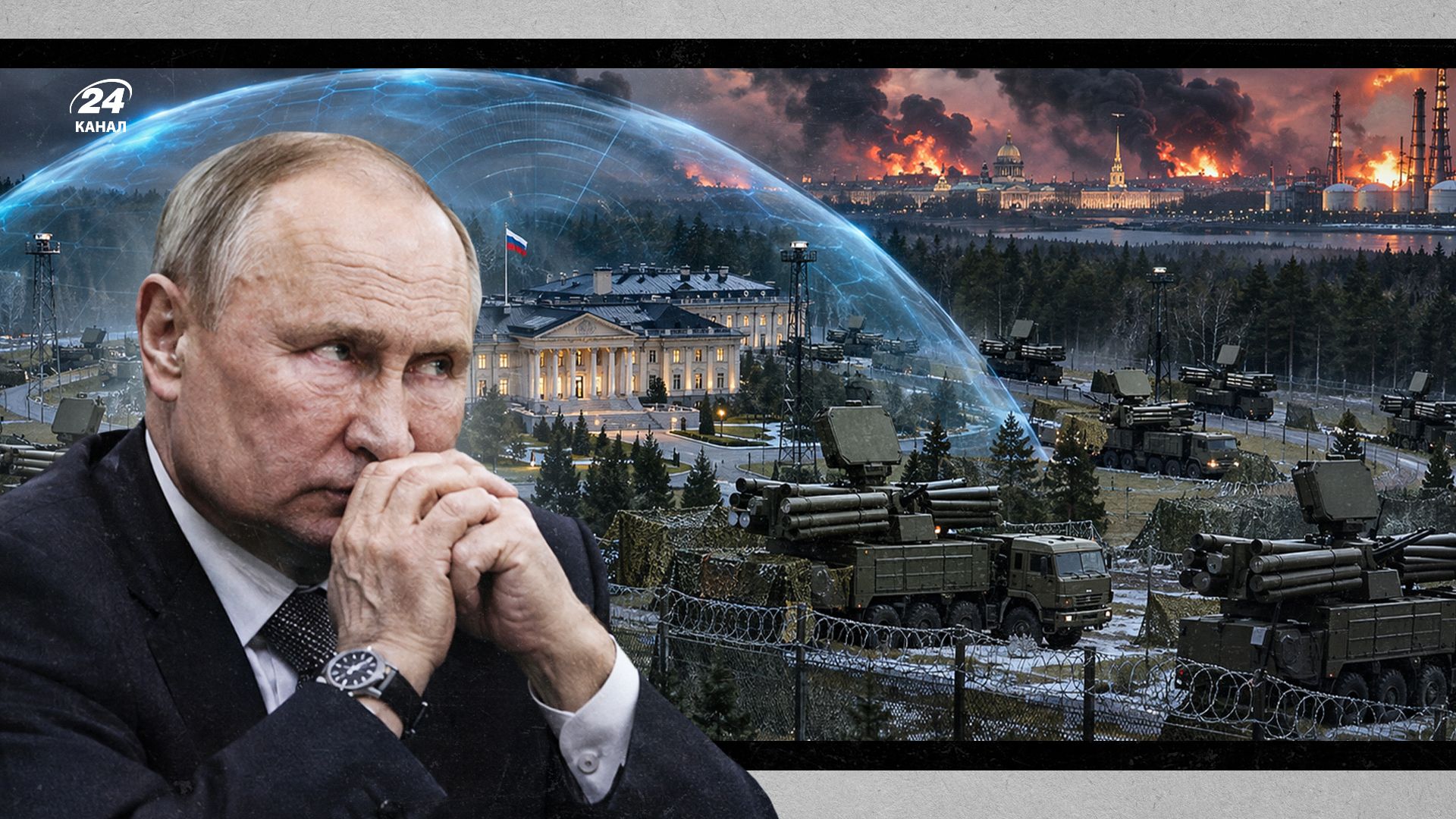
Putin is shielding Moscow and his own residence
Ukrainian drones continue to attack targets deep inside Russia, particularly near St. Petersburg. Among the targets of recent strikes were an oil terminal, port and logistics infrastructure, a data center, and facilities related to digital services.
At the same time, reports of attacks on individual enterprises do not always make it possible to determine the extent of the damage. However, the sheer variety of targets under threat demonstrates just how important the issue of protecting strategic infrastructure remains for Russia.
The uneven distribution of “Pantsir” air defense systems has drawn particular attention. According to published estimates, there are more than 98 positions with such systems near Moscow and more than 31 in Valdai, while only two positions and eight prepared earthworks were reported around St. Petersburg.
St. Petersburg is of great political and economic importance to Russia. It is Vladimir Putin’s hometown, unofficially referred to as the “northern capital,” as well as a major industrial, port, and logistics hub.
The “Pantsir” systems are designed, in particular, to counter drones, and their capabilities have been upgraded to counter modern aerial threats. Therefore, St. Petersburg’s insufficient protection cannot be explained by the fact that these systems are generally incapable of shooting down Ukrainian drones.
The first reason is a shortage of air defense systems throughout the Russian Federation, particularly “Pantsir” anti-aircraft missile systems. The second reason is a matter of priorities. The top priority is Moscow as the capital. It must be protected as much as possible so that Moscow residents are the last to feel the effects of the war,
Popovich explained.
Ukrainian drones periodically penetrate as far as the Russian capital, despite heightened defenses. However, the Kremlin is trying to ensure that the effects of the war have as little impact as possible on the daily lives of Moscow residents.
Another key area for the deployment of Russian air defense remains Valdai, where one of Putin’s residences is located. Resources are being used to protect it that could otherwise be directed toward defending other cities, military facilities, or Russian army positions on the front lines.
The second priority is the location where Putin himself is staying: Valdai. And here, Putin is providing his own cover; he is defending himself. In this way, he is diverting air defense resources away from other sections of the front and the rest of the Russian Federation. One such location is St. Petersburg,
– the military analyst emphasized.
The Russian command has to simultaneously protect airfields, oil refineries, industrial facilities, ports, and troops on the front lines. With a limited number of anti-aircraft systems, strengthening the defense of Moscow and Valdai reduces the ability to defend other important areas.
Therefore, even St. Petersburg, despite its status and economic importance, may remain vulnerable to Ukrainian strikes. According to the analyst, the Kremlin is forced to allocate insufficient air defense resources, prioritizing the capital and Putin’s personal safety.
Strikes on targets near St. Petersburg target several key sectors of Russian infrastructure at once. These include the oil industry, logistics, port facilities, and digital systems, which pose additional challenges for Russian air defense.
At the same time, Donald Trump continues to demand that Ukraine restrict strikes on Russian oil facilities. Popovich attributes the U.S. president’s current stance to the approaching midterm elections for the U.S. Congress, but does not expect his attitude toward Ukraine to necessarily improve after the vote.
I’m not ready to predict what will happen after the elections. I have a grim prediction that things won’t get any better with Trump himself. But what’s happening now is purely election-related. And since we’re already trying to set the information agenda and maintain the initiative, we need to continue telling the foreign media about all of this,
– Popovich noted.
Ukraine continues to actively explain its position to Western audiences. Volodymyr Zelenskyy, in particular, raises the issues of Ukrainian strikes on Russian territory and restrictions on U.S. support in interviews with Bloomberg and other international publications.
According to Popovich, such efforts help convey Ukraine’s arguments to U.S. citizens, among whom support for Ukraine remains strong. He believes it is advisable to continue strikes on Russian oil and other critical infrastructure, while explaining to the international audience their importance in weakening Russia’s ability to wage war.
Denis Popovich on the suspension of Starshield for Ukraine and Russia’s massive strikes on western regions: watch the video