
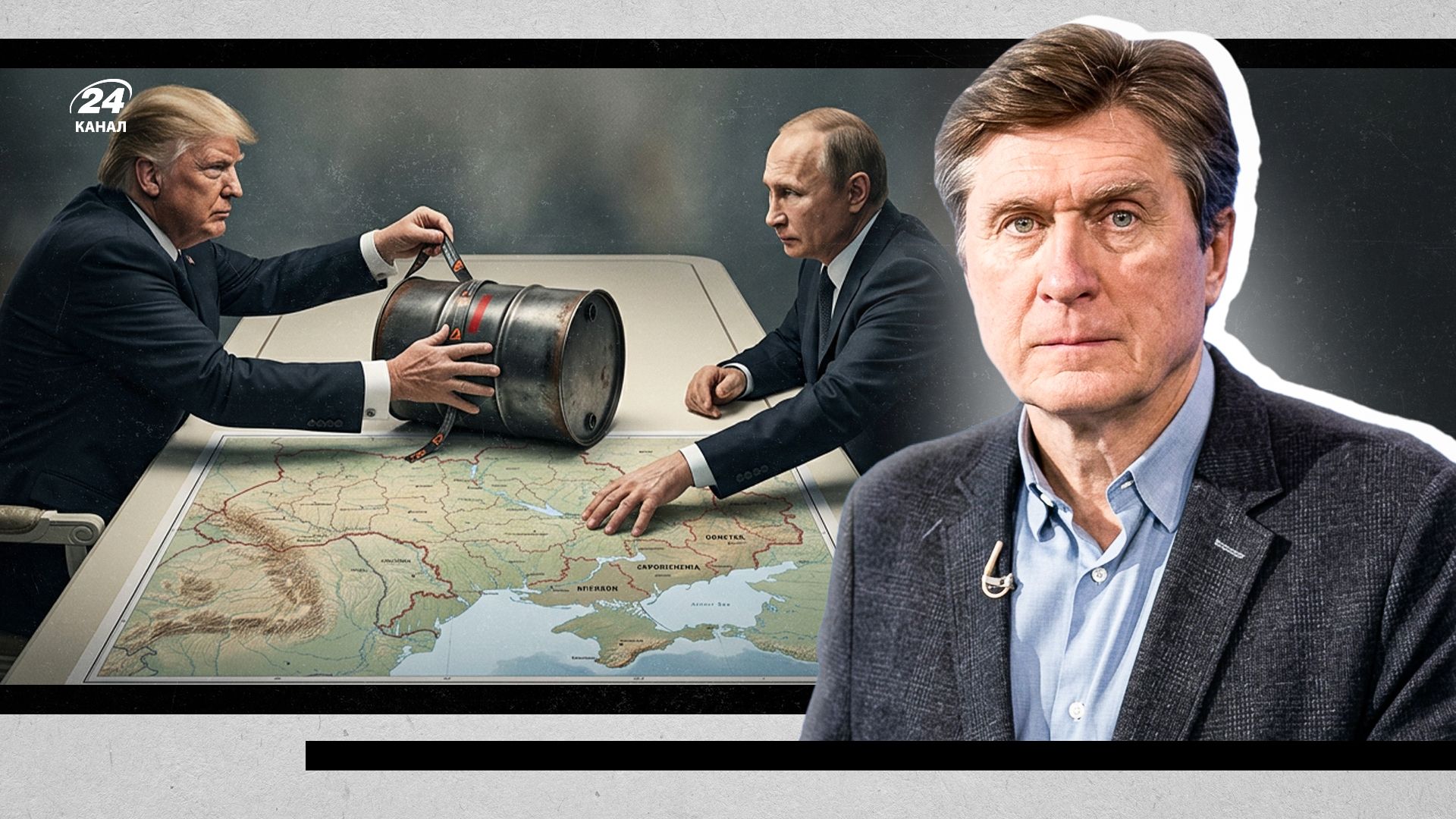


The U.S. and Europe are discussing a possible peace plan that calls for a ceasefire along the front lines, security guarantees for Ukraine, and a gradual resumption of economic cooperation with Russia. At the same time, Washington has authorized trade in Russian diesel fuel, even though the Kremlin continues the war and has not renounced its territorial claims.
Political analyst Volodymyr Fesenko, in an interview with Channel 24, explained why the new diplomatic initiatives may suffer the same fate as previous attempts to reach an agreement with Moscow. He also assessed the possible consequences of economic concessions to Russia and the risks of increased U.S. pressure on Ukraine.
Peace agreements won’t work without Europe
The Washington Post reported on preparations for a possible joint U.S.-European peace plan. Its provisions reportedly include a ceasefire along the current front line, security guarantees for Ukraine at the level of NATO's Article 5, the country’s reconstruction, and compensation for victims. An energy agreement is also being discussed, involving the possible resumption of Russian oil and gas supplies and the gradual lifting of sanctions against Moscow.
The attempt by Washington and European capitals to coordinate a common position could increase the chances of future agreements. After all, it is impossible to implement a significant portion of the economic provisions without Europe’s participation, especially when it comes to easing sanctions, returning a portion of frozen Russian assets, and determining compensation for Ukraine.
However, the substance of the proposed plan does not contain any fundamentally new solutions. Similar initiatives have been discussed repeatedly, but negotiations have stalled due to conditions unacceptable to Ukraine or Russia’s unwillingness to end the war.
The problem, as before, is that Putin does not want to end the war. That is the main problem right now, not the absence of a peace plan. There have already been peace plans – even the Americans had several. And they didn’t work because either they didn’t serve Ukraine’s interests, or Russia doesn’t want to end the war on those terms,
Fesenko explained.
One of the most important provisions of the new plan could be an energy agreement between Russia, Ukraine, the U.S., and Europe. The political analyst suggested that the U.S. administration is trying to return to the approach once used by former German Chancellor Angela Merkel.
During her chancellorship, the “Nord Stream 1” and “Nord Stream 2” gas pipelines were developed. At the time, it was expected that the economic interdependence between Russia and Europe would deter Moscow from military aggression, as the Kremlin would have an interest in maintaining profitable trade.
However, the Russian leadership did not abandon its intentions to regain control over Ukraine. Moreover, the Kremlin hoped that European countries’ dependence on Russian gas would prevent them from actively resisting Russian aggression.
Angela Merkel believed that if Russia traded with Europe, it would not go to war. But this logic ultimately did not hold up. Russia wanted to both wage war and trade. They thought that if Europeans were dependent on Russian gas, then they would not oppose Russia as it sought to regain control over Ukraine, even by military means,
the political scientist noted.
Now, according to Fesenko’s assumption, the United States may be interested in participating in the trade of Russian energy resources. In particular, American companies could theoretically act as intermediaries in gas supplies to Europe and receive a share of the profits. A return to the issue of pipeline supplies cannot be ruled out, though the possibility of such agreements remains open for now.
The Kremlin’s territorial demands have brought negotiations to a standstill
The most difficult issue in any agreement remains the future of the occupied Ukrainian territories. After Putin announced the illegal annexation of four more Ukrainian regions in late September 2022, Russia began demanding recognition of these territories as its own, even though it does not fully control them.
For Ukraine, legal recognition of such claims is unacceptable not only because it violates its sovereignty. Agreeing to Russia’s demands could set a dangerous precedent, under which Moscow would go on to make claims on other Ukrainian regions.
For us, this not only contradicts our sovereignty but also poses a huge risk. Tomorrow, Russia could just as easily declare any Ukrainian region to be Russian, and the whole thing would repeat itself. Therefore, we absolutely cannot agree to this. Moreover, these are our lands, and we cannot consent to them becoming Russian,
Fesenko emphasized.
The issue of Ukrainian territories does not depend on whether fighting took place there. For example, Ukraine does not recognize Crimea as Russian, even though there was no full-scale fighting over the peninsula during its occupation in 2014. This is also a matter of historical justice and a state’s right to its own lands.
At the same time, there is a fundamental difference between the legal recognition of an occupation and the actual cessation of hostilities. Ukraine may consider an agreement on a ceasefire along the current front line, even if some territories remain temporarily under Russian control.
We can agree to a ceasefire along the front line, and then part of our territory will remain under Russian control for an indefinite period. But legally, we will not recognize this. That is the compromise that is acceptable to us. But legally, we certainly cannot agree that these territories are Russian,
the political analyst explained.
Russia’s claims, however, are not limited to the Donbas. The Kremlin also continues to demand the Kherson and Zaporizhzhia regions, which is why Fesenko is skeptical about the possibility of finding a territorial compromise that would satisfy both sides.
He considers a phased ceasefire to be the most realistic path under the current circumstances. However, this requires forcing Putin to agree to at least a ceasefire, since proposals for economic cooperation alone are unlikely to change Moscow’s position. Russia must understand that rejecting the agreements will lead to new sanctions and an increase in arms supplies to Ukraine.
The diesel deal sets a dangerous precedent
Amid discussions of the peace plan, the U.S. administration has authorized trade in Russian diesel fuel. Steve Witkoff and Jared Kushner hope that economic concessions might encourage Putin to return to the negotiating table, but Fesenko does not see a coherent diplomatic strategy in such actions.
U.S. approaches to ending the war have changed repeatedly. Last March, Washington began negotiations on a ceasefire proposal – specifically regarding the sea and energy infrastructure – but no concrete agreements were reached.
At that time, Keith Kellogg was in contact with Ukraine, while Witkoff and Kushner were working with the Russian side, and Marco Rubio was also involved in the process. According to the political scientist, the lack of coordination among the various American negotiators was one of the reasons for the previous failures.
That’s their worldview – it’s not even a strategy. I don’t see any strategy at all on the part of the Americans. You know, it’s pure improvisation. One peace plan one moment, another the next. They started negotiating – and rightly so – with a ceasefire. But everything fell apart because there was no consistency either,
– Fesenko noted.
After Witkoff and Kushner took the lead in the negotiations, business issues began to come to the forefront more and more often. Valeriy Zaluzhny, the former commander-in-chief of the Armed Forces of Ukraine and now Ukraine’s ambassador to the United Kingdom, had previously criticized this approach to a peaceful settlement.
What sets the current agreements apart is that Washington is opening the door to economic cooperation with Moscow without first demanding an end to Russian attacks. Although the potential volume of diesel trade is not yet of great economic significance, the political consequences of such a decision could prove to be much more serious.
This agreement – this deal, essentially – between Trump and Putin regarding diesel is the very epitome of a business-first approach, where the Americans are pursuing their own selfish – and, moreover, temporary and situational – interests at Ukraine’s expense. And they are setting a precedent by striking business deals with the Russians without Russia ceasing hostilities. That is the danger of this agreement,
the political analyst emphasized.
Alongside economic proposals, American representatives continue to raise the issue of Ukrainian concessions. Whereas previously the focus was mainly on Russia’s territorial demands – particularly regarding the Donbas – the discussion has now shifted to the possibility of halting Ukrainian strikes on Russian oil refineries.
At the same time, sanctions remain an important tool for exerting pressure on the Kremlin. Russia itself insists on their lifting during discussions of peace agreements, which, according to Fesenko, confirms the significance of economic restrictions for Moscow.
The political analyst does not expect a quick resumption of substantive negotiations, but suggests that new opportunities may arise next year. For this to happen, Ukraine must hold out through the winter and prevent any significant advance by the Russian army, so that the Kremlin becomes increasingly aware of the impossibility of achieving a military victory.
However, Putin may decide to continue the war while awaiting political changes in Europe. In particular, Moscow could bet on the elections in France, where the possible rise to power of right-wing political forces could affect the European Union’s unity in supporting Ukraine. Therefore, Fesenko considers maintaining military parity and continued assistance from European partners to be essential prerequisites for future negotiations.
Ukraine Can Withstand Pressure from Washington
During recent talks in Miami, the Ukrainian side raised the issue of possible reciprocal steps by the U.S. in the event of a relaxation of sanctions against Russian oil. The New York Times reported that U.S. representatives allegedly responded that Washington is already doing enough for Ukraine and therefore should not offer additional concessions in exchange for halting strikes on Russian oil refineries.
Fesenko believes that Ukrainian negotiators should thoroughly discuss the scope and nature of U.S. support. After all, under President Joe Biden, Ukraine received free weapons and financial aid, whereas under the Trump administration, the format of cooperation changed significantly.
Here, our negotiators should have posed a counter-question: What exactly? What exactly are our American partners doing? Under Biden, we received free weapons and financial support. And what are we getting from Trump? We’re getting intelligence,
Fesenko explained.
U.S. intelligence remains important for Ukraine, although the Ukrainian military has already learned to obtain a significant portion of the necessary information on its own. The Starlink satellite communication system is also of great importance, but its complete blocking for political reasons, according to the political scientist, would damage Elon Musk’s reputation as a provider of such services.
A more serious risk could be restrictions on the sale of American weapons, a possibility reported by the Financial Times. Fesenko pointed out that such supplies are not free aid, since American manufacturers receive payment for them.
Washington has already employed tough pressure tactics during negotiations over the resource agreement. In the spring, the U.S. administration temporarily suspended the transfer of intelligence and the delivery of weapons that Ukraine was supposed to receive under Biden’s earlier decisions. These deliveries were later resumed, and the parties were able to reach a compromise.
This experience could prove useful in the current negotiations as well. According to the political scientist, the Ukrainian side must act flexibly and diplomatically, but should not agree to demands that run counter to its national interests.
Donald Trump, too, could have reached an agreement on Iran many times, but he did not. Why? Because he does not want to agree to terms that do not serve U.S. interests. And we cannot agree to terms that do not serve Ukraine’s interests. A compromise is needed. It is your role as Americans to find such an effective compromise, rather than demanding that we agree to Russia’s terms of peace,
– the political analyst emphasized.
Washington’s arguments regarding the need to halt Ukrainian strikes on Russian targets also require a response. Fesenko recalled that the United States itself, during the war with Iran, carried out strikes on military targets and members of the enemy’s leadership. Ukraine is likewise at war and is responding to Russian aggression.
Over the past six months, the Ukrainian side has repeatedly faced pressure from the U.S., with the political analyst noting that the negotiations on the resource agreement were the most difficult. At that time, despite harsh statements from Trump and his administration officials, Ukraine managed to reach agreements based on compromise.
Fesenko supports the idea of a joint U.S.-European peace plan, provided that Ukraine’s position is taken into account during its development. European partners share significantly more common ground with Kyiv on ending the war, so their participation could help Ukraine resist demands for unilateral concessions.
The U.S. may limit intelligence sharing for strikes against Russia
Following the ballistic missile attack on Kyiv, during which the air raid siren sounded late, questions arose regarding the operation of the missile warning system. Reports of possible U.S. pressure on Ukraine to restrict the sharing of intelligence information caused further concern.
A theory began circulating on social media and in the press that the United States may have deliberately failed to warn Ukraine about the Russian missile launches. In particular, military analyst Yevhen Dykyi voiced this assumption; however, there is no evidence of a deliberate halt to the transmission of relevant data.
Fesenko cautioned against jumping to conclusions, as the mechanism for detecting ballistic missiles and transmitting satellite data requires expert analysis. U.S. satellite capabilities remain critically important for Ukraine; however, the political scientist doubts that Washington would use warnings about missile attacks specifically as a tool for political pressure.
As for ballistic missiles, if – God forbid – such an event were to occur, the alarm must be sounded immediately, and the American media must be notified as widely as possible. Because doing so would effectively make the Trump administration an accomplice in the war against Ukraine. This would increase the number of civilian casualties,
– Fesenko emphasized.
Delays in air raid alerts during ballistic missile strikes have occurred before, particularly this summer. One reason may be the extremely short flight time of the missiles that Russia launches from the Bryansk and Kursk regions. In such cases, “Iskander” missiles can reach Ukrainian territory in about three to five minutes, which is why the warning sometimes arrives almost simultaneously with the strike.
At the same time, the political analyst does not rule out a partial restriction on U.S. intelligence data. In his view, Washington may attempt to limit Ukraine’s ability to strike targets on Russian territory, particularly oil refineries.
The Ukrainian military has its own means of target identification, but U.S. intelligence can help pinpoint their locations and characteristics. This involves not only geographic coordinates but also additional information necessary for planning precision strikes.
This is precisely where the Americans could limit some of our capabilities, specifically regarding strikes on Russian territory. This is just my assumption; I’m not claiming to be an expert here. But I think that if the Americans were to do this, they would be withholding intelligence that could help us strike Russian oil refineries, rather than ballistic missile facilities,
– the political analyst suggested.
At the same time, intelligence cooperation benefits both countries. The United States receives a large amount of information from Ukraine about the use of Russian weapons, ways to counter them, and the effectiveness of American systems in real combat conditions.
Such data is crucial for improving military technologies, particularly artificial intelligence systems. Therefore, Fesenko does not expect a complete cessation of U.S. satellite and intelligence support, although he acknowledges the possibility of selective restrictions on information related to Ukrainian strikes on Russian territory.
Volodymyr Fesenko on Trump’s diesel deal with Putin: watch the video