
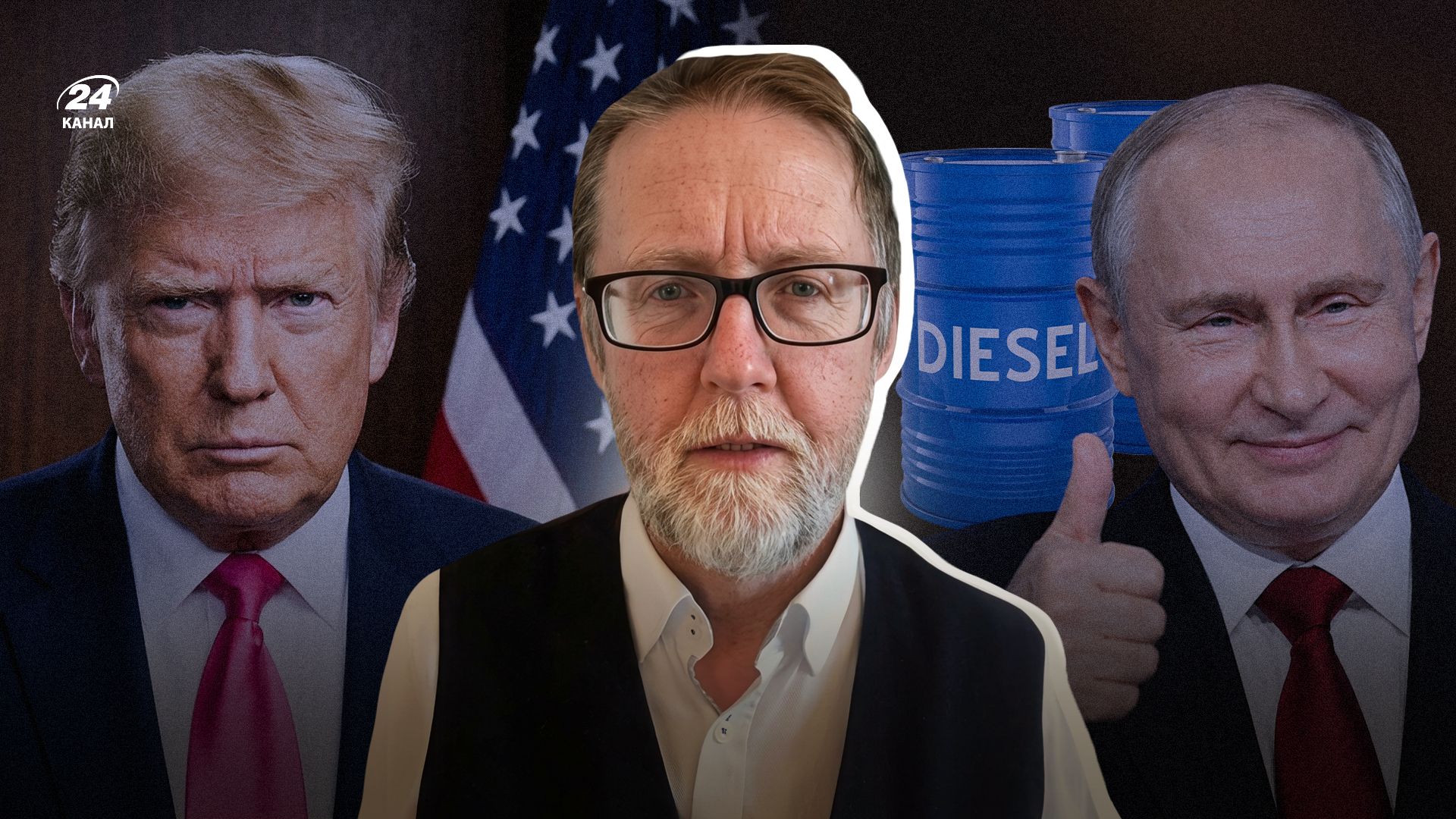


Donald Trump is declaring an energy truce, but at the same time is easing sanctions pressure on Russia and considering the possibility of purchasing Russian diesel fuel. Against this backdrop, questions arise about Washington’s true goals: Is the White House trying to force the Kremlin into negotiations, or, on the contrary, is it giving Vladimir Putin new leverage over Ukraine?
Scott Lucas, a professor of international politics at the Clinton Institute at University College Dublin, explained in an exclusive interview with Channel 24 why an energy truce could benefit Moscow, how the purchase of Russian diesel affects U.S. sanctions policy, and why Washington’s threats to halt intelligence sharing with Ukraine are dangerous. The expert also analyzed the possible terms of a peace agreement, the risks of territorial concessions, and whether the U.S. Congress will be able to limit Trump’s influence on the further course of the war.
Russian Diesel and New Pressure on Ukraine
Trump announced an energy truce between Russia and Ukraine, although Zelenskyy stated that he was unaware of such an initiative, and Russia continued to attack Ukraine’s energy infrastructure. At the same time, the U.S. authorized the purchase of Russian diesel despite sanctions. What is behind these decisions by Trump: a desire to lower fuel prices or an attempt to persuade Putin to negotiate?
I think it’s worth starting with two things about the Trump administration – and not just about Trump himself. First, Donald Trump doesn’t always tell the truth. Sometimes, as in the case of this statement about an energy truce, he says what he wants to believe is true. He wants a truce he can take credit for: “It’s all thanks to me,” he’ll say, “and everyone agreed to my brilliant deal.”
Sometimes he writes something like this because he doesn’t really understand what’s going on. But quite often, he tries to shape reality: I’ll declare a truce, and then everyone will agree. The key point here – and everyone knows it – is that the Kremlin is the obstacle to any ceasefire – whether full, partial, or energy-related.
It is Vladimir Putin who wants to continue seizing new territories in Ukraine and is, in fact, seeking to force Ukraine to capitulate through airstrikes. We know this will happen this winter.
So, if the Russians do not agree to Trump’s ceasefire, we need to take a step back and ask another question: why did Trump, last Friday, without warning Ukraine and, apparently, without warning Russia, suddenly declare that “The U.S. will purchase Russian diesel fuel”?
Let me emphasize just how important this is from a political and symbolic standpoint. In April 2022, the United States banned all imports of Russian fuel – all of it, without exception. This ban has remained in effect until now, and last month the U.S. Congress extended sanctions against Russia by imposing 100 percent tariffs on its largest oil buyers. Trump hasn’t implemented them yet, but the U.S. Congress has.
Professor on Trump’s Latest Political Failure: Video
Now Trump is not only undermining the sanctions; he is effectively entering into a partnership with the Russians to provide them with billions of dollars. And here’s an important clarification: I initially thought it was Putin who called Trump, since they spoke on Friday. I thought it was Putin himself who might have offered Trump the chance to buy Russian diesel fuel. But that’s not what happened.
Ukrainian officials have now made it clear that when they arrived in Florida for a meeting with Steve Witkoff and Jared Kushner, Witkoff told them that Trump was planning to do just that – buy diesel fuel. During the meeting, Witkoff excused himself and stepped out to listen in on the conversation between Trump and Putin. In other words, either Trump called Putin or Putin called Trump to inform him that Trump was planning to buy diesel fuel.
So, this wasn’t even an initiative of the Kremlin. Trump is making this decision. And why would he do that? There’s an obvious reason: because of the senseless war in Iran, Donald Trump has contributed to a nearly 100% increase in diesel fuel prices – that is, a doubling of prices since last year. A few weeks ago, they reached a record high – about $6.52 per gallon. Now it’s $6.28 per gallon.
But buying Russian diesel makes no sense in this context. Russia doesn’t send enough diesel to the U.S. to have a significant impact on the market. The proposed volumes would cover only a few days of surging demand in the U.S. Moreover, the problem isn’t that the U.S. needs diesel fuel from abroad: the U.S. exports diesel fuel itself, has more fuel than it can use, or can obtain diesel fuel from Canada.
So this is a symbolic move that does little to change diesel prices. But what comes next is even more important: a U.S. official spoke to Axios. And if a U.S. official goes to Axios, there’s a good chance it’s Steve Witkoff. This official – presumably Witkoff – told Axios: the reason the U.S. is buying Russian diesel fuel is that it will soften Moscow’s stance, and they’ll be ready for negotiations.
That’s not how it works. If you really want to bring the Russians to the negotiating table, you first force them to sit down, and only if there is progress do you buy Russian diesel fuel. You cannot give up your leverage over the Russians before negotiations begin, because the Kremlin will simply sell the diesel fuel, then come up with a new reason why it won’t negotiate, and wait for another concession to be made to them.
And there’s another important point here. Although Trump and Witkoff have immediate motives for such concessions, there’s a broader picture: the Kremlin is manipulating Trump, Witkoff, and Kushner by offering them joint projects. This involves the sale of Lukoil assets to individuals connected to Trump, Kushner, and Witkoff.
It involves a proposal to jointly resume operations of the Nord Stream pipelines, with contracts that would likely go to people connected to Trump, Witkoff, and Kushner. It also involves even larger joint economic projects being touted by Kirill Dmitriev, Putin’s financial adviser.
So, we have a mix of a compromised administration seeking business deals, an American president afraid of losing the election, and a real estate developer and the president’s son-in-law – neither of whom are qualified diplomats. This is a bad combination when dealing with people like Vladimir Putin.
Is the energy truce fair, and why is it dangerous for Ukraine?
This also applies to the strange energy truce, as a White House official told Axios that it pertains only to a halt in strikes on oil refineries. Ukraine has only one such refinery, and it is not operating properly. Russia, on the other hand, has dozens of refineries that fuel Putin’s war machine. So is this a fair deal? And isn’t this an attempt by Trump to impose a ban on Ukrainian strikes against oil refineries because he thinks it will help him ahead of the midterm elections and lower oil prices?
Yes, you know the answer to that question, but let’s say it out loud. There are two points here. First, Donald Trump’s priority at this stage is not to reach a realistic ceasefire agreement. He’s simply shouting “ceasefire” and wants Ukraine to stop attacking Russian oil refineries because of the problem with gasoline and diesel prices in the U.S.
Second, remember what I said about people who pretend to be diplomats, even though they aren’t really diplomats. This idea from Witkoff and Kushner about a “refinery-for-refinery” ceasefire is absurd because it means that Ukraine loses its leverage over the Russians in the form of counterattacks, while Russia loses nothing because it isn’t attacking refineries. They’re attacking the power grid. They’re attacking other energy infrastructure.
That is why, as early as Friday, the Ukrainians told Witkoff and Kushner: we need an “energy truce” that includes a halt to Russian strikes on power supply systems, power plants, and other parts of the power grid. That is what a sensible ceasefire looks like.
So, Witkoff and Kushner came up with something that doesn’t actually solve the real problem, and then they expect Ukraine to accept it. Otherwise, Donald Trump will be unhappy. And when Ukraine says, “No, we won’t accept this,” they’re told, “Then we’ll go buy Russian diesel fuel.”
Even more seriously, Ukrainian and European officials who were at that meeting say that Witkoff and Kushner threatened to halt the exchange of intelligence. And this exchange of intelligence with the U.S. is vital for Ukraine’s defense, as well as crucial for Ukrainian counterattacks on Russian territory.
Can the U.S. Really Cut Off Intelligence and Military Aid to Kyiv?
Let’s also address another interesting issue regarding intelligence sharing between the U.S. and Ukraine, as reports have emerged that the U.S. is threatening to stop sharing intelligence and providing military support to Ukraine. Some U.S. officials spoke by phone with European allies this weekend regarding a possible halt to military supplies to Ukraine. And President Zelenskyy has just confirmed that Ukraine did not receive any intelligence warnings from its partners prior to yesterday’s Russian ballistic missile strike on Kyiv. How would you comment on this, and do you think the U.S. is capable of such a move?
This is a very important question, and we need to establish what we know and what we don’t know. As I just said, the threat was issued on Friday: if Ukraine does not accept the U.S. conditions for negotiations – which would effectively amount to concessions to the Russians – the U.S. will stop providing them with intelligence.
Then we see Russian attacks, because the Russians are not ceasing fire but continue to strike energy infrastructure and civilian targets. And we’ve heard two different accounts from Ukrainian officials, and here I may need to ask you to help me sort this out before we speak again on Thursday.
President Zelenskyy initially said, following the latest Russian attacks on Kyiv, as well as on Kharkiv – the second-largest city – and other areas, that we had not received any warning. But then Foreign Minister Andriy Sibiga said at the Warsaw Security Conference in Poland this morning: no, it wasn’t a matter of a halt in intelligence sharing. He noted that there simply wasn’t time to provide intelligence because the Russians were using a certain type of weapon.
Clarity is needed here. And I understand why some things must remain secret, but clarity is essential. If the foreign minister says there wasn’t time to share intelligence, that’s a serious turn of events given the type of weapons the Russians may possess. Because that means that even with an intelligence-sharing agreement in place, you don’t have time to issue a warning. This will be very important as winter approaches.
If, on the other hand, the Ministry of Foreign Affairs is trying to diplomatically conceal the fact that Ukraine still does not know why it did not receive the intelligence, then a key question arises: was access to it blocked? And I suspect that this is exactly what happened here.
In that case, Ukraine must hold urgent consultations with American and European officials regarding the status of intelligence sharing. Ukraine does not rely solely on the U.S. for intelligence. So we need to find out whether the Europeans were able to provide intelligence but were unable to do so.
But we need to go back to what happened last year: the Americans threatened to halt intelligence sharing. We remember that. We discussed this back when the Trump administration was preparing to cut off all aid. And the Europeans, together with Ukraine, worked with agencies such as the CIA and the U.S. military to ensure that intelligence continued to flow. This must be a priority.
The problem is that people are simply unsure of the exact status of intelligence sharing, which is why we’re hearing conflicting statements from Ukrainian officials today.
The Peace Agreement Plan: What’s Unacceptable to Ukraine
Let’s also discuss a recent article in the Washington Post regarding the terms of a possible agreement between Ukraine and Russia. There are ongoing discussions about security guarantees similar to NATO’s Article 5. This term is very popular among President Trump’s envoys: security guarantees similar to those in Article 5, economic cooperation, and a pipeline to transport Russian oil to Europe – which would benefit both Ukraine and Russia. Some rather interesting ideas are laid out there. What is your opinion on this, and do you think Kushner and Witkoff are behind this plan?
Oh yes, we’re reporting that Kushner is leaking elements of this plan, but pay attention to what’s missing from it. First, does it call for a ceasefire along the current front line? If it’s not a ceasefire along the current front line, that’s unacceptable.
Second, does it involve concessions of Ukrainian territory? We, of course, always come back to the Donetsk region in eastern Ukraine. Is it supposed to go to the Russians? If so, that’s unacceptable.
Third, does this entail any legal recognition of Russia’s seizure of any occupied Ukrainian territories, including Crimea, which has been occupied since 2014? If there are calls for legal recognition of Crimea or other territories as Russian, that is unacceptable.
Fourth, what does “Article 5” mean, and what are NATO’s guarantees? Does this mean, for example, that foreign troops could be stationed in Ukraine as part of security guarantees? Does this mean absolute certainty that if Russia attacks again, NATO members will come to Ukraine’s defense? Does this mean there will be restrictions on Ukraine’s army or the size of its armed forces? These are all questions without answers.
I understand that the Americans are pushing this issue now, but we know these are essentially the same proposals that were considered earlier this year. And we know that the negotiations didn’t make any political progress back then because the Russians demanded the rest of the Donetsk region.
So Witkoff and Kushner can leak information to as many media outlets as they like. But until they come forward and are candid about this, and until they tell the Russians: “You will not get the rest of Donbas; Ukraine will not agree to this” – they will not agree to such a territorial concession.
Can U.S. law stop Trump?
Let’s also touch on the current pressure from U.S. lawmakers, the U.S. Congress, and these midterm elections. If the Republicans do lose, for example, the House of Representatives or the Senate, how might that affect the diesel deal between Russia and the U.S. and Trump’s policy toward Ukraine?
There are already lawmakers talking about introducing a bill that would ensure enforcement of the 2022 ban on Russian fuel imports. This means that Trump’s executive order lifting that ban – that is, allowing diesel imports – would be rescinded.
Of course, if there is a Democratic majority in the House of Representatives and the Senate, this could serve as a counterweight to Trumpism. But again, there are many “ifs” here. First, the question is how large this Democratic majority needs to be in order to be effective.
Second, not all Democrats agree that Ukraine deserves full support. You need to be aware of this. There are several Democrats, mainly on the so-called left wing of the party, who do not actually believe that the U.S. should be involved in Ukraine’s defense. So this is an issue that needs to be addressed.
There are too many “ifs” regarding where the election might go and what might happen next. And it’s worth adding that this is a very erratic president. So typically, when legislation moves forward, the president has to respond – either by compromising or pushing back. Donald Trump might simply try to ignore what’s happening or attempt to undermine it.
Let me give you a basic example: a sanctions bill was passed by a bipartisan majority last month. Has it been implemented yet? Absolutely not. Why? Because Donald Trump does not want to impose sanctions on Russia. And it doesn’t matter how large the majority in Congress is – unless Congress makes it clear that what he is doing is unacceptable.
Until Republicans and Democrats jointly declare this unacceptable and clarify their position on his actions, he will continue to either effectively support Russia or fail to adequately protect Ukraine.
The Divide in the White House and the Future of the U.S. Stance on the War
Do you feel there is now a risk of a repeat of the clash in the White House, as in February 2025?
The administration is divided. And that, I think, is what sets this situation apart from February 2025. Back then, a group of people entered the White House – and not just Trump. Take a look at Vice President J.D. Vance. Take a look at adviser Stephen Miller. They didn’t believe in European security – not just Ukraine’s security, but European security as a whole. That’s exactly what was behind the ambush on President Zelenskyy at the White House.
But remember, just a few weeks later, Europe and Ukraine fought back by bringing in two officials from the Trump administration who believe in European security. We can mention Keith Kellogg, the former envoy to Ukraine. He’s no longer there, but we know there are officials in the State Department, the Treasury, intelligence, NATO, and other branches of the U.S. Armed Forces who believe in European security.
That’s the situation right now. So we’re waiting to see if we’ll hear from those officials who disagree with what Trump did regarding diesel fuel, who disagree with his threats to oust Zelenskyy, and who disagree with him on abandoning Ukraine during negotiations. They cannot speak out openly and say this. You cannot come out openly and say this. You must send messages through the media. You must take the initiative.
And I’ll come back to this. Where is CIA Director John Ratcliffe now? Normally, CIA directors aren’t supposed to speak publicly because they head the agency, but John Ratcliffe was in Moscow in August, telling intelligence officials: Tell Vladimir Putin that he won’t win this war. Is that still the case? Are they continuing to convey this message to Putin: “You’re not going to win this war”?
This doesn’t help Ukraine immediately, because a divided administration is an administration that is effectively paralyzed and cannot provide what is needed to help Ukraine. But that doesn’t mean the administration is completely in Vladimir Putin’s pocket, even if Donald Trump himself could fit quite nicely into Vladimir Putin’s pocket.