
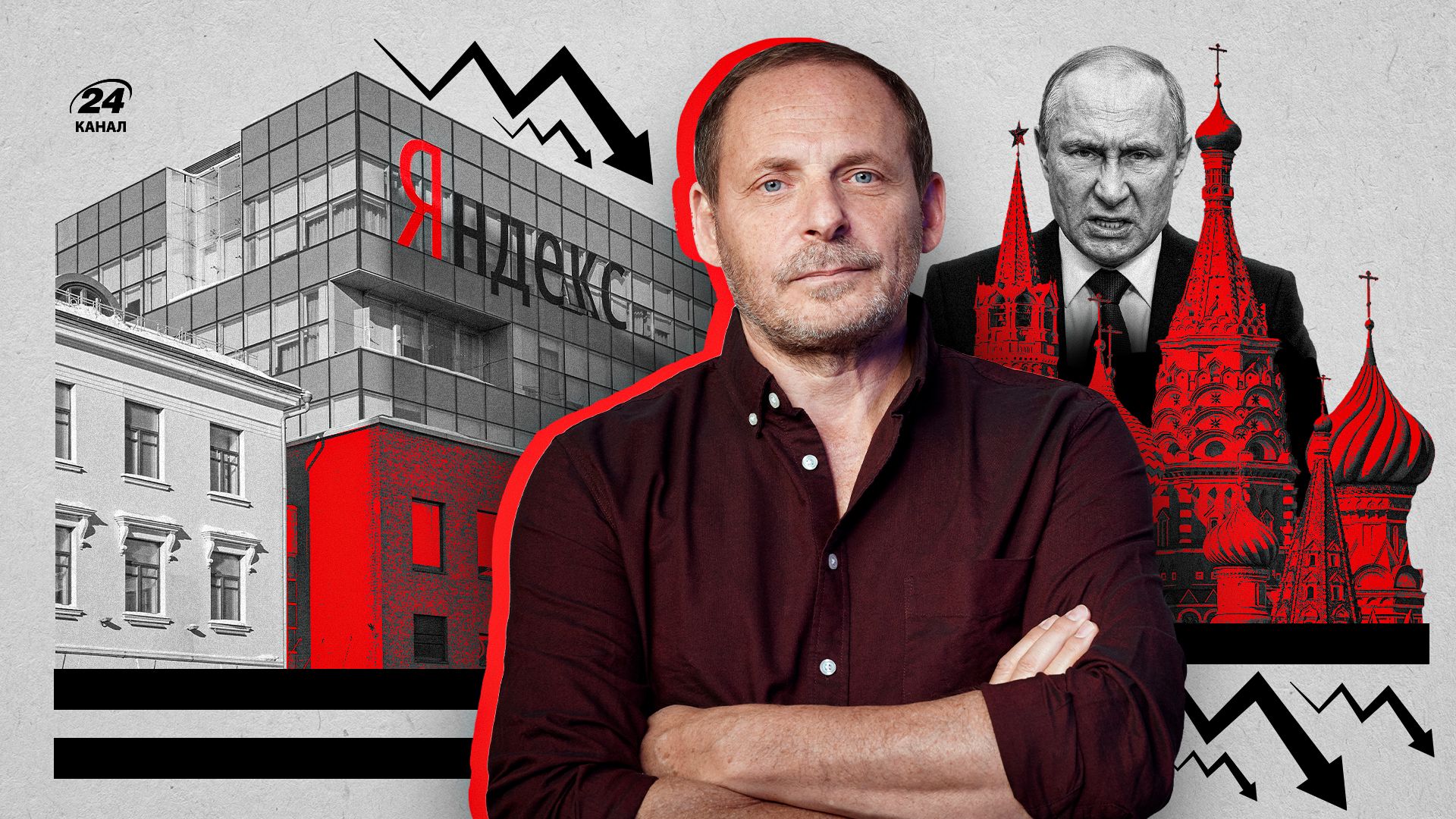


Just fifteen years ago, Yandex was considered one of Russia’s key technological successes. The company successfully competed with the American firm Google, particularly in post-Soviet countries, expanded into international markets, and attracted billions in investments.
But as soon as the Russian authorities figured out how the internet works, they immediately decided that such a powerful tool for controlling information and citizens’ personal data should not remain beyond their influence.
Today, however, the former pride of the Russian IT industry is going through what are arguably its worst times. In late September , Russia launched strikes against Ukrainian data centers and apparently decided that it alone had the right to do so. But this is a game for two. So, in early October, Ukrainian drones attacked three Yandex data centers, causing widespread disruptions to dozens of the company’s digital services and, in addition, dealing a painful blow to the operations of Russian bot farms around the world.
Channel 24 investigated how Yandex went from being a promising tech startup to an integral part of Russia’s so-called “digital Gulag,” in Russia, how the Kremlin gained control over the once-independent company, and whether Ukrainian drones were indeed able to strike not only at Russian servers but also at Moscow’s propaganda machine.
Russia’s Google: How Yandex Was Created and Why It Is Now in the Hands of Russian Security Forces
The history of Yandex began long before the Russian authorities even realized how important a tool control over the internet is in the hands of the state. In the late 1980s, mathematician Arkady Volozh was developing software for searching for information, and programmer Ilya Segalovich later joined the project. In 1993, Segalovich came up with the name Yandex, and work began in earnest on the company’s core service – the search engine.
Yandex was launched as a full-fledged search engine in September 1997, allowing users to conveniently and fairly quickly find the Russian-language websites they needed – of which there were only a few thousand at the time. By 2000, Yandex had become an independent company, with Arkady Volozh serving as its CEO.
Arkady Volozh and Ilya Segalovich / Photo – Kommersant

This was followed by the company’s rapid expansion. The search engine was expanded to include email, a news aggregator, maps, advertising tools, and other services. Later, the company ventured into taxi services, delivery, cloud technologies, and even artificial intelligence. In fact, what started as a single search engine gradually grew into an entire digital ecosystem, without which a vast number of Russians today would find it difficult to imagine their daily lives.
Moreover, unlike many other Russian tech projects, Yandex didn’t just blindly copy a Western idea (like “VKontakte” and “Odnoklassniki”), but ultimately succeeded in competing with Google itself, even outside of Russia. The pinnacle of this success was Yandex’s listing on the U.S. NASDAQ stock exchange in May 2011, which allowed the company to raise an additional $1.3 billion in investments.
But Russia wouldn’t be Russia if the authorities hadn’t set their sights on a successful domestic business. Back in 2009, Yandex transferred a so-called “golden share” to the Russian state-owned Sberbank, which allowed it to block the concentration of more than 25% of the company’s shares in a single entity.
Formally, this was intended as protection against hostile takeovers, and the share itself did not grant the right to interfere in the company’s management. However, it also meant that the state had, in fact, gained a powerful tool to influence Yandex’s future development.
Subsequently, this mechanism was only strengthened, and the Kremlin increasingly made clear its desire to control the Russian internet, constantly citing China’s success in this arena. Ultimately, while Yandex had previously been able to outcompete Google thanks to its own technologies and a broad Russian-speaking audience across the post-Soviet space, in its confrontation with the state, the rules were dictated directly from the Kremlin.
The Russian authorities never simply wanted a successful search engine that made everyday life easier for citizens. The Kremlin needed control over the information that millions of citizens receive through the domestic news aggregator, as well as the data that users leave online every day.
Technology in the Service of the Regime: How the Kremlin Monitors Citizens Through Yandex Services
The Russian authorities’ gradual takeover of Yandex began long before the full-scale invasion of Ukraine. The Kremlin understood very well that a company controlling one of the country’s most popular search engines has enormous influence over the information citizens receive.
The protests of 2011–2013 served as a particularly loud wake-up call for the Kremlin, as their organizers actively mobilized people specifically through the internet, and immediately afterward, the Russian authorities set about bringing it under their control with particular zeal.
Protest rally on Bolotnaya Square in Moscow / Photo – Wikimedia

The first to come under fire was the “Yandex.News” service, which compiled selections of reports from Russian media outlets and reached millions of readers daily. The Kremlin even passed a separate law on news aggregators. Under the new rules, these aggregators were held responsible for spreading “inaccurate” information; however, an exception was made for content from officially registered media outlets. In other words, the company was effectively pushed to rely exclusively on Russian state media.
The final nail in the coffin for Yandex News came with the start of the full-scale invasion of Ukraine. In 2022, the company sold its news aggregator to VK, which was already under significant influence from the Russian government and its affiliated entities. In effect, Russia’s largest search engine divested itself of its own news platform, transferring it to a business directly affiliated with Russian intelligence agencies and the Kremlin.
But control over the news feed is just one element of the company’s entire ecosystem, since Yandex has, in fact, been accumulating vast amounts of users’ personal data for years: from search queries and correspondence to travel routes, home addresses, and payment information – which ultimately caught the attention of Russian intelligence agencies.
Advertisement for the Yandex Go service in the Russian metro / Photo – Petertransport

In 2023, the publication Meduza published an investigation revealing that, starting September 1, the FSB was to gain round-the-clock access to the user data of the “Yandex Go” taxi service. Moreover, it wasn’t just Russian citizens who were at risk, as the service also operated in more than twenty countries – including Georgia, Armenia, Serbia, and Israel – and trip data was stored on Russian servers.
Yandex itself, of course, denied reports that it had transferred data on its users’ international trips to Russian law enforcement agencies.
Moreover, one of the most well-known instances of Russian law enforcement agencies using Yandex data occurred back in 2019. At that time, information about journalist Ivan Golunov’s taxi rides was used by the police to fabricate a criminal case against him. As it later turned out, law enforcement received about a hundred addresses from Yandex linked to the journalist’s taxi orders, including even the address of the Meduza editorial office in Riga (the capital of an EU and NATO member state).
Also, following the start of the full-scale invasion, a major change in the company’s ownership took place. Yandex co-founder Arkady Volozh fell under European sanctions and stepped down from his executive positions, while the company itself began to gradually separate its Russian and international operations. The Russian portion of the assets was sold to a consortium of Russian investors in July 2024 for approximately $5.4 billion.
Subsequently, Arkady Volozh himself condemned Russia’s invasion of Ukraine, The sanctions against him were lifted, and in 2026, he even renounced his Russian citizenship, hired security guards, rightly fearing retaliation from his fellow villagers. Later, his new company, Nebius, signed a deal with the American firm Palantir, whose AI technologies are actively used in the military sector, including in cooperation with Ukraine.
In other words, in the end, the Kremlin – in its typical manner, by forcing the former owner out of the country – did indeed gain control over the company, and, as a result, gained not only the ability to intensify surveillance of citizens through data from digital services but also to significantly increase its influence over the entire ecosystem of the company, on which millions of Russians now depend.
But any digital empire has one rather tangible weakness. For it to function, it relies onIt requires massive data centers, servers, and computing power – which Russian security forces are unable to protect, either through internet censorship or by circumventing sanctions. And in early October, Ukrainian drones proved this to the Kremlin.
Destroyed Data Centers: How Ukrainian Drones Freed the Western Internet from Russian Bots
In early October 2026, the Russian tech empire faced a problem that its founders could hardly have foreseen thirty years ago. It turned out that to cause serious disruptions in the operations of one of Russia’s largest IT giants, it wasn’t necessary to launch a large-scale cyberattack – sometimes, all it took was a few Ukrainian drones.
On the night of October 7–8, Ukrainian drones attacked the Yandex data center in Sasovo, Ryazan Oblast. The facility sustained serious damage and ceased operations entirely. It is particularly interesting that two of the company’s three supercomputers, used for developing Russian artificial intelligence, were located there. However, it is currently unknown whether they were completely destroyed.
Explosion at the Yandex data center in Vladimir / Photo – ASTRA

The very next day, a much larger data center in Kaluga was hit, where some of the equipment also failed. And on October 11, Ukrainian drones struck a third facility, this time in the Vladimir region, forcing Yandex to shut it down completely. Thus, in just four days of this campaign, three of the company’s five major data centers were hit.
The consequences of these attacks were felt almost immediately. According to preliminary reports, service disruptions were recorded in more than 80 digital services, including the “Alisa” voice assistant, “Yandex.Music,” cloud platforms, and others. Moreover, problems arose even for third-party companies that simply used Yandex’s servers for their own applications, including banking services, e-commerce, and taxi booking.
The company itself acknowledged the scale of the damage and stated that it cannot yet provide an exact timeline for the full restoration of its infrastructure, but it is important to note that any such predictions are only meaningful if there are no further attacks.
Ironically, however, these attacks did not affect only Russians. The American company Cloudflare reported a sharp decline in automated requests from the Yandex network – that is, bots active on Western websites. As the tech publication Tom’s Hardware noted, after the first strike, the figure dropped to about 57% of its previous peak, and by October 11, it had plummeted to 0.4%.
On social media platform X and other Western services, users are now celebrating a sort of “liberation” from the “Freethinkers” – who are, in reality, Russian bots that were actively spreading disinformation to Western audiences. In addition, a decline in activity was immediately observed among accounts linked to the Trump-backed MAGA movement, as well as the German far-right party “Alternative for Germany.”
The situation has cleared up to such an extent:
However, it is unlikely that Russian bot farms have lost all opportunities to spread their propaganda (that would be too easy). These were more likely temporary issues, as by October 11, some of the relevant traffic had already begun to gradually recover.
Nevertheless, even without proven paralysis of the propaganda bots, the situation looks rather unpleasant for the Kremlin. The Russian tech giant, which for years had been expanding its infrastructure and becoming increasingly integrated into citizens’ daily lives, proved vulnerable to direct attacks from a state that the Kremlin itself had promised to capture within a few days. Moreover, it is not only Yandex itself that is now facing problems, but also numerous Russian companies that depend on its technologies.
After all, for years the Kremlin has sought to turn the Russian internet into a space under maximum state control, where the government can restrict information and access user data. However, in doing so, Moscow has created yet another vulnerable infrastructure, one that has proven far more difficult to protect than blocking yet another website or silencing yet another dissident with a one-way ticket to a Russian prison.
The history of Yandex itself is quite revealing and reflects the fundamental nature of any private enterprise within modern Russia. Although the developers did manage to create a model technology company, Yandex was ultimately unable to avoid interference from Russian security agencies and the Kremlin. At first, they gradually stripped the company of its independence, and now the war – unleashed by the Russian authorities themselves – has begun to destroy the company’s technological capabilities as well.
And while competition with Google was once considered the greatest threat to Yandex, today we can safely add to that list internal competition for the defense industry with companies like Wildberries or oil refineries.