
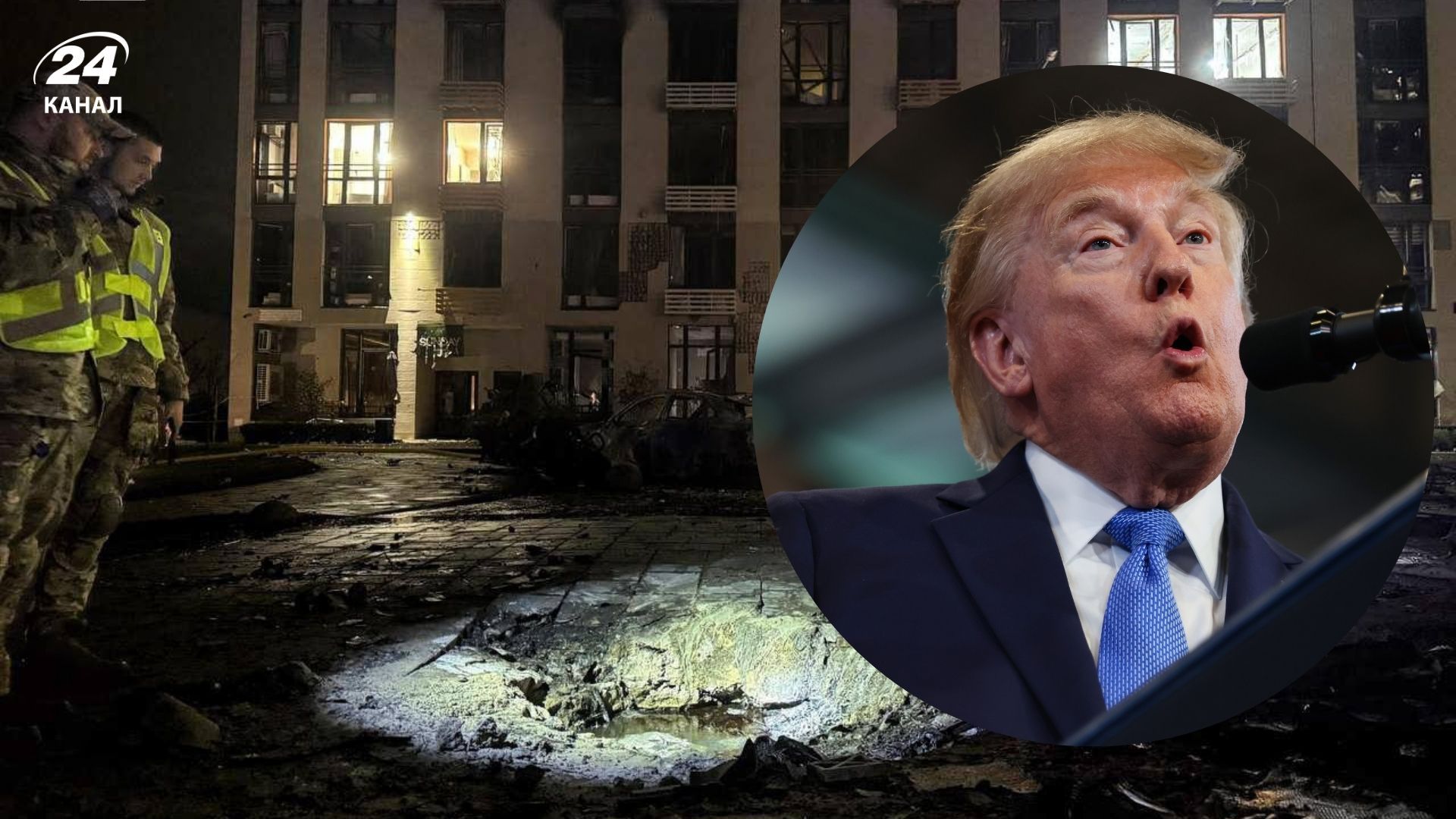


On October 10, the Financial Times reported that the U.S. is once again threatening to suspend the exchange of intelligence with Ukraine, allegedly to force our country to stop strikes on Russian oil refineries.
Against this backdrop, on October 12 at 10:10 p.m., Russia launched a ballistic missile attack on Kyiv. The air raid siren sounded late, so afterward, a number of Telegram channels began spreading information claiming that “this was linked to the suspension of intelligence sharing with the U.S.”
This incident highlighted several issues at once: Ukraine’s dependence on its allies’ technological capabilities, the political nature of military support, and the vulnerability of the information space to unverified conclusions. However, it is important to distinguish between two questions here: Is Washington truly prepared to change the terms of cooperation, and what consequences will this have for Ukraine’s ability to detect Russian attacks in advance?
Channel 24, together with experts, examined what happened on October 12, why Donald Trump is applying this particular kind of pressure on Ukraine, whether our country will be left without intelligence data from its partners, and why such an attack on the capital was nothing new. Read the full article for details.
Trump’s Threats and Russia’s Strike on Kyiv – Is There a Connection?
The issue of a possible suspension of U.S. intelligence sharing became one of the main topics on October 12 against the backdrop of yet another round of chaotic actions by the Trump administration.
On his Telegram channel, presidential adviser Serhiy “Flash” Beskrestnov seemed to sum up the discussion by stating that one component of U.S. intelligence is information about the launches and preparations for the launch of ballistic missiles.
“Flash” emphasized that the primary concern here is the safety of the civilian population, so that people have time to take shelter. That is precisely why, in the expert’s opinion, the U.S. will not carry out its threats, if they ever actually existed.
“You can call me an optimist, but I don’t believe (I don’t want to believe) that the U.S. would leave us without this information,”
he emphasized.
This post went out at 8:39 p.m. Kyiv time, and by 10:10 p.m. Kyiv time, Russian missiles had already struck, yet there were no warning signals.
According to the Ukrainian Air Force, enemy targets were detected by radar only during the attack itself, as no prior information about launches from enemy territory had been received. This is because, in such situations, the speed at which information spreads can outpace the speed at which the facts are established.
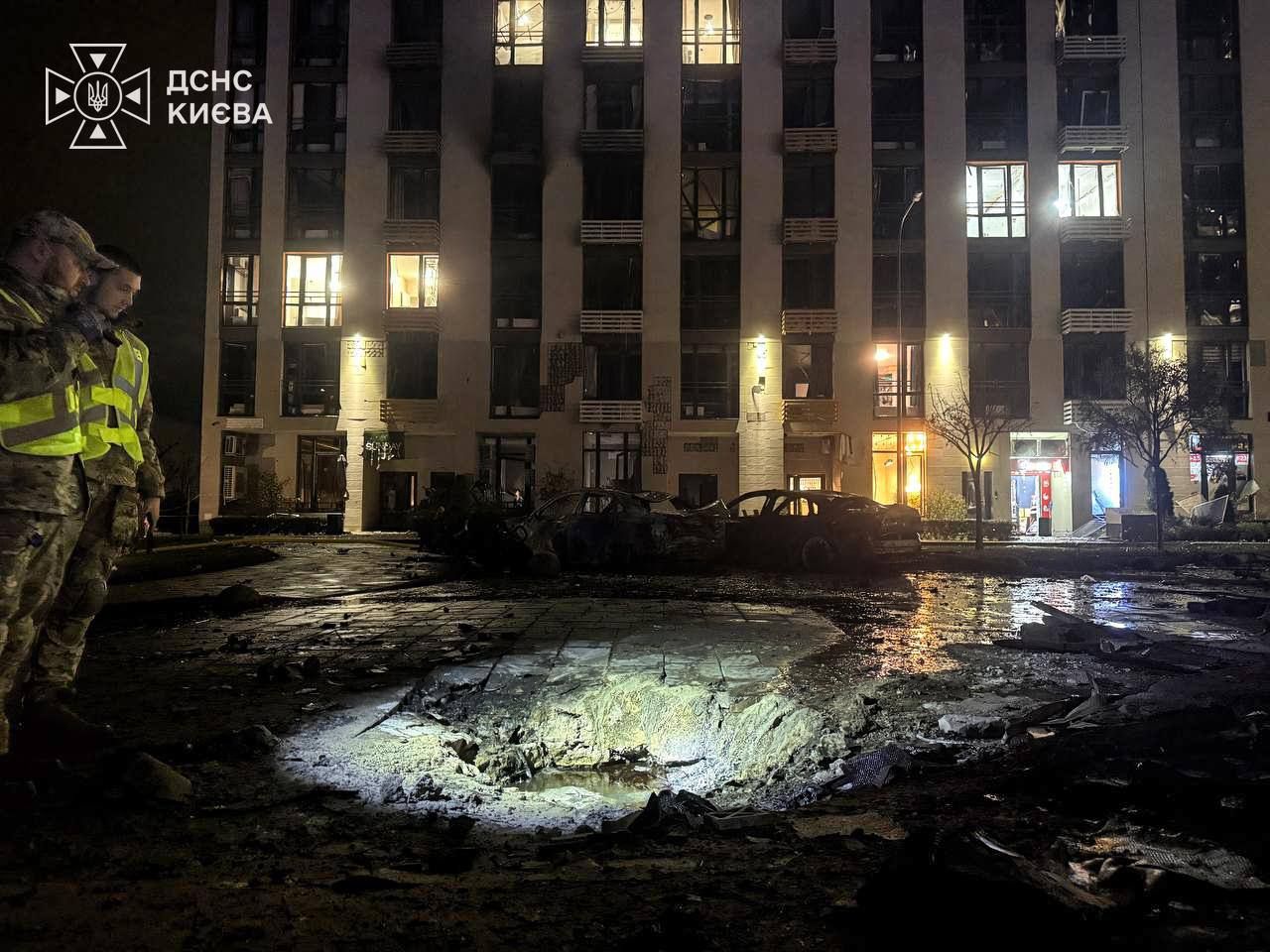

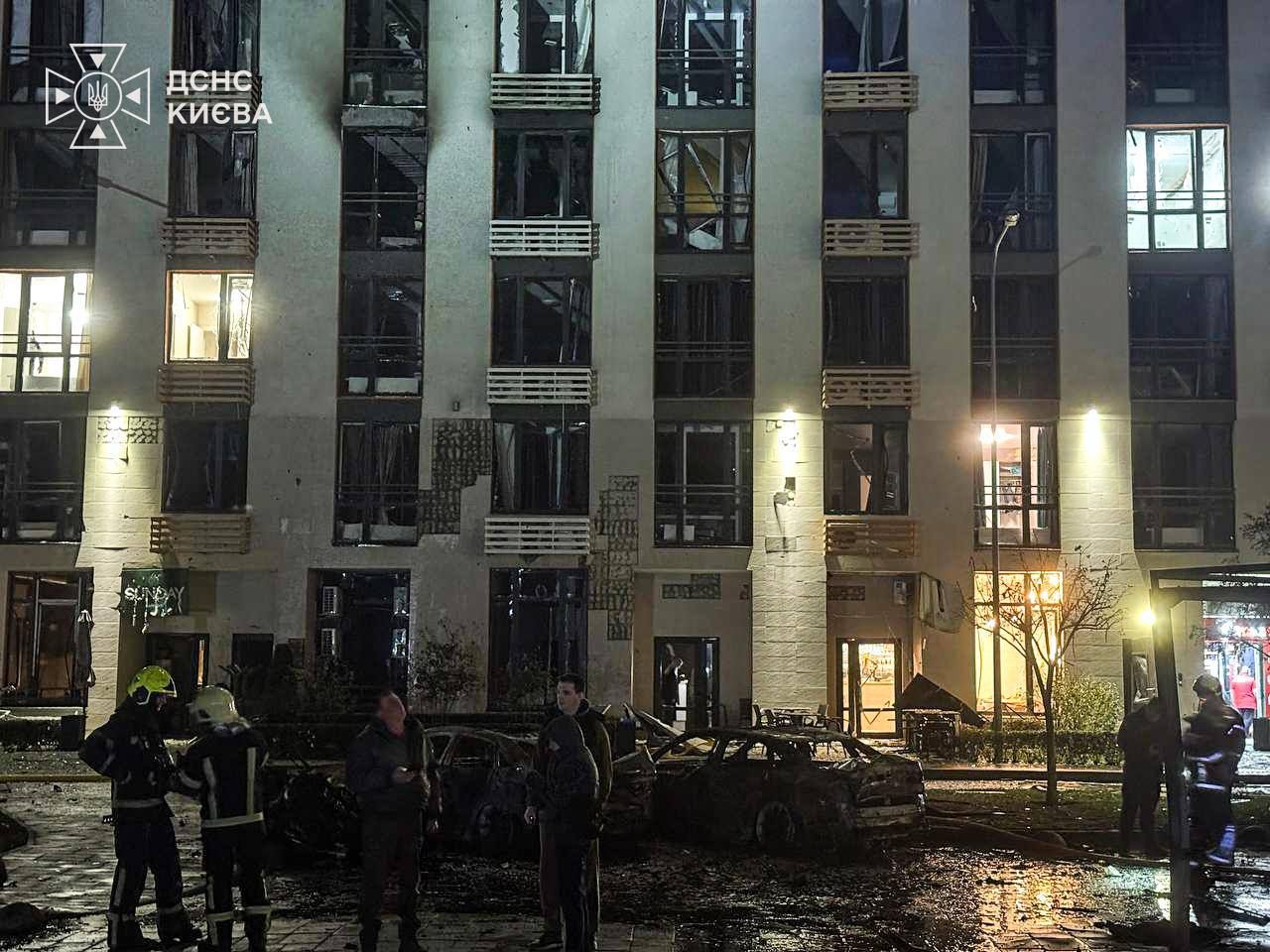
Consequences of the attack on the capital / Photo by Kyiv State Emergency Service
This inevitably sparked a new wave of online discussion and speculation regarding the suspension of U.S. aid. After all, this had already happened – in March 2025.
In response to the wave of social media posts, the Center for Countering Disinformation urged people not to spread unverified claims and to wait for official announcements, and the former head of the Center immediately wrote on his page: “Don’t spread rumors about ballistics and the lack of an alert because ‘intelligence data was taken.’ It’s not true.”
Indeed, it’s important to understand that “later” doesn’t always mean “as a result.”
Military expert, Lieutenant General, and founder of the “Let’s Close Ukraine’s Sky” charitable foundation, Ihor Romanenko, commented on the use of S-400 anti-aircraft missile systems in their ballistic configuration to strike ground targets.
According to him, Ukrainian systems detect such launches with a delay, when the missiles are already in the air. In the expert’s view, the warning time can be influenced by the technical characteristics of the weapons, the specifics of their launch, and the capabilities of radar detection.
U.S. intelligence data has been instrumental in helping Ukraine respond to these threats in a timely manner. But not this time. However, it is currently premature to claim that data from our partners is no longer being received.
Schrödinger’s Help
Foreign Minister Andriy Sibiga stated on October 13 that Ukraine continues to receive intelligence from the U.S., but did not explain why no alarm was sounded on October 12 during the shelling of Kyiv. So questions remain.
Political analyst Volodymyr Fesenko also noted that tensions in U.S.-Ukraine relations arose due to the U.S. side’s attempts to lower diesel prices ahead of the U.S. elections.
The Trump administration decided to groundlessly blame Ukraine and its strikes on Russian oil refineries for the rising cost of fuel. This is why there is now a risk that the sharing of intelligence data could be restricted. This cooperation is becoming not only a defense tool but also the subject of broader political and economic bargaining.
According to Fesenko, the U.S. is unlikely to stop providing satellite data on Russian ballistic missile launches, as this would lead to civilian casualties and place direct blame on Washington. However, they may temporarily restrict information that helps the Ukrainian Armed Forces carry out strikes deep behind enemy lines.
The United States Is Not the Only Partner
Even if Washington decides to scale back certain areas of cooperation, this will not automatically mean the end of all opportunities for Ukraine to obtain intelligence.
Military analyst Denis Popovich noted that this is not the first time Washington has taken such a hard line – a year ago, the U.S. briefly halted the transfer of intelligence data, and Ukraine cooperated with France in this area.
Now, even in the worst-case scenario, according to the military analyst, Ukraine will not be left “blind.”
French intelligence data cannot replace American intelligence. The U.S. has an extensive satellite system. Our situational awareness will be reduced, but, of course, without U.S. assistance, we will not be “blind,” Denis Popovich stated.
Meanwhile, aviation expert and leading research fellow at the State Aviation Museum Valery Romanenko noted on Vecher.LIVE that Ukrainian radar systems are capable of independently detecting Russian “Iskander” missiles at altitudes exceeding 40 kilometers. The early warning capability may indeed deteriorate, but our country will continue to be able to track the Russian threat.
At the same time, European allies – including Norway, France, and the United Kingdom – are working to expand their intelligence capabilities.
This is not the first time this has happened
Serhiy “Flash” Beskrestnov noted that this failure by partner intelligence services to detect launches – particularly of S-400 missiles – is not the first time it has happened and involves certain technical nuances.
He emphasized that it is not yet time to jump to premature conclusions about the effectiveness of monitoring.
Rob Lee, a senior research fellow at the FPRI, shares this view. He noted that there have been several previous instances where Russian ground-based ballistic missiles struck Kyiv before the air raid siren sounded.
The warning time in such cases is shorter than with air-launched missiles. This does not necessarily mean that U.S. intelligence has stopped receiving relevant information,
– he wrote on his “X” page.
In particular, the Telegram channel InformNapalm provided statistics on recent such incidents:
- January 14, 2023 – explosions in Kyiv occurred before the air raid siren sounded (the Air Force attributed this at the time to difficulties in detecting ballistic targets);
- November 11, 2023 – the situation repeated itself: explosions, then the air raid siren;
- January 18, 2025 – the first explosion in the capital also occurred before the air raid siren sounded;
- July 11, 2026 – the explosions began at 3:38 a.m., and the air raid siren was sounded at 3:40 a.m.
Yuriy Ignat, head of the Communications Directorate of the Ukrainian Air Force, also explained this situation in more detail to Channel 24. According to him, it is now necessary to de-escalate the situation and wait for information from experts who will determine all the circumstances.
Unfortunately, there are sometimes glitches in the warning system for various specific reasons – objective ones, I believe – which will be determined. Not only the United States is involved in providing us with this information, but also other partners from Europe. Therefore, there is no need to escalate or politicize this issue right now. Such incidents have occurred before, so I think we’ll wait and see until everything stabilizes,” Yuriy Ignat noted.
It should be noted that Volodymyr Zelenskyy stated that yesterday’s strike occurred due to a lack of warning from partners, but did not specify which ones. The president also did not elaborate on his statement or reveal what caused the lack of warning – whether it was ill will or the fact that on the evening of October 12, the Russians managed to outmaneuver the Defense Forces and our allies by taking advantage of a unique combination of factors.
Washington is not mentioning an important detail
Amid reports of possible restrictions on intelligence sharing by Washington, it is important to understand that intelligence cooperation between Washington and Kyiv is not merely charitable aid from Donald Trump or his administration.
Political analyst Volodymyr Fesenko noted that the United States is critically dependent on the unique data it receives from the Ukrainian side. This aspect is often overlooked when the discussion boils down to what exactly the United States is providing to Ukraine.
In exchange, we provide the Americans with large volumes of intelligence information. Specifically, regarding the effectiveness of Russian strikes, certain types of Russian weapons, the use of American weaponry, and the application of artificial intelligence programs for military purposes,
– Fesenko explained.
If this process were one-sided, the United States could much more easily resort to blackmail or completely suspend the transfer of data. The loss of Ukraine’s unique intelligence would then deal a serious blow to the analytical and military capabilities of the U.S. itself.
For now, we must wait for official explanations regarding the circumstances of the attack on Kyiv and Washington’s next steps. At the same time, this situation serves as yet another reminder of how important it is for Ukraine to develop its own intelligence capabilities and strengthen cooperation with its European partners.