
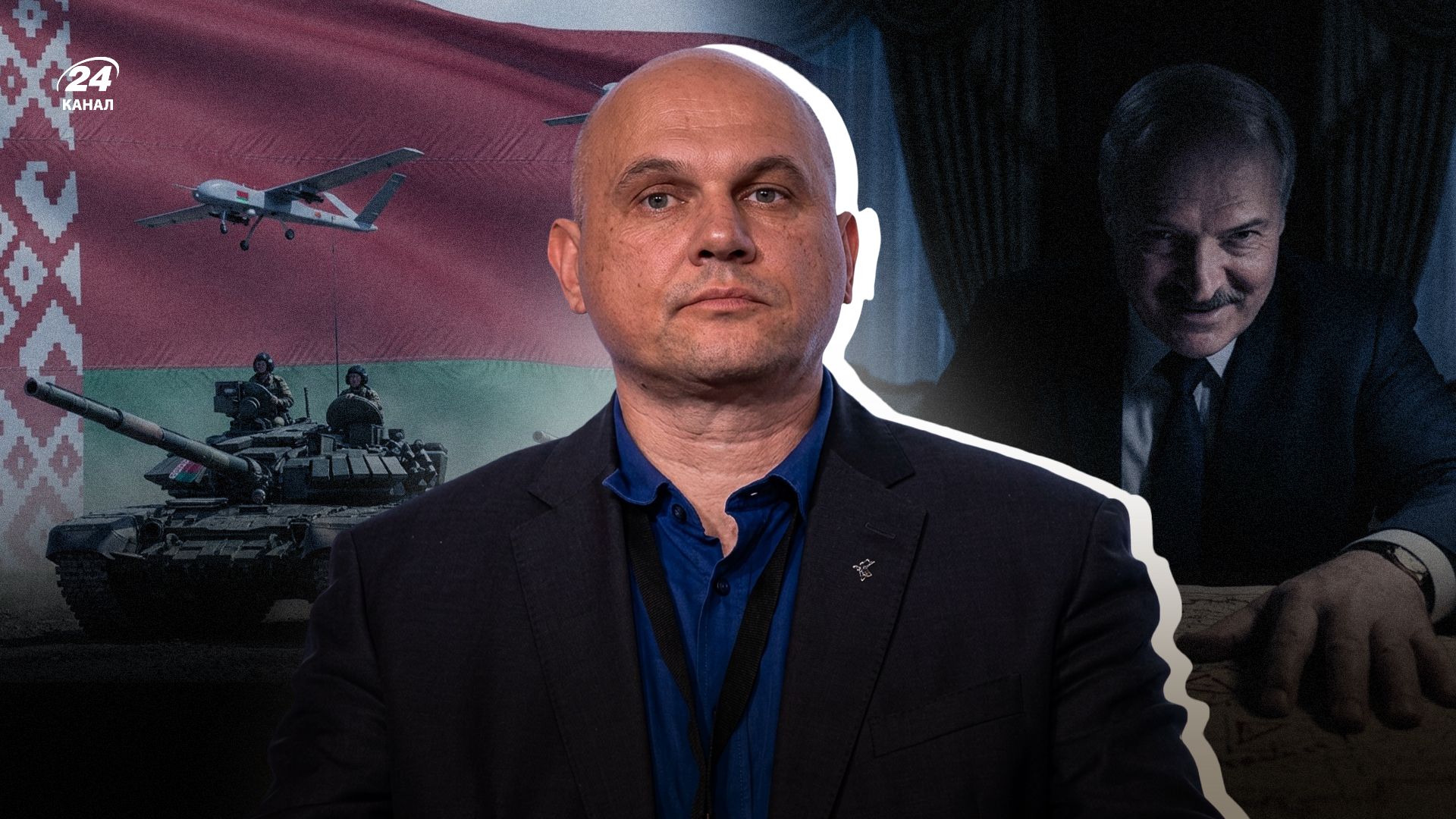


Belarus is being drawn ever deeper into Russia’s military plans, and its army risks losing its independence for good. Minsk is ramping up military production, while migration pressure on European Union countries remains a tool of political blackmail.
Vadim Kabanchuk, a representative of the United Transitional Cabinet of Belarus on Defense and National Security, explained in an exclusive interview with Channel 24 what lies behind the new CSTO exercises, why the Belarusian military-industrial complex could reach maximum production capacity by 2027, and whether the regime is preparing a new escalation along its western borders.
CSTO exercises and the scenarios being rehearsed in Belarus
New CSTO exercises are underway in Belarus, involving more than 1,500 military personnel, hundreds of pieces of equipment, and drones. What scenarios are the participants rehearsing, how is the war against Ukraine affecting the training, and do these maneuvers pose a threat to neighboring countries, and how does the war against Ukraine affect the preparation?
The stated goal of the exercises is to conduct peacekeeping operations. A rather diverse contingent of forces and equipment from five countries has been assembled there.
The most important thing will be to observe, after the exercises conclude, whether the Russian units that were brought into Belarus will remain in Belarus itself or whether they will withdraw back to Russia.
Of course, we can’t let our guard down, because everyone remembers how, under the guise of ongoing exercises in 2021–2022, they concentrated a strike force that later launched an offensive against Ukraine.
What does the fact that the police are involved alongside the military tell us? That this is not a peacekeeping operation or training to secure territory, but perhaps the suppression of a protest?
Obviously, yes – they are practicing interagency coordination, because for the Belarusian regime, “such exercises ” always follow a dual-track principle.
The first is the buildup of force, projecting that force onto the region, and testing combat readiness.
And second, they always take into account the aspect of suppressing internal unrest – as they put it, suppressing internal discontent within Belarus itself. To this end, given the lack of consistent loyalty from the armed forces and the population, Lukashenko is forced to constantly test the readiness of his personnel to carry out such tasks.
Participants in the CSTO exercises / Tg: Ministry of Defense of the Republic of Belarus

And on that developed infrastructure within Belarus – which has been prepared for this purpose – will Putin be able, not only in theory but also in practice, to deploy a large military force or mobilize Belarus’s active military reserve on short notice?
Yes, they are currently preparing the infrastructure and logistics and standardizing rail transport. We know that right now, for example, for some reason there is a shortage of rail platforms for transporting large-scale equipment.
There is a certain reserve capacity, and we know that they have strengthened the command structure of the Belarusian railway system, taking into account the experience of 2022, when Belarusian citizens blocked the movement of trains in several areas.
They now have the capability to rapidly redeploy forces and equipment from Russian territory into Belarus. Belarus’s mobilization capacity is estimated at 200,000 people.
And there are varying deployment times for special operations forces. It ranges from just a few days to four days. Territorial defense forces take the longest to deploy – about 30 to 40 days. In principle, Lukashenko could mobilize a significant force within a month to a month and a half.
Full interview with VadymKabanchuk: watch the video
How Minsk is drawing on Russia’s experience in the war against Ukraine
To what extent is the experience of the Russian-Ukrainian war being utilized during these CSTO exercises? What do you know about this? In what context? Is it specifically new drone technologies or maneuver warfare?
Yes, certainly, the Belarusian side is closely observing the military experience. Moreover, thousands of Belarusians are integrated into the Russian troops participating in the so-called “special military operation.”
Some are not entirely there of their own free will but were simply seconded by special agencies of the Republic of Belarus. They are conducting monitoring, gaining experience, and this experience is then implemented in the Belarusian armed forces.
For example, after the start of the full-scale war, we observed that so-called “mangals” began appearing on military equipment. They incorporate lessons learned from the use of unmanned systems in combat. They incorporate lessons from electronic warfare, and they continue to provide a certain amount of intelligence and logistical support to the Russian forces on an ongoing basis.
But could Moscow now be using such exercises to keep our forces tied down in the north?
Yes, they are certainly using this now. For example, on the Belarusian side, there are about a thousand military personnel stationed there on a rotational basis. They are constantly being rotated in from various units, mainly special operations forces.
We know that the Russians are currently carrying out, for example, strikes from the north, and their drones continue to fly along the Belarusian-Ukrainian border. Some of them are also entering the western part of Ukraine.
There is a map from open sources showing the coverage of relay stations installed on Belarusian territory. This coverage spans a significant portion of Ukraine’s territory and facilitates the delivery of strikes.
Are the repeaters currently operational?
I’m basing this on reports from Ukrainian border service sources, which indicate that yes, the repeaters are operational.
What are Minsk and Moscow planning?
And what does the division of authority between Minsk and Moscow look like now in military matters? Does Lukashenko still have any influence at all in such decisions?
Undoubtedly, after February 24, 2022, it’s clear that Belarus has lost its military sovereignty. We know that Lukashenko was playing the role of a clown, that he no longer has any influence there, and that Russian troops were returning home and decided to pass through Ukraine.
But seriously, there is information that in 2022 there was joint operational command. Russian military personnel were present at the General Staff of the Republic of Belarus.
They had been coordinating their actions long before this February attack, and preparations had been underway for at least half a year prior to February 2022.
Alexander Lukashenko has declared his readiness to cooperate with Poland, Lithuania, and Latvia, linking economic ties to the possibility of avoiding war. What is really behind these signals from Minsk, and is Lukashenko trying to break out of isolation and cement his role as a guarantor of regional security?
Yes, he is, as usual, playing both sides between the West and the East, trying to maneuver, but lately he hasn’t been very successful at it.
Everyone understands that he has extremely limited options for getting out of this situation, into which he has driven himself – and worse, has effectively driven all of Belarus under a military protectorate by Russia.
Yes, he may realize that there will be negative consequences for him if the crisis escalates, but there is practically nothing he can do about it anymore.
How can we prevent Lukashenko from securing a relaxation of sanctions in exchange for empty promises, while he continues to pose threats to neighboring countries? What measures – ranging from tightening sanctions to strengthening borders and countering migration pressure – could be effective?
In fact, Belarus shares a 2,300-kilometer border with Ukraine and NATO countries, and it poses a problem for all countries in our region.
Accordingly, we must respond jointly to this threat; we must coordinate our efforts; and we must have a rapid exchange of information in order to counter these provocations.
We are now seeing that their activities are escalating. They have activated their sleeper agents and are using one-time operatives to create tension in European Union countries. And we are seeing a number of signs that these migrant attacks will intensify.
Unfortunately, according to my information, I’ve seen reports here and there that sabotage groups – and they’re even wearing uniforms – are periodically attempting to break through in the Chernihiv region and elsewhere. Is this also some kind of test or preparation for something bigger right now? What do you know about this?
In fact, they have now intensified the pressure on European Union countries. Let me remind you that the migrant influx has been going on for several years now.
Periodically, this has taken on very serious forms, such as the attempt to breach the border toward Poland, when about 800 migrants gathered at a single point. A Polish soldier, a border guard, was killed there.
But last week, there was an incident on the Latvian border, where an armed group entered from Belarusian territory, destroyed several cameras, and all of this was accompanied by a disinformation campaign to cover it up. In fact, they carried out a classic false-flag operation.
And according to our information, there is now, for example, a so-called “double border” along the route toward Latvia: the Belarusian side has retreated slightly inland and erected a second, so-called fence, behind which our Belarusian security forces are stationed.
And in the neutral zone between these two fences, they They are releasing undocumented immigrants have placed illegal migrants, most of whom now hold Russian visas. In other words, this is a planned operation; they are being brought in from the Middle East and Africa.
And in the conditions of an autumn forest, these people simply cannot physically survive there for more than a couple of days. They are forced to attempt a breakthrough. They are no longer allowed back into Belarus.
Returning to the incident we witnessed, Latvian authorities reported that migrants were aggressively escorted by armed individuals from the Belarusian side, which resulted in damage to border infrastructure. Do you think such incidents might become more frequent in the near future?
Yes, as I’ve already said, there are a number of indicators suggesting they are preparing for more active attacks, because, for example, they have now started digging tunnels along the Latvian border. This is something they previously did along the Lithuanian border.
It’s entirely possible that this could be used not only to smuggle migrants but also for further military operations, should they decide to do so.
And, as I said, they have effectively resorted to such aggressive tactics as the incursion of groups of people into NATO countries – something that did not happen before.
They are taking advantage of certain loopholes in European legislation. For example, I was surprised to learn that Latvian border guards are not allowed to use firearms in such cases and require special permission. They are now rushing to amend their national legislation.
Recruitment of Agents and the Participation of Belarusians in the War on Russia’s Side
In Warsaw, you presented an initiative to counter the recruitment of Belarusians by Russian and Belarusian intelligence services. Why was a separate countermeasure mechanism needed, how is the scale of recruitment changing, what methods do the intelligence services use, and how can one protect oneself from these threats?
Well, in fact, they work with the Russian émigré community in Europe; they operate through messaging apps – mainly Telegram – and social media, typically targeting émigrés who are not entirely legally savvy or those in difficult financial situations.
And there, for literally a pittance, they can recruit so-called “one-time agents” who – either voluntarily or under blackmail – carry out what are initially minor tasks, but if they don’t get caught, they move on to more complex ones.
And we see that both our fellow citizens and other refugees and emigrants from other former CIS countries are falling into these traps.
And what most often leads a person to fight on Russia’s side in the war, if they’re not from Russia? Is it money, conviction, or deception?
Practically everything you listed plays a role here. No more than 10% go for ideological reasons – for example, from Belarus.
Most are labor migrants from the eastern regions of Belarus who were already working in Russia on various construction sites and the like. And this environment is conducive to the spread of rumors about easy money in the so-called “special military operation.”
And, of course, these rumors are always accompanied by false claims that you’ll be serving as a driver or handling logistics, and so on. But the truth is that 80% of them end up in assault units right away.
And, as a rule, their first battle turns out to be their last. Well, the survival time for a Russian assault soldier in the heat of battle is only a couple of dozen minutes. Of course, no one shares this information with potential victims.
During our previous conversation on September 29, we discussed the development of military logistics in the Suwałki Corridor area, particularly the railway and warehouse infrastructure. What has changed since then? Have any new problems arisen, and how far along are preparations for the rapid deployment of troops and equipment to the region?
We’re simply observing a trend: they’re expanding all of this and building new logistical capabilities for the rapid deployment of troops.
Our main task here is to monitor the situation and understand that all this infrastructure will, in fact, be used by the Russians at some point. And perhaps only Putin himself knows when that moment will come – if he decides to spark a new regional crisis.
In that case, Lukashenko will simply fall in line. They will carry out whatever orders come down from Moscow.
We discussed back then that this was infrastructure preparation in the Suwałki corridor for 2027. Has anything changed?
There is information that the Belarusian military-industrial complex, which currently operates primarily in Russia’s interests, is set to reach maximum military production output precisely in 2027.
Accordingly, a number of other indicators suggest that they are preparing for a crisis specifically in 2027. But we cannot say at this point that an attack is inevitable, or that it will be an attack like the one they launched in 2022.
This is because warfare has changed, and they have developed new methods, such as a wide variety of drones and cruise missiles, among other things.
That is why it is necessary to monitor the situation, and Western countries must strengthen vulnerable areas, particularly the Suwalki Corridor, because if it is cut off, the three Baltic countries will effectively be isolated from the rest of the NATO alliance, and they are banking on the fact that, in this isolation, the rest of the NATO alliance will be unable to help.
Is there a risk that Russia and Belarus will attempt to cut off the logistical routes through which NATO countries transport aid, in order to prevent it from reaching the region?
This is exactly what Russia is doing, for example: it is constantly testing Europe’s so-called limits, and they are expanding this “gray zone” of what is permitted, walking a fine line to avoid triggering consultations on the invocation of NATO’s Article 5.
And in principle, Putin has no intention of going to war with NATO as a whole. He intends to take Europe apart one country at a time.
In fact, they’re doing this through blackmail or bribery. If, for example, two drones flying into Latvia trigger a government crisis and the defense minister resigns, well, why shouldn’t they keep doing this? And, for example, try launching 20 drones, and then 200 drones.
Belarusian Volunteers in Ukraine
As for forming a Belarusian drone company, you mentioned that this could mark the beginning of a drone corps within the new Belarusian army, correct? Why is this area becoming a priority, based on our experience?
Yes, our volunteers have been in Ukraine since 2014, but this is probably the first time we’re talking about creating a Belarusian unit that will operate at medium and long ranges.
This is a new field for us, a new experience, because the young men and women who previously fought as part of an international legion were essentially infantry – light infantry.
Our guys there also operated small tactical-level drones, such as the Mavic or FPV. But these drones allow us to significantly expand the unit’s combat capabilities.
And we’re talking about this innovative unmanned systems battalion, in which a Belarusian company is currently being formed. I hope that everything goes well there and that we’ll continue to scale up.
And what does the opportunity for Belarusians to hold officer and sergeant positions change? How important is this for training our own command staff?
Yes, absolutely. Ukrainian legislation already allowed for the appointment of foreigners to sergeant positions, but now, as I understand it, there is the possibility of partially filling officer positions, even if the person is not an officer in the Armed Forces of Ukraine.
Of course, all of this requires completing certain training courses, especially since the work involves the use of complex unmanned systems that require high-quality training.
The fact is that we already have some people who came from Europe and previously served, for example, in the Belarusian Armed Forces. And we even have some officers from various branches of the military.
Some have even come from the police or the Internal Troops. After all, these people have dedicated part of their lives to the army and military service. They understand what it’s all about. With that experience, it’s much easier for them to integrate into the Armed Forces of Ukraine.
What are the main challenges facing Belarusian volunteers today?
Unfortunately, these are mainly related to paperwork and social issues – specifically, legal status.
After all, I understand that Ukraine is at war for its independence. And on our part, we have no serious complaints against the Ukrainian side, because we understand the difficult conditions under which Ukrainians are operating.
And, for example, the process of vetting our people is currently taking a very long time, but at the same time, when a person gains access to serious programs and training, we understand that this is a necessary procedure.
Of course, we would like to see changes to Ukrainian laws so that, for example, the issue that is most painful for us – when fallen soldiers’ families cannot receive compensation because they are citizens of Belarus – can be resolved.
And this is an issue we have not been able to resolve since the start of the war. Let’s hope it will be resolved step by step.
This interview has been condensed, corrected, and edited for better understanding by the audience.