
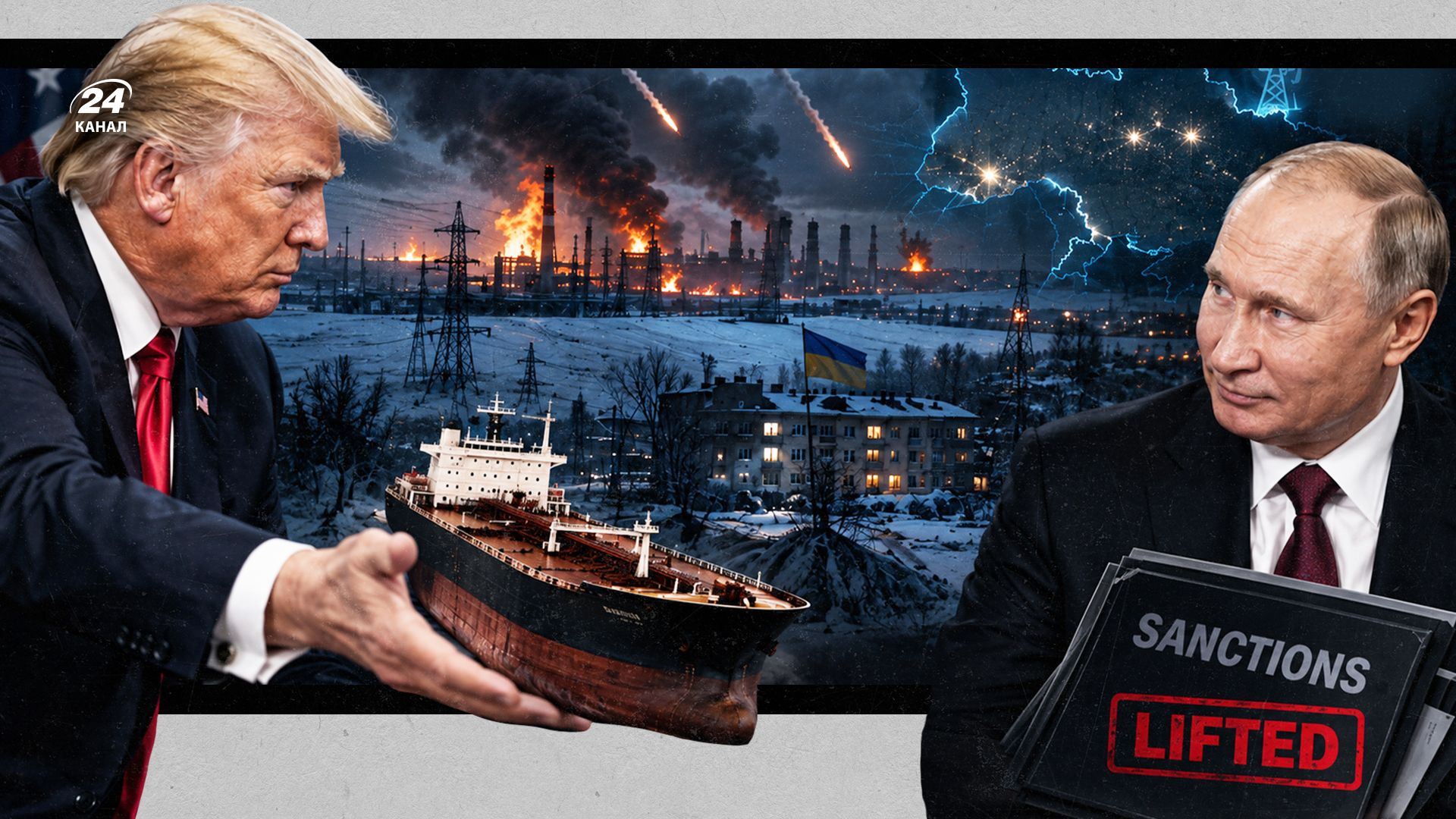


Donald Trump continues to seek an agreement with Russia, offering to ease sanctions and make economic concessions, but the Kremlin shows no willingness to end the war. At the same time, Ukraine is facing delays in the delivery of missiles for the Patriot system, problems with Starlink, and concerns about receiving timely warnings of Russian ballistic missile strikes.
In an exclusive interview with Channel 24, political analyst Volodymyr Fesenko explained what interests might be behind the U.S. president’s controversial decisions and why these concessions are not bringing peace any closer. He also assessed the risks of new restrictions on military aid to Ukraine, the impact of protests in the U.S., and Putin’s intentions to negotiate a new division of spheres of influence with Trump and Xi Jinping.
Energy Concessions to Russia
Trump accuses Zelenskyy of being unwilling to end the war, while the U.S. is easing sanctions against Russia, delaying military aid to Ukraine, and demanding an end to strikes on oil refineries. Is all of this related to the approaching U.S. elections?
If you look at all these decisions together, it does indeed seem as though Trump has sided with Russia and is trying to force Ukraine to end the war on Russia’s terms. However, I hold a slightly different view. Each of these cases has its own logic, and not everything can be explained by a single motive.
First and foremost, we need to understand that Putin has no intention of ending the war against Ukraine right now. He believes he can win it and continues to intensify his attacks. In the coming months, in my opinion, he will not engage in any real negotiations – not even about ending the war on his own terms.
One reason is that Trump is willing to negotiate with him without a prior cessation of Russian hostilities. Putin sees this willingness and perceives it as an additional opportunity to continue the war.
But not all the problems with U.S. aid stem from a desire to pressure Ukraine. For example, the situation with Patriot missiles is largely due to a shortage of them.
The Americans produce about 60 interceptor missiles per month, possibly slightly more now. Under certain circumstances, that quantity might not even last a week for Ukraine. This shows just how high the demand for these missiles is.
The U.S. keeps most of what it produces for itself or sends it to the Middle East. Fighting continues there between the Houthis and Saudi Arabia, and the risk of a new escalation between Iran, the United States, and Israel persists. Therefore, at best, Ukraine will receive only a few missiles.
There is also the issue of Greece, which has some stockpiles of older Patriot missiles but has not yet agreed to sell them. Therefore, the situation regarding missile supplies is much more complicated than simply a political decision by Trump.
It’s a different story with Russian diesel fuel, oil, and the shadow tanker fleet. Here, American economic interests, the election campaign, and attempts to reach an agreement with Russia are all intertwined.
It is now very important for Trump to lower prices on oil and petroleum products. At least until November 3, this directly affects his political interests and the Republicans’ standing ahead of the congressional elections.
He hopes that even a short-term drop in diesel prices – even if only for a few days – can be presented to American voters as a success. However, the issue is not limited to the elections alone.
Trump wants to influence the global oil market. It is important for the U.S. economy to stabilize energy prices and curb inflation. And here, he thinks first and foremost like a businessman.
His calculation is that easing sanctions against Russia will allow for an increase in Russian oil supplies to the global market. If supply increases, prices may fall. At least, in my opinion, this is the logic being used in the White House.
Moreover, this is linked to the situation surrounding Iran. War and instability in the Persian Gulf are creating serious problems for the oil market. If the U.S. continues its oil blockade of Iran, Tehran may respond with restrictions that will affect exports from other countries in the region as well.
This raises the question: where will the oil come from? Trump believes that Russian supplies can make up for part of the shortfall.
The same logic applies to the shadow tanker fleet. There is currently a shortage of tankers, and their charter rates have risen significantly. Therefore, the U.S. administration likely expects that easing sanctions will increase the number of available vessels and help reduce transportation costs.
But there is another important story related to the energy agreement being promoted by Steve Witkoff and supported by Trump. As far as I know from reports by American journalists, it was Witkoff who proposed making Russia’s return to the European energy market part of a possible peace agreement.
Here, we must take into account the situation in Europe itself. European countries have almost stopped buying Russian pipeline gas but continue to import liquefied natural gas, in particular through international companies with Russian capital.
According to the information I have, such purchases have even increased this year compared to last year. Europeans would like to completely abandon Russian energy sources, but the problem of finding replacements arises.
Dependence on American gas has increased, but there isn’t enough of it to meet all needs. Supplies from Qatar are also significantly limited due to the situation in the Persian Gulf.
Therefore, the economic interests of individual countries sometimes take precedence even over security and political considerations. Europe continues to assist Ukraine with money and weapons, but at the same time buys Russian gas because it is needed in the winter.
We face a similar paradox here. Ukraine receives mostly American gas, but some of the diesel fuel we purchase from Europe or Turkey may be of Russian origin.
As for Witkoff’s plan, his idea is to combine economic and political interests. Russia’s return to the European energy market and the possible return of some of the frozen Russian assets are viewed as a kind of bonus for Putin in exchange for ending the war.
But there is a fundamental problem here. Russia does not currently want to end the war; it wants to win it. Moreover, the Kremlin perceives the U.S. as willing to make concessions. Why, then, would Putin agree to any compromises?
In my opinion, the main mistake made by Trump and Witkoff lies in the strategy they’ve chosen. Unilateral concessions do not bring an end to the war any closer; on the contrary, they encourage Putin to continue hostilities and demand further concessions from Ukraine and Europe.
But for Trump, ending the war is not the only priority. He promised to bring about peace and wants to present this as his own achievement. At the same time, I see another motive: the desire to reap economic benefits from the agreements in which he acts as a mediator.
This logic can be seen not only in relation to Ukraine but also in his approaches to Palestine, Iran, Azerbaijan, and Armenia. Trump is trying to combine peacemaking initiatives with economic projects.
In the case of Russian gas, this could involve the creation of a consortium involving American participation. Some 20 years ago, the idea of a gas transportation consortium was already being discussed. It was criticized at the time, but now a similar model could return in a different form.
Under this plan, American companies could gain control over part of the gas transportation infrastructure in Europe and the export of Russian gas. They would act as operators or intermediaries and receive a share of the profits.
In other words, the gas would remain Russian, but it would technically be sold by the Americans. A portion of the proceeds could supposedly be directed toward the reconstruction of Ukraine, as well as Russia.
I have many questions about the feasibility of such a plan. But, as far as I understand, the American side is indeed trying to promote such ideas.
The main obstacle isn’t even the economic mechanisms. I am absolutely skeptical about the possibility of a peace agreement being reached in the near future, because Russia shows no willingness to end the war, even under the terms currently being offered by the Americans.
Pressure via Starlink and Intelligence Data
Zelenskyy stated that the U.S. is holding up Patriot missiles that have already been paid for. Is this just a shortage, or is it also a way to put pressure on Ukraine?
The problem is that missiles are currently being withheld not just from Ukraine. The Americans keep most of what they produce for themselves or send it to the Middle East. Everyone else receives missiles on a first-come, first-served basis, and so do we.
I don’t rule out that there may be a certain political motive here. But right now, I don’t consider the delivery of Patriot missiles to be the main tool for exerting pressure on Ukraine.
Of course, every interceptor missile is important to us. However, a few missiles a month cannot radically change the situation with our air defense.
It would be far more important to reach an agreement with Greece. By my estimates, there could potentially be up to 200 missiles there that could be negotiated for transfer. Even if we managed to obtain 100, that would already be substantial assistance.
So far, we haven’t been able to reach an agreement. And that remains a separate issue.
However, I see more immediate pressure from the U.S. administration regarding Starlink, as well as, presumably, restrictions on satellite intelligence.
I do not rule out that the Patriot system could also be used as additional leverage. However, in this case, the main factor is most likely the U.S. desire to stockpile missiles for its own needs and for a possible new escalation in the Middle East.
Following the latest strikes on Kyiv, questions have once again arisen regarding the U.S. early warning system. Could the repeated Starlink malfunctions and delays in intelligence data be intentional?
Technical glitches can certainly happen. But when all these problems occur almost simultaneously, it starts to look suspicious.
We’re seeing speed limitations and service interruptions with Starshield, the military version of Starlink. And these issues have been recurring for at least a week. At the same time, there are problems transmitting information about Russian missile attacks.
Therefore, I do not rule out that this is not a coincidence, but rather a means of exerting targeted pressure on Ukraine.
At the same time, there is an interesting detail. The Americans are not completely shutting down either Starlink or the transmission of satellite data. The restrictions, as far as we can tell, are selective in nature.
Furthermore, the U.S. side officially denies that it is intentionally creating such problems. This is important because openly acknowledging the restrictions would trigger a new wave of criticism against Trump.
With the congressional elections approaching, the administration has no interest in additional scandals that could harm the Republicans. But we shouldn’t overstate Ukraine’s significance for the U.S. elections.
Here, we often think that the war in Ukraine is one of the main factors shaping U.S. politics. In reality, domestic issues are more important to most voters: diesel prices, inflation, and the overall economic situation.
Trump is already trying to use the Ukraine issue in his campaign rhetoric. For at least a week, his most radical supporters have been accusing Ukraine of allegedly deliberately striking Russian oil refineries to help the Democrats win the election.
This is already part of the campaign strategy. Therefore, I suspect that partial restrictions on military technology may also be linked to the White House’s political calculations.
But this is precisely where Ukraine has an opportunity to influence the situation. We need to engage more actively with American public opinion – and not just by arguing that such restrictions benefit Putin.
It is far more important to explain the humanitarian consequences. For example, the speed limitations of Starshield complicate the work of Ukrainian interceptor drones, particularly against high-speed jet drones.
If interception does not occur in time, Russian drones can reach their targets, which means a greater risk of civilian casualties.
The same applies to warnings about ballistic missile attacks. When information about a launch arrives too late, people may not have time to reach shelter. Therefore, the consequences of such restrictions are measured not only in terms of military capabilities but also in terms of human lives.
I think we need to emphasize this point specifically in the U.S. It’s not enough to simply say that such actions help Putin, since this argument doesn’t seem to sway Trump.
Instead, the issue of human life is tied to moral and religious values that are important to many Americans. Journalists, bloggers, representatives of Protestant communities, and the Ukrainian diaspora should be speaking out about this.
Unfortunately, our diaspora is not currently active enough in this area. Perhaps this is partly because there are Trump supporters among its members. But we must use all available channels to explain the humanitarian consequences of potential restrictions.
As for satellite intelligence, the situation is not entirely clear-cut. A representative of the Ukrainian Air Force reported that during the first wave of one of the attacks, there was no warning from partners, whereas during the second wave, a warning was received.
In addition, I read a report citing American sources stating that the U.S. had warned Ukraine in advance of a possible massive combined missile and drone attack within the next 48 hours.
But there is a fundamental difference between a general warning about a threat and operational intelligence regarding a specific ballistic missile launch. For Ukraine, it is precisely the second type of intelligence that is of crucial importance.
There is another issue to consider. Russia launches some of its ballistic missiles from regions bordering Ukraine, specifically the Bryansk and Kursk regions.
In such cases, the flight time may be as short as two, three, or five minutes. Even if the information arrives in a timely manner, the air raid siren sometimes sounds almost simultaneously with the strike. Such cases occurred as far back as this past summer, so not every delay can automatically be attributed to the actions of the U.S. administration.
And yet, I am inclined to believe that there is some targeted pressure from the Trump administration. That is precisely why, given the pre-election situation in the U.S., this issue must be publicized as widely as possible.
It is important that the American public – especially religious communities and voters for whom the protection of human life is a matter of principle – demand explanations from the White House.
Then the Trump administration will have to do more than simply deny the existence of restrictions; it will have to address their consequences and, possibly, abandon this practice.
The “No Kings” Protests and the U.S. Elections
On October 17, large-scale “No Kings” protests against Trump took place in the U.S. Could they influence the midterm congressional elections on November 3?
This is not the first such demonstration. A social movement has gradually taken shape in the United States that regularly organizes protests against Trump. Therefore, the current demonstrations cannot be viewed as a one-time outburst of discontent.
Right now, they are directly linked to the approaching elections. I think the Democratic Party can use this protest movement to mobilize its supporters.
But this isn’t just about people who traditionally vote for Democrats. There are many Americans without strong party affiliations who may have previously supported different candidates or not voted at all.
Now, some of these people are dissatisfied with Trump’s policies, so the Democrats will try to win them over.
The main source of dissatisfaction remains the president himself and his decisions. First and foremost are economic problems: record-high diesel prices, inflation, and other hardships that directly affect Americans’ daily lives.
Added to this are international issues. The war with Iran is not over, and Trump’s foreign policy is straining U.S. relations with other countries and undermining the trust of allies.
Of course, the United States’ international reputation is not the main concern for all American voters. But for a segment of society – particularly the middle class – the country’s standing in the world and its prestige also matter.
National diasporas may play a distinct role. Among their members, there are also many people dissatisfied with Trump, and this is yet another reason to engage more actively with such communities.
Therefore, the “No Kings” protests could become one of the factors influencing the course of the election campaign. On their own, they are unlikely to determine the overall outcome of the vote, but in certain states, they have the potential to help mobilize voters and influence the results of close races.
Putin Seeks a New “Yalta”
Putin wants to meet with Trump and Xi Jinping at the APEC summit in China, without the participation of Ukraine or Europe. Could such a meeting lead to a new division of the world?
In fact, this idea is not new. In Russia, the possibility of such a meeting has been openly discussed for nearly a month and a half, and it is the Kremlin that is interested in organizing it.
The first reports, as far as I recall, appeared back in August, and in September, various sources confirmed this information. The Russian side would like to hold trilateral talks on the sidelines of the Asia-Pacific Economic Cooperation (APEC) summit in China.
At the same time, Volodymyr Zelenskyy is proposing a different format: a meeting of the leaders of Ukraine, Russia, and the U.S. on the sidelines of the G20 summit, which, according to his plans, is scheduled to take place in December in the United States. But I doubt that Putin will travel to the U.S. for such an event. He is, however, planning to go to China.
There is a view that the main goal of a possible meeting between Putin, Trump, and Xi Jinping is to reach agreements regarding Ukraine. Certainly, the war may be one of the topics, but I do not consider it the main one.
For Putin, the symbolic significance of such a format is far more important. He has long dreamed of a kind of “new Yalta,” where the leaders of three influential states meet and agree on the division of spheres of influence in the world.
This idea has been on his mind for over a decade. He essentially wants to recreate the historic image of the Yalta Conference, where Stalin, Churchill, and Roosevelt met.
Putin wants to be seen as one of the leaders shaping the future of the world order. For him, this is a matter of Russia’s international status and his personal political prestige.
But the problem is that Xi Jinping has little interest in such a format. Why would he share influence with Putin when he can negotiate directly with Trump?
China and the U.S. view themselves as the two most influential powers in the world, capable of resolving the most important international issues between themselves. In this configuration, they do not necessarily need a third party.
The Americans, too, have not yet shown much desire to hold a trilateral meeting. After all, China and Russia have a partnership, so Trump would risk finding himself at the negotiating table facing two leaders who can coordinate their positions.
It is tactically more advantageous for him to hold separate talks with Xi Jinping and separate talks with Putin.
Moreover, a potential meeting would not be limited to discussions about Ukraine. There are issues regarding Taiwan, the division of spheres of influence in various regions, and other strategic disputes among the three countries.
Even if these negotiations take place, reaching an agreement will be extremely difficult. The interests of the U.S., China, and Russia do not always align, and dividing influence among several major powers has never been easy.
The experience of the Yalta Conference itself is also telling. Its participants were able to reach agreements, but about a year later, the Cold War began, and former allies effectively became adversaries.
Therefore, even a formal agreement among the three leaders by no means guarantees long-term cooperation between them.
For Ukraine, of course, there are risks. Putin would like to use such a meeting to persuade Trump and Xi Jinping to support ending the war on Russia’s terms.
But one shouldn’t assume that he is currently seeking merely some kind of peace agreement that would allow him to gain control of certain Ukrainian territories. Putin, in my opinion, wants a complete victory over Ukraine.
He is counting on being able to break Ukrainian resistance this winter, in particular thanks to concessions from the U.S. administration. Therefore, I do not rule out that his demands will be significantly broader than simply agreeing to the peace proposals that have already been made public.
At the same time, any agreements regarding Ukraine and European security cannot be implemented without the consent of Ukraine itself and the European states. This is a fundamental point that should not be forgotten.
Therefore, together with our European partners, we need to coordinate a common position in advance. And not just one universal option, but several scenarios for action.
To put it simply, there should be Plan A, Plan B, and Plan C.
The first scenario is needed in case Putin, Trump, and Xi Jinping do reach an agreement on certain decisions. We need to understand right now what our joint response with Europe will be and what steps we can propose in response.
Another scenario is needed if there is no trilateral agreement, but the U.S. administration continues to push the Witkoff plan, particularly its energy component.
Separately, we need to define our position regarding China and the possible formats for future peace talks. If the negotiation process comes to a complete halt, we need to have a plan for how to resume it – through which international forums and under what conditions.
Therefore, I do not consider the risks of a new meeting between the three leaders to be insurmountable. They exist, but so far they remain relative, and it is possible to prepare for them.
The main thing is that Ukraine and Europe should not wait passively for the Americans to propose yet another peace plan. We need to put forward our own initiatives, coordinate our proposals, and actively influence the position of the United States.
Fesenko on Trump’s concessions to Russia: watch the video