


 2
2 On October 9, Donald Trump announced an agreement on the supply of diesel fuel from Russia. At the direction of the U.S. president, the Treasury Department immediately issued a temporary license allowing Russian diesel fuel to be supplied to global markets. This White House policy sent shockwaves around the world and made clear the current U.S. administration’s stance toward the aggressor nation.
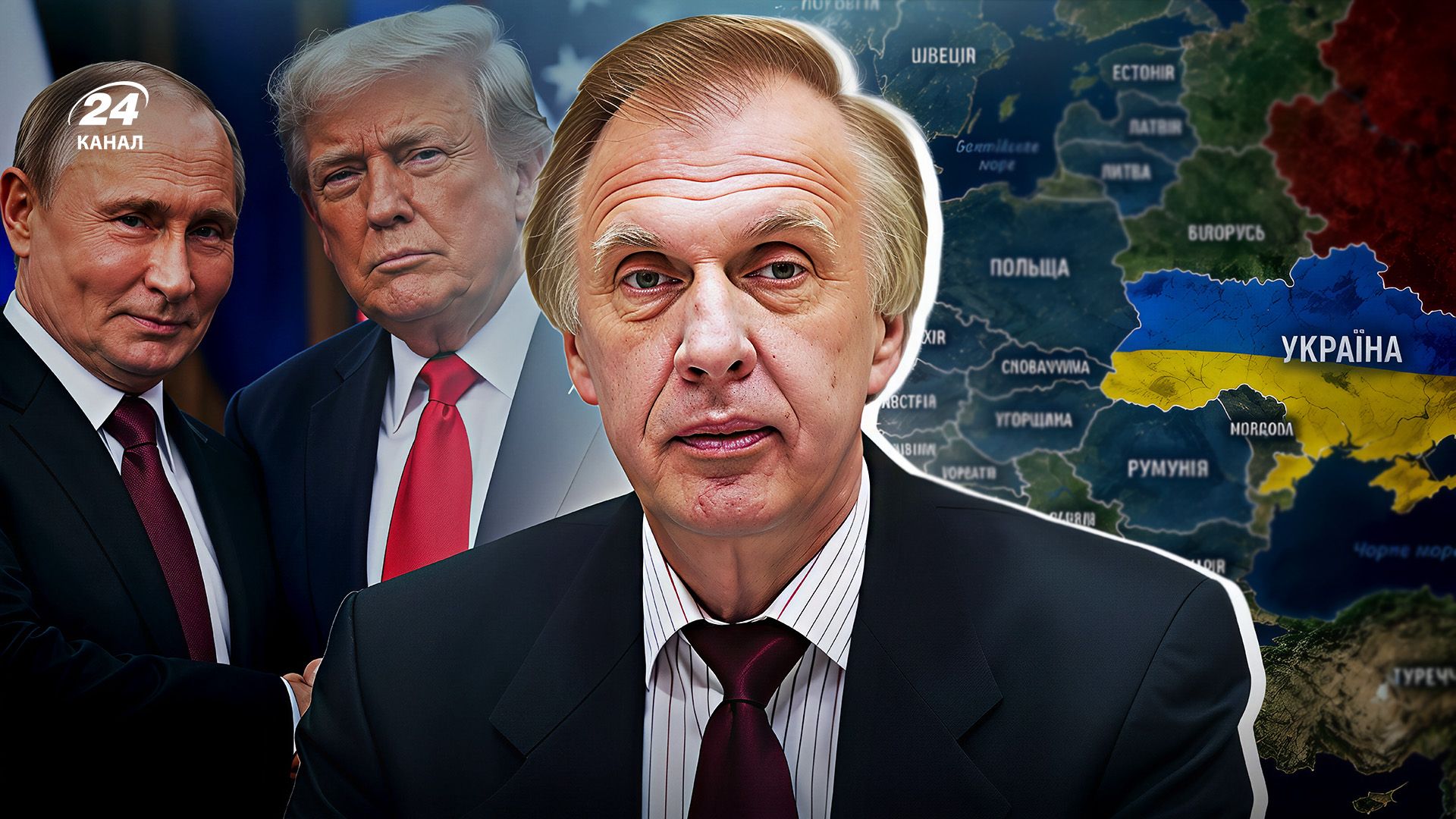
In an exclusive interview with Channel 24, Ukrainian diplomat and Minister of Foreign Affairs of Ukraine from 2007 – 2009, Volodymyr Ogryzko analyzed the cynical U.S. policy and explained why Donald Trump is not interested in exerting strong pressure on Moscow.
He also answered questions about whether Russia is capable of waging a full-scale war against Europe, why Europeans should set aside their fears of the Kremlin’s “legal aggression,” and how to compel the EU to transfer frozen Russian assets to Ukraine. Read more in the article.
What is Trump’s devious plan regarding Ukraine?
The White House now views the war in Ukraine as a threatening situation that can be resolved in two ways. The first is through diplomatic negotiations, which, clearly, aren’t working very well. The second is the path of escalation, which could obviously draw in more countries. In your opinion, what exactly has the United States realized right now?
It seems to me that President Zelenskyy answered that question very well, in response to this statement – perhaps emotionally, perhaps in somewhat heightened tones – said that this, to paraphrase his words, is cynicism.
It’s a double standard. It’s something that clearly cannot be called an alliance. It’s a version of what people simply call – pardon my language – meanness.
That’s exactly how I interpret it, because when you start talking about a diplomatic impasse, while supposedly helping Ukraine with one hand and doing business with Russia with the other, when you refuse to see what Russia is doing and continue to equate the aggressor with the victim of this aggression, then my assessment is this: it’s meanness.
This should not happen in international relations. But if we translate this to the human level, it’s simply such a despicable, cynical, utterly repugnant policy.
Full conversation: watch the video
There’s nothing we can do about it here, becauseRubio, unfortunately, is not a figure in his own right. He cannot articulate what he should, as Secretary of State and National Security Advisor, because he is directly under his “patron” (Trump – Channel 24). And as for the “patron,” we know how he views everything that’s happening in the world: cynically, with a hidden agenda, so to speak.
So we shouldn’t expect anything like that from Rubio. Although he has reached the point we’ve been discussing for months and months now.
To be sure, we’ve both said that there is no diplomatic solution to this situation. Why? Because we’re dealing with an aggressor who is still capable of waging war. The U.S., for its part, could easily put the aggressor in its place if there were the political will to do so. Especially now, when Trump holds in his hands such a massive, powerful weapon with which he could strike so hard that it would be unforgettable. And he could do so without losing a single soldier, a single bullet, or a single shell. He could simply impose real, tough, painful, and truly devastating sanctions.
Will Trump do this? My answer is no. Why? Because Lavrov has repeatedly spoken about this at sessions of the UN General Assembly, and because Ukraine is a thorn in Trump’s side – he wants to remove us from the path to Russia so he can start that very same boundless business.
So Rubio is simply telling us what has long been known. But he doesn’t ask what the Americans can do. He says, “No, of course, we’ll provide support.” Why will you only provide support? Is that so this aggression can continue? Or will you support putting the aggressor in its place?
That’s exactly how the question should be framed, rather than beating around the bush and saying, “We wanted to, of course, but it just didn’t work out.” What kind of stance is that for a country that claims to be a leader?
Is Russia capable of launching a full-scale war against Europe?
Recently, the threat to European countries has been growing. And now Europeans no longer dismiss this idea; they clearly sense the flames of war, which could spread to their own territory. In this situation, the question arises: Is the United States preparing for a possible confrontation on European soil, and how will it respond to this display of aggression on Russia’s part? And who can Ukraine count on – do we have the resources if we have to rely solely on ourselves?
My view – which I constantly reiterate – is that there will be no aggression. Why? Because Russia lacks the tools, forces, and means to carry out such aggression.
I recently heard a military officer say: “Our situation in the sector in the Donetsk region is as follows: on our side – one. On the Russian side – there are six.” In other words, the enemy has a numerical advantage in manpower. However, at the same time, he says: “Every day, 140 occupiers are killed, and there are countless wounded, maimed, and so on. So we’re defeating them not with numbers, but with technology – with what we’re capable of and already know how to do.”
And this numerical advantage, of course, matters, but not enough to change the situation on the front lines. This military officer also noted that Ukraine is currently working on the complete destruction of Russian logistics within a 200-kilometer radius. If you don’t deliver what the troops need, they’re helpless. They can’t fight.
What am I getting at? The point is that to wage war, you need resources. If those resources are cut off, then this war essentially becomes a paper war. It comes to a halt. How can Russia wage war against Europe today if it cannot even cover the staggering monthly losses it is suffering on the Ukrainian front? Yes, it will not be able to muster anything. There are no resources to carry this out: neither in terms of manpower, nor equipment, nor logistics, nor finances, and so on.
Provocations – absolutely. Constant provocations, various kinds of provocations. Russia is the world’s best provocateur. It continues to manage a network of sleeper, semi-active, and semi-passive agents. They pop up again and again, here and there. They sow confusion in certain countries. They influence public sentiment and so on.
But Russia cannot launch an offensive – that is, a full-scale war against Europe. It has nothing with which to do so. It lacks the resources.
Before the full-scale invasion of Ukrainian territory, military formations – say, ranging from 100,000 to 150,000 troops – were being assembled. Where do you see such a formation in Europe right now? It doesn’t exist.
Russia claims that since Finland has joined NATO, they will build some kind of military bases along the border. A base is just a base. A base does not mean 100,000 or 150,000 people ready to launch an offensive.
But the fact is that they’re carrying out targeted attacks across all European countries – blowing up factories, blowing up warehouses, targeting people, and striking power grids and the like.
At people – including people. If it has come to the point where Germany is now, pardon the expression, “upside down,” discussing how Former BND chief turned out to be a spy of a certain country. They’re pointing the finger at Azerbaijan, but let’s not be naive. What does this tell us? It tells us that the infiltration ran deep.
This is how it works and will continue to work, because rooting out the entire mass of espionage vermin that has accumulated there is truly a massive problem. I very much hope that the former German ambassador to Ukraine, and now the head of the BND, and other intelligence agencies as well, of course, will finally sort out the mess that Merkel herself created over the years when she allowed Germany to turn into a hotbed of Russian spies of all kinds and types.
Who can Ukraine rely on instead of Trump?
So in this context, what should we do? Stand with a responsible Europe. It’s very good thatMerz arrived. Yes, he brought a billion for the war and 300 million for the energy sector. Okay, that’s important.
Even if part of that goes to German factories, that’s understandable. But this is a concrete step that’s actually happening. And it’s not just Germany doing this. Look, many European countries are announcing contributions in the billions. Norway, for example, and other countries.
So we have only one path now – don’t look toward Trump or Rubio. Instead, focus on European security in the literal sense of the word. They see us, so to speak, as their salvation, and we see the same in them. And we need to finally put this synergy to good use.
Sometimes I get the feeling that Europe is using Ukraine as a shield that is supposed to burn so that Europe can be saved.
We cannot be that naive and must act in a way that serves our interests in this regard. Therefore, we must do everything we can to ensure that we do not burn up and that Europe survives. Because if either of these two elements fails, it’s a loss.
This means we need to ensure that Europe survives and gives us what it can, and that we do not lose our own opportunities with Europe’s help. This is an objective process in which we will be forced – whether we like it or not – to unite and work as necessary, because we are already interdependent. We’re already like those communicating vessels: when the level rises in one place, it drops in another. That’s the balance that will exist, no matter what.
Where will the money come from to support Ukraine?
But now the issue has resurfaced that Europe is facing certain economic problems, and that some European countries simply cannot afford to continue funding us. That is a fact. Our “great friend” Marine Le Pen has stated that France can no longer help Ukraine, that it has nothing left to give. “Alternative for Germany” is criticizing Merz, saying that he has ruined the economy.
Our European partners clearly don’t have enough money to just take it and hand it out.
This raises the question: where can we get the money? The answer, once again, is right there on the table: frozen Russian assets. But here we come back to the point where we need to “reorient” our European friends’ thinking in a different direction.
Here’s what’s happening right now: The main argument of our European partners is that we must somehow protect ourselves from Russia’s legal aggression. I say, “Do you even understand what you’re talking about?” Russia is the aggressor. Russia attacked another country, and you’re afraid it will attack you legally.
Maybe Europe should do the opposite? What’s the problem with Euroclear? What’s the problem with Belgium? We need to put pressure on them – on the European Union – using the many resolutions that have been adopted by the General Assembly, the Council of Europe, the Parliamentary Assembly of the Council of Europe, and so on.
We are currently preparing the relevant legal materials, which, in my view, could help our European friends look at this issue from a slightly different angle.
Let’s say Patrushev calls and says, “We’re going to blow up your subway.”
The response to that is: “And we’ll blow up yours.” That’s all.
Why are Polish trains or something in Leipzig being blown up? Do you think European intelligence agencies are taking out Russian ones?
I think that in this context, Rubio is right – it simply raises the level of escalation. And at some point, regarding all these things you mentioned, something will happen that will come as a huge surprise.
Because some European partners are saying: “Yes, we’re aware of the situation. We understand what’s happening. There will be responses, but they won’t be symmetrical. They’ll be asymmetrical.” This means people realize that everything is escalating to a certain level.
God willing, this process of realization will come as soon as possible and translate into practical steps. Only then will Moscow quickly realize that it needs to stop.
I constantly think of our great Turkish friends, who simply shot down a Russian plane. And after that, peace reigned between the Republic of Turkey and Russia. That’s all there is to it.