


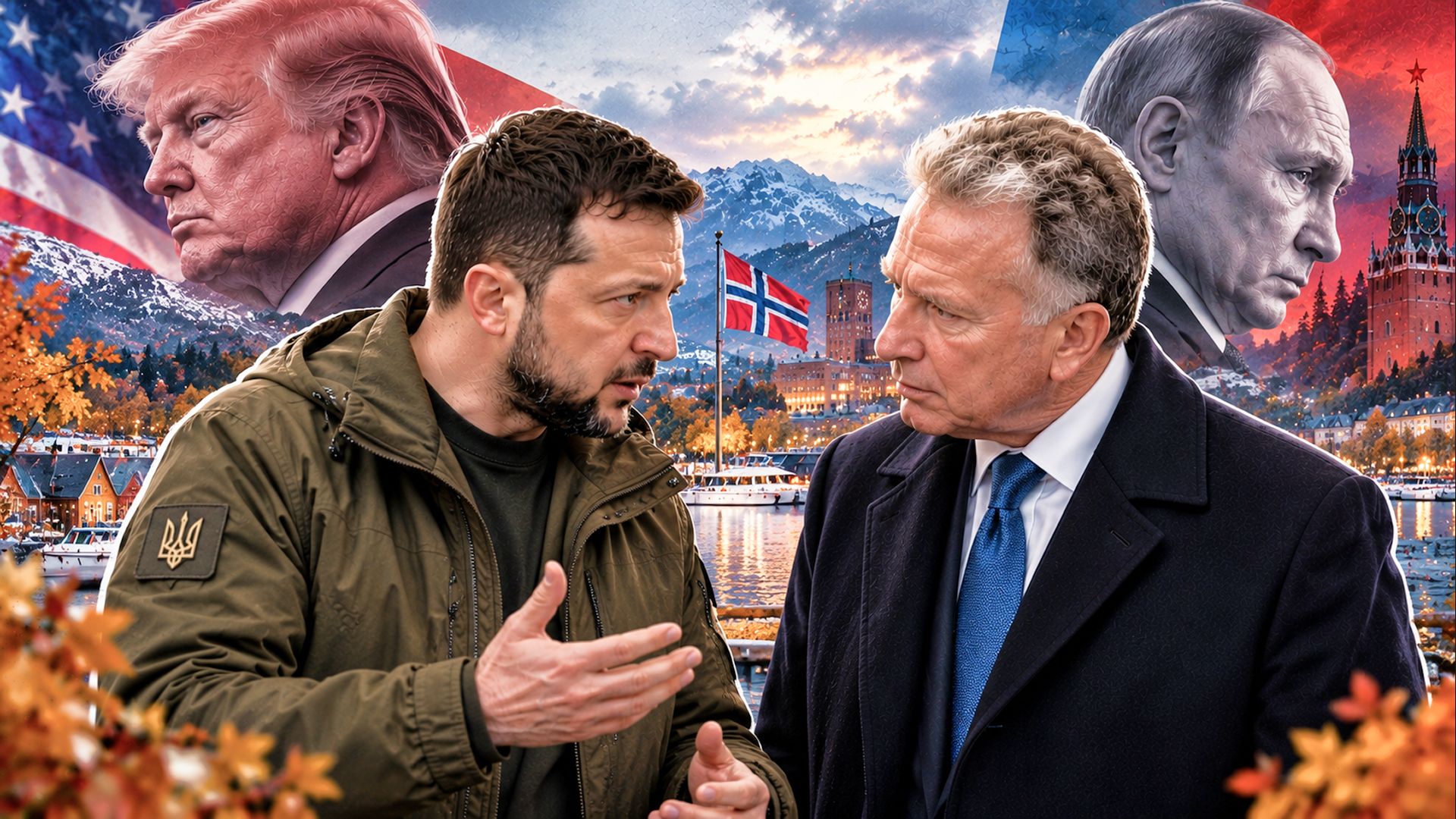


On the evening of October 20 in Norway, talks between Ukrainian President Volodymyr Zelenskyy and U.S. Presidential Special Envoy Steve Witkoff concluded.
Norwegian Prime Minister Jonas Gahr Støre and Finnish President Alexander Stubb also participated in the discussions. Representatives of the “European Quartet” – Germany, the United Kingdom, France, and Poland – as well as EU and NATO officials were also present. Trump’s son-in-law, Jared Kushner, was not physically present at the talks due to the flu, but he actively participated in the discussions via video link.
Meanwhile, on the morning of October 21, Steve Witkoff’s plane had already arrived in St. Petersburg. He was personally met by Kirill Dmitriev, the Russian president’s special representative. Another meeting between Witkoff and Vladimir Putin is expected.
Channel 24 analyzed the course of this round of negotiations with the Americans in Norway and what our so-called “partners” are offering us this time.
Trilateral Leaders’ Meeting
The Trump administration has not yet abandoned its idea of holding a trilateral meeting between the U.S., Russia, and Ukraine at the leadership level. Despite the fact that Putin has made it clear that this will not happen, the Americans continue to insist on their position. Politico reports that Steve Witkoff took this idea to St. Petersburg, where he will personally present it to Vladimir Putin. This is precisely how the U.S. hopes to achieve a ceasefire in Ukraine.
The Americans believe that Trump, through his own charisma and leadership “chemistry,” will be able to achieve a breakthrough in the diplomatic process on the spot. The publication also reports that Zelenskyy is not opposed to this.
The Kremlin, however, had previously stated that such a meeting could allegedly take place only in Moscow – which, in diplomatic terms, means it won’t happen. Putin is still not ready to meet with Zelenskyy and “simply look him in the eye,” as he does not consider him his “equal” – for some reason, he has decided to measure himself against Peter the Great and Catherine the Great. Moreover, Moscow has repeatedly claimed that Volodymyr Zelenskyy is allegedly an illegitimate president, so it is difficult to believe in the feasibility of such a plan, at least at this stage of the war.
Zelenskyy and Witkoff’s meeting in Norway – watch the video:
Steve Witkoff will also present Putin with an “updated proposal” to end the war in Ukraine. The U.S. hopes that the new plan will pave the way for direct trilateral and broader multilateral negotiations.
Axios notes: The White House hopes that Putin will show greater willingness to compromise after Trump agreed to lift sanctions on Russian diesel fuel exports and took other measures that were viewed positively by Moscow.
In Washington, officials are once again reporting that the parties have made significant progress and now have a mutual understanding regarding next steps. But all previous experience with such announcements following this type of negotiation suggests there is little to get excited about.
Halting Strikes on Oil Refineries
The Trump administration continues to pressure Ukraine to ensure that Russian oil refineries are protected from strikes, as the U.S. president firmly believes (or pretends to firmly believe) that this is the cause of the sharp rise in fuel prices.
Jared Kushner, son-in-law of U.S. President Donald Trump, actively participated in the negotiations virtually despite having a cold. Kushner demanded via Zoom that strikes on Russian oil refineries cease. President Zelenskyy stated that he is ready to halt strikes on Russian oil refineries if Moscow takes reciprocal measures in response.
As a reminder, Trump’s previous attempts to “impose” an energy truce in Ukraine have twice ended in complete failure. The latest diplomatic defeat for the U.S. was particularly telling. On October 11, Trump announced on the social media platform Truth Social that an immediate energy ceasefire between Ukraine and Russia had been established. Meanwhile, the Ukrainian president learned of the agreement from the news. There was no official confirmation of this agreement from either Kyiv or Moscow, but Trump continued to believe that it was working. On October 18, the Ukrainian president noted that since President Trump announced the “energy ceasefire,” Russia had struck Ukraine’s energy and oil and gas sectors 76 times. That figure has since increased significantly.
Resumption of Intelligence Sharing
One of the few positive outcomes of the “Norwegian Discussions” was the resumption of intelligence sharing.
According to President Zelenskyy, Ukraine is already receiving intelligence from the U.S., particularly as part of the early warning system for Russian ballistic missile attacks. A full resumption of Starlink/Starshield operations is also expected:
We are grateful that intelligence data is now flowing effectively. This refers to the early warning system – it is extremely important for our people, for children and adults alike, because we receive a signal when ballistic missiles are approaching. So we are grateful to the American side; the system is working, and that’s wonderful.
Security Guarantees
President Zelenskyy stated that during the talks in Oslo, the U.S. side promised to provide Ukraine with “reliable” security guarantees.
We discussed NATO – Article 5 of the Alliance and security guarantees – similar to those provided for in Article 5. The document outlines various options for such guarantees. Steve will convey this document to the Russians, and we’ll hear his response within a day. This is extremely important, because once this war is over, we will need strong security guarantees,” said Volodymyr Zelenskyy regarding the U.S. proposal.
Previously, the U.S. side had promoted the idea of providing Ukraine with guarantees similar to those in Article 5 of the NATO Charter, which states that an attack on one member of the organization is considered an attack on all Alliance states. In other words, the U.S. is proposing a ceasefire backed by its security guarantees and is even prepared to pledge military action in response to any violation of the ceasefire terms by Russia.
Zelenskyy sums up the results of the talks with the Americans – watch the video:
However, without the physical deployment of U.S. troops in Ukraine – as in the case of South Korea – such guarantees cannot be called “reliable.” Moreover, everything will once again depend on the mood and political will of Donald Trump, who is now openly siding with Putin in the war against Ukraine.
Hope is not a strategy
So, the American negotiators brought to Europe the very same ideas they had proposed before, simply dressed up as “novel” and “creative.” Their plans once again boil down to “hopes” and “expectations,” but, as they like to say in the West: Hope is not a strategy.
Hopes alone will not end Europe’s largest conflict since World War II. Appeasement and attempts to “bribe” Russia won’t help either: Putin couldn’t care less about money or joint business projects. None of that is of interest to him without, at the very least, the capture of the entire Donbas.
President Trump, for his part, has done everything in recent weeks to undermine the negotiation process as much as possible and to completely destroy any trust in even his most modest statements.
He has made concessions to Russia – in particular, purchasing diesel fuel and lifting sanctions against Russian energy products – without securing not only equivalent but any concessions whatsoever from Russia regarding Ukraine, not even a limited ceasefire in the air. It’s like sitting down at a poker table with a royal flush in your hand – and voluntarily folding your cards before the hand even begins.