


In nearly a year and a half at the helm of the Catholic Church, Pope Leo XIV has managed to do what the cardinals hardly expected of him when they were choosing Francis' successor. The first American pontiff in history has found himself at the center of international politics, publicly clashed with US President Donald Trump, been named a possible contender for the Nobel Peace Prize, and stepped up the Vatican's efforts to end Russia's war in Ukraine.
However, in October 2026, the 71-year-old pontiff faced a completely different test. During a routine medical examination, doctors discovered a tumor in his lung, and on October 13, Leo XIV even underwent surgery in one of the Roman clinics.
Channel 24 analyzes the extensive and rich biography of Robert Prevost, a man who went from an American missionary in Peru to the Holy See. How Leo XIV managed to become one of the most prominent critics of Donald Trump's policies, why he was named among the possible contenders for the Nobel Peace Prize, what is known about the pontiff's struggle with Trump and his own cancer, and most importantly - is he able to use his authority to help Ukraine achieve a just peace? Read all about this in the extensive material of Channel 24.
Prevost or Prévost?
With the first reports about the new Pope, many Ukrainian media outlets outlined the grounds for a philological battle, as the Conclave elect was called in two ways - "Prévost" and "Prevost".
The second reading is in accordance with the norms of the English language, while the first is a tribute to Mr. Robert's Francophone origin. According to this tradition, the unusual for Ukrainians accumulation of consonants at the end of the surname Prevost is ignored and should be read as "Прево".
At the same time, another conflict arises - regarding the name. Because the Pope has the name Robert Francis, which in the USA would be read as "Robert Francis", and in the same France as "Robert Francis". In addition, given the Spanish roots of his mother and the corresponding traditions, the surname should be double - Prevost Martinez.
It should be noted that the Ukrainian version of the official Vatican website insists that the new Pope is not Prevost, but Prevost , and his correct full name should be read in English - Robert Francis Prevost.
In view of this, it is even good that the churchman chose a new name for himself - Leo XIV, which, however, also has its own reading in different languages of the Catholic world, in particular in Latin it is Leo XIV, and in Portuguese it is Leão XIV. So who is he and where is he from?
The Path to the Holy See: Biography of Pope Leo XIV
On May 8, 2025, white smoke appeared over the Sistine Chapel in the Vatican. A conclave of 133 cardinals, including Ukrainian Mykola Bychok , quickly elected a new head of the Catholic Church on just the fourth attempt. Soon, the traditional announcement of the election of a new Pope was heard from the balcony of St. Peter's Basilica, and before thousands of believers appeared 69-year-old American Cardinal Robert Francis Prevost, who chose the name Leo XIV .
How long were previous Popes elected / Infographics – Avvenire

The choice of the Vatican cardinals surprised everyone quite a bit, because unlike Italian Pietro Parolin or Filipino Luis Antonio Tagle, Prevot was not one of the most noticeable favorites in previous media and bookmaker predictions.
However, he was by no means a random figure in the church hierarchy , and behind his shoulders were decades of missionary work, leadership of an international monastic order, and a fairly close relationship with the late Pope Francis.
Robert Prevost was born on September 14, 1955, in Chicago. His father, Louis Marius Prevost, was a World War II veteran and teacher, and his mother, Mildred Martinez, worked as a librarian. The family was of mixed descent, with French, Italian, and Spanish roots mixed in with the pontiff's lineage, and according to genealogical research, he even had African roots.
The future Pope, Robert Prevost, in second grade with his classmates, 1962 / Photo – St. Mary of the Assumption School

Prevost studied at one of the most prestigious universities in the United States, Villanova in Philadelphia. There, Robert studied mathematics and philosophy, but the former did not appeal to the boy's soul, and he increasingly thought about its salvation. He began to understand this while studying at the Catholic seminary.
- Prevost decided to connect his life with the Church and entered the Augustinian Order after graduating from university in 1977. On September 2, 1978, Prevost took his first vows, and on August 29, 1981, he took his perpetual vows.
- This was followed by studies at the Catholic Theological Institute in Chicago. After that, Robert continued his spiritual studies in Rome - at the Pontifical University of St. Thomas Aquinas (the famous Angelicum), where he received the title of Doctor of Canon Law.
- On June 19, 1982, at the Augustinian College of Saint Monica in Rome, the American was ordained a priest.
Robert Prevost, the future Pope Leo XIV, pictured in the 1977 Villanova College graduation album / Photo courtesy of the NY Post

An important page in the biography of the future pontiff was a trip to Peru, where the young priest was first sent in 1985. There, Prevost worked with local communities, taught in seminaries, and was involved in the training of clergy and church administration. Later, he even received Peruvian citizenship, so after the election of Leo XIV, two American states immediately had reason to consider the new Pope theirs.
It was in Peru that the future Pope experienced one of the first serious blows to his health. During his missionary work, he fell ill with typhoid fever and was hospitalized. Later, the priest recalled that the ordeal only strengthened his conviction in the correctness of the chosen path.
Today, four decades later, he will face a much more serious illness, but no longer in the status of an ordinary missionary, but as a leader of the Catholic Church. But you will learn about this if you read the article to the end.
Robert Prevost's career, meanwhile, continued to develop actively. In 1999, he became the head of the Augustinians in Chicago, and in 2001 he became the superior general of the entire order, which he led for two six-year terms. He later returned to Peru, where in 2014 he was appointed apostolic administrator of the diocese of Chiclayo, and the following year became its bishop.
Robert Prevost and Francis / Photo by Getty Images

But it was his personal acquaintance with Pope Francis that gave Prevost his ticket to the Vatican’s highest offices. In 2023, the pontiff appointed him prefect of the Dicastery for Bishops, the powerful Vatican department that selects bishops around the world. That same year, Prevost was made a cardinal and became head of the Pontifical Commission for Latin America.
In fact, Francis entrusted his American associate with influencing the future personnel of the Catholic Church, and although Prevost himself continued to stay largely out of the media spotlight, his authority among the cardinals steadily grew.
So when Francis died on April 21, 2025, it was this little-known churchman who turned out to be a compromise candidate capable of uniting the different wings of the Catholic Church. An American with many years of experience serving in Latin America, a supporter of the Church's social teaching, but at the same time quite conservative in matters of faith and morality.
How the Pope's enthronement took place
On May 18, 2025, Leo XIV was enthroned as Pope at the Vatican. He was presented with the pallium, a strip of sheepskin symbolizing his role as a shepherd. He was also placed on his shoulders with three pins, symbolizing the nails from the crucifixion of Christ.
He was later presented with a fisherman's ring, named after the first Pope, Saint Peter, who was a fisherman by profession.
The Pope was enthroned as pontiff / Photo AP

The event was held together with the sacred liturgy. The event was attended by world leaders, including Volodymyr Zelensky, who was believed to managed to find common ground with President Trump for the first time , who a few months earlier, together with J.D. Vance, had set a trap for the Ukrainian leader in the Oval Office.
The Vatican, responding to questions about the Pope's visit, noted that it is too early to talk about it. Secretary of State of the Holy See Pietro Parolin stressed that Leo XIV will not be able to respond to President Zelenskyy's invitation at this time.
Politico explained that the Vatican has a tradition of diplomatic neutrality , although Leo promised to "make every effort" to try to bring Russia and Ukraine to the negotiating table.
The Holy See is always ready to help bring enemies together face to face, to talk to each other, so that peoples around the world can find hope again and recover the dignity they deserve, the dignity of peace, he said.
Conservative, reformer or successor to Francis: how Leo XIV is changing the Vatican
From the moment Leo XIV first appeared on the balcony of St. Peter's Basilica, Vatican experts began looking for signs of how different the new pontiff would be from his predecessor. And there was some reason to speculate.
Unlike Francis, who has ostentatiously eschewed the flamboyant papal attire, Robert Prevost appeared before the faithful in the traditional red mozzetta and gold-embroidered epitrachelion. To the average observer, this might seem like a small thing, but in the Vatican, where even the color of clothing sometimes becomes a political statement, such details do not go unnoticed.
Pope Leo XIV / Photo - Getty Images
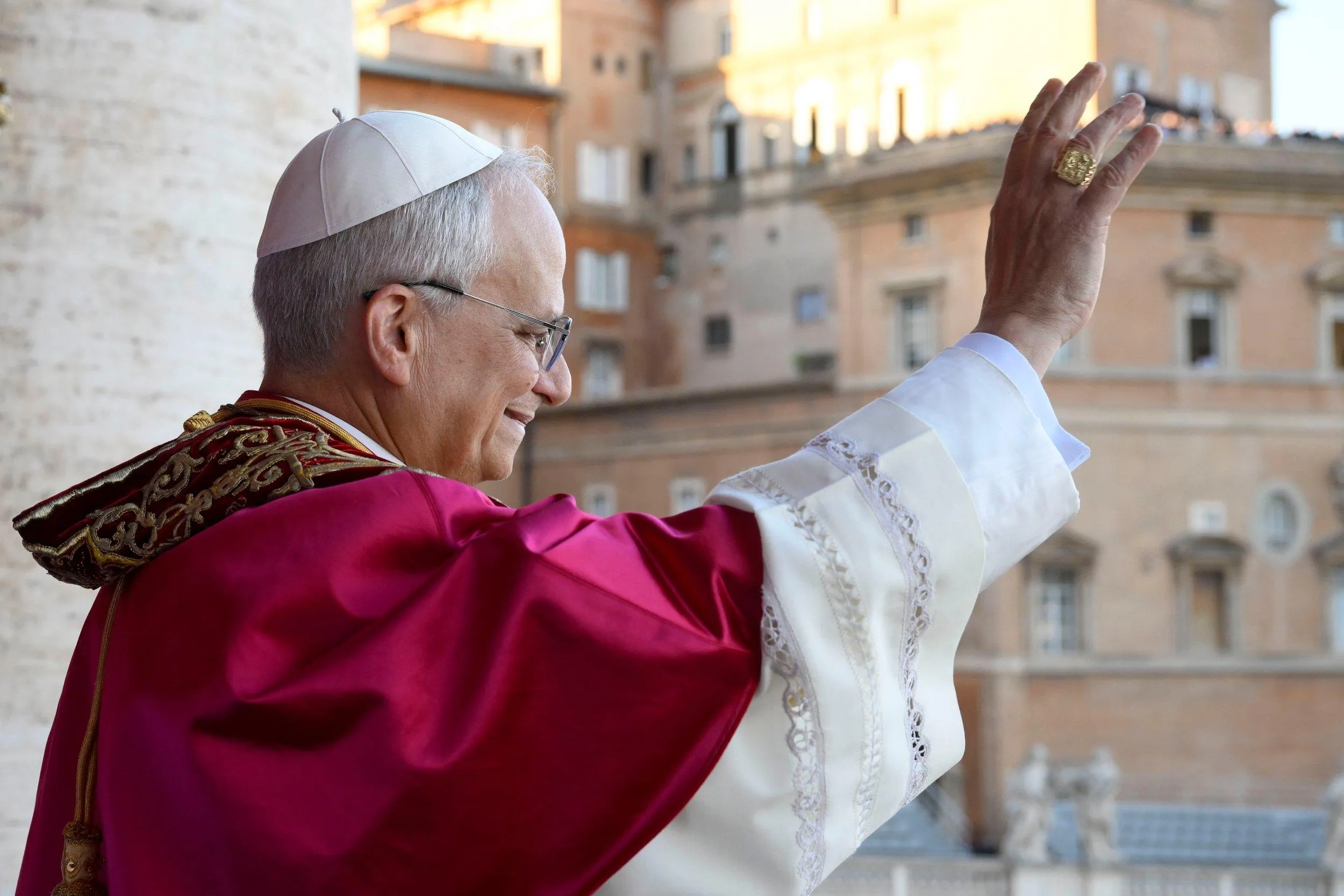
Even more interesting was the choice of the papal name , since among the thirteen previous Leos were pontiffs who crowned Charlemagne, excommunicated Martin Luther, and clashed with European monarchs. However, Prevot himself explained that he was primarily guided by Leo XIII , who led the Catholic Church in the late 19th century. In 1891, he published a famous encyclical dedicated to the situation of workers, social justice, and the consequences of the Industrial Revolution.
According to the new Pope, humanity is experiencing similar upheavals today, only this time, instead of steam engines and factories, the main challenge is artificial intelligence and the digital revolution. And the Catholic Church, in his opinion, should not remain aloof from issues of protecting human dignity, labor, and social justice.
However, within a year and a half, it became clear that expectations of a conservative revolution in the Vatican were at least premature. Leo XIV turned out to be a cautious successor to Francis's policies rather than his ideological opponent. He supported the Church's openness to believers in difficult life circumstances and continued the discussion of the controversial reforms of his predecessor.
At one time, Pope Francis published a document that caused a real storm among Catholic conservatives , because it allowed an individual approach to the issue of communion for divorced believers who entered into a new civil marriage. Leo XIV did not abandon this legacy, but instead proposed to evaluate how the relevant provisions are applied in practice.
At the same time, calling the new Pope a liberal in the modern sense would also be an exaggeration. Leo XIV remains a supporter of traditional Catholic teaching on marriage and family, does not support the church's recognition of same-sex unions , but at the same time insists that these issues should not overshadow the Church's much broader mission of defending human dignity, freedom and justice.
His personnel decisions are also noteworthy. In particular, in October 2026, he approved the election of Filipino Cardinal Luis Antonio Tagle as Dean of the College of Cardinals, which was the first time in history that such a position was given to a representative of Asia. It is especially symbolic that Tagle was considered one of the main competitors of Prevost himself in the 2025 conclave. Now he will play an important role in organizing the upcoming election of the next Pope.
Thus, Leo XIV does not yet demonstrate a desire to radically change the Catholic Church, but he does not intend to return it far into the past either. It seems that his main goal is to preserve the traditional foundations of Catholicism, while forcing the Church to respond more actively to the challenges of the modern world. And, as it soon became clear, such a position is not always to the liking of those who are accustomed to considering religion as a convenient tool in promoting their own policies.
The conflict between two influential Americans: why Donald Trump quarreled with Pope Leo XIV
For those who are more distant from religious issues, another plot that unfolded with the arrival of Leo XIV became much more interesting. The first Pope from the United States in history could become a great ally for Donald Trump, and for Washington - an additional tool for influencing more than a billion Catholics around the world.
However, it quickly became clear that Robert Prevost had no intention of turning the Holy See into a religious appendage of the White House administration . Moreover, it was the American Leo XIV who became one of the most prominent critics the U.S. president's erratic policies .
The first differences appeared even before Prevost was elected pontiff. In February 2025, the future Pope publicly criticized Vice President J.D. Vance for trying to explain Christian love through a kind of hierarchy, where first one must love family, then fellow citizens, and only after that the rest of humanity. Later, he also criticized the Trump administration's tough immigration policy , emphasizing the inhumane treatment of migrants.
However, the real conflict between the two Americans erupted in April 2026 against the backdrop of the US-Israeli war against Iran . The pontiff condemned the hostilities and called on the parties to return to diplomacy. He reacted particularly harshly to Trump's threat to destroy Iranian civilization, which Leo XIV called unacceptable. During a prayer vigil on April 11, he also condemned the show of force and the pursuit of omnipotence that has engulfed world politics today.
Trump is obviously not used to the fact that someone may disagree with his "brilliant" ideas, especially if this person also has significant international authority. Already on April 12, the American president began his " "crusade" against a fellow countryman , when he published a lengthy post on Truth Social, in which he called Leo XIV "weak on issues of fighting crime", "terrible in foreign policy" and accused him of flirting with the radical left. Given the primitiveness and even a certain "childishness" in the wording, it can be assumed that the author of the post was the US president himself, who at that time was already a laureate of the FIFA Peace Prize.
Donald Trump's post criticizing the Pope / Screenshot
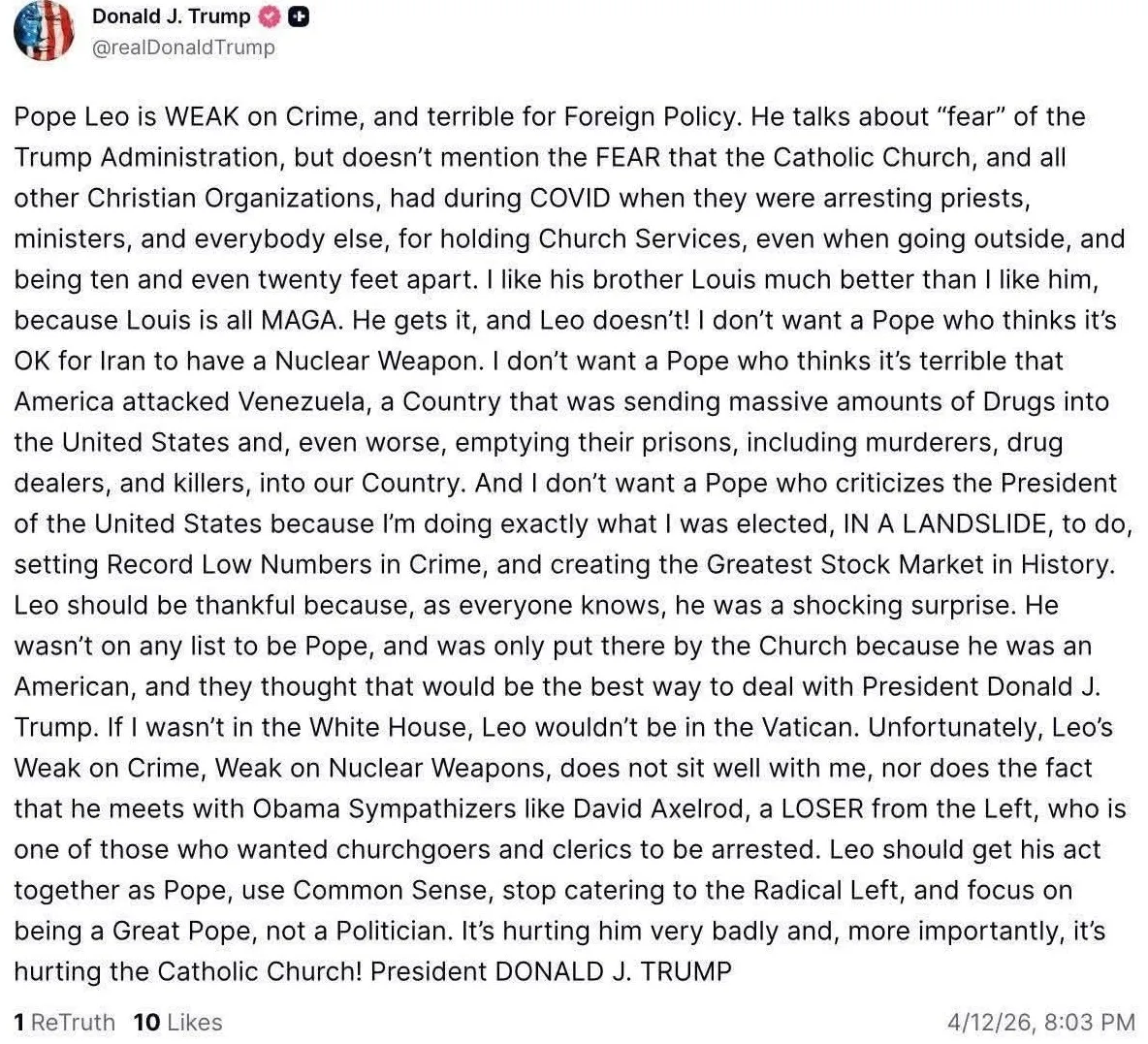
Later, the US president even stated that the pontiff owed some personal credit to Trump for his election . He said that the cardinals had deliberately chosen an American to please Donald Trump. Of course, Trump did not provide any real evidence for this rather original theory.
Leo XIV himself reacted much more restrainedly, and on April 13 he stated that he was not afraid of the Trump administration, did not intend to enter into a personal dispute with the US president, but would not abandon his calls for peace. After all, while Trump increasingly considers military force as a tool for solving international problems, Leo XIV insists on diplomacy, dialogue, and the inadmissibility of justifying war with religion.
The Nobel Peace Prize has added a special poignancy to this story . Donald Trump continues to convince everyone that he is the one who most deserves the award for his real and imagined peacemaking achievements, even though his promise to end the Russian war against Ukraine has remained unfulfilled, and instead the US and Israeli operation against Iran has escalated into a large-scale and protracted armed conflict that has claimed too many lives and cost the world too dearly in every sense.
Leo XIV himself is registered in the USA as a Republican.

And while Trump is so eager to be awarded this award, experts have named Leo XIV among the possible contenders for the 2026 Nobel Prize. The question was not even that the pontiff would win, and thus become the first Pope to win the Nobel Peace Prize, the problem was that even the nomination of Prevost for this award caused personal irritation and resentment in Trump.
But in the end, for Leo XIV, a much more difficult test than the clash with Trump or the Nobel prospects was the illness, which the world learned about just a few days after Announcement of the Award Results . And this time it was not about political ambitions or moral authority, but about the life of the pontiff himself.
New pontiff, old problems: how Leo XIV was diagnosed with oncology
Despite his advanced age, 71-year-old Leo XIV until recently gave the impression of a man who has every chance of leading the Catholic Church for another decade. Unlike his predecessor Pope Francis, whose last years were marked by constant illnesses and hospitalizations, Robert Prevost had no publicly known health problems, maintained an active lifestyle and even enjoyed tennis . However, in October 2026, this illusion was shattered.
On October 11, during the traditional Sunday prayer, The Pope unexpectedly told the faithful that doctors had discovered a small tumor in his lung . According to the pontiff, it was found at a very early stage during a routine examination, but doctors recommended not to delay the operation. On October 13, Leo XIV was hospitalized in the Gemelli clinic in Rome , well known for treating his predecessors – John Paul II and Pope Francis.
Robert Prevost and his illustrious predecessor, Pope John Paul II:
During the approximately one and a half hour operation, Surgeons removed the lower lobe of the Pope's right lung . A tissue examination confirmed the worst fears – the Pope was diagnosed with lung adenocarcinoma, one of the most common types of cancer . At the same time, encouraging news came from the Vatican. The operation itself passed without complications, and the pontiff himself woke up normally after anesthesia and returned to the hospital ward.
However, it is too early to speak of a final victory over the disease. Adenocarcinoma can be successfully treated surgically, especially if it is detected before it has spread to other organs. However, the Vatican has not yet reported the exact stage of the disease or whether doctors have found lymph node involvement. The results of further examinations will determine whether the Pope will need additional treatment, including chemotherapy or immunotherapy.
For now, Leo XIV is expected to spend about a week in the hospital, and all his public events have been canceled until October 20, 2026. A major trip to South America planned for November, including Peru, where Robert Prevost spent a significant part of his life, is also in question.
And now, against the backdrop of the pontiff's illness, another discussion arose about what would happen if the Pope's health did not allow him to continue performing his duties.
The fact is that the Catholic Church still does not have a clear mechanism for transferring power in the event of a long-term incapacity of the Pope. Unlike secular states, where the powers of the head of state can usually be temporarily taken over by another official, in the Vatican the pontiff formally remains the head of the Church even in the event of a serious illness. The transfer of power is possible only after his death or, as an exception, in the event of a voluntary abdication of the throne, as Benedict XVI did in 2013.
Thus, Leo XIV's oncology became not only a personal test for the pontiff, but also another reminder of the vulnerability of the entire archaic system of governance of the Catholic Church, despite the fact that the forecasts for his recovery are currently quite optimistic.
In turn, for Ukraine, the Pope's health is far from being only symbolic. In a relatively short period of time, Leo XIV has managed to turn into one of the leading international figures, who does not just resort to abstract statements, but actively promotes the idea of a just peace for Ukraine and tries to use the influence of the Holy See to return Ukrainian prisoners and children back home.
Peacemaker critical of Moscow: how is Leo XIV promoting peace in Ukraine?
Robert Prevost himself, when he was a cardinal, spoke little about Ukraine and the war, but still clearly defined his position, as reported by the WSJ .
This is a real invasion, imperialist in nature, where Russia wants to conquer territory for reasons of power. It is proven that crimes against humanity are being committed in Ukraine,
– emphasized Prevost.
So, when Ukrainian President Volodymyr Zelensky congratulated the new Pope on his election, he was addressing a like-minded person.
I sincerely congratulate Pope Leo XIV on his election to the Throne of Saint Peter and the beginning of his pontificate. Ukraine highly appreciates the consistent position of the Holy See on compliance with international law, condemnation of the Russian Federation’s military aggression against Ukraine, and protection of the rights of innocent civilians. At this crucial moment for our country, we hope for further moral and spiritual support from the Vatican for Ukraine’s efforts aimed at restoring justice and achieving lasting peace. I wish His Holiness Leo XIV wisdom, inspiration, spiritual and physical strength in fulfilling his high mission. Ad multos annos!, – the head of the Ukrainian state congratulates the Pope on his election.
A few days later, Pope Leo XIV had a telephone conversation with the President of Ukraine, during which Volodymyr Zelensky invited the pontiff to come on an Apostolic visit. The invitation was later repeated by the head of the UGCC, Sviatoslav Shevchuk. He met with the Pope in the Vatican on May 16.
The Pope welcomes the Primate of the UGCC, His Beatitude Sviatoslav, to the Vatican / Photo by the Vatican Press Service

The Ukrainian bishop also handed over to the pontiff a list of prisoners still held by Russia, and the Pope promised to help and stated that he was ready to mediate in the negotiations, and the Vatican could become their place.
My heart goes out to the martyred and beloved people of Ukraine. Let us do everything possible to achieve a true peace as soon as possible – just and lasting! And may all prisoners be released, and may children return to their families,
– The Pope promises help during a meeting with the Primate of the UGCC.
The first phone call was followed by several personal meetings, including in July and December of that year. During the latter meeting, the parties discussed American peace initiatives, the release of prisoners of war, and the return of Ukrainian children . In April 2026, the pontiff spoke with Zelensky again by phone, reaffirming the Vatican's readiness to assist humanitarian efforts and diplomacy.
The President of Ukraine and the First Lady during an audience with the Pope / Photo – Office of the President
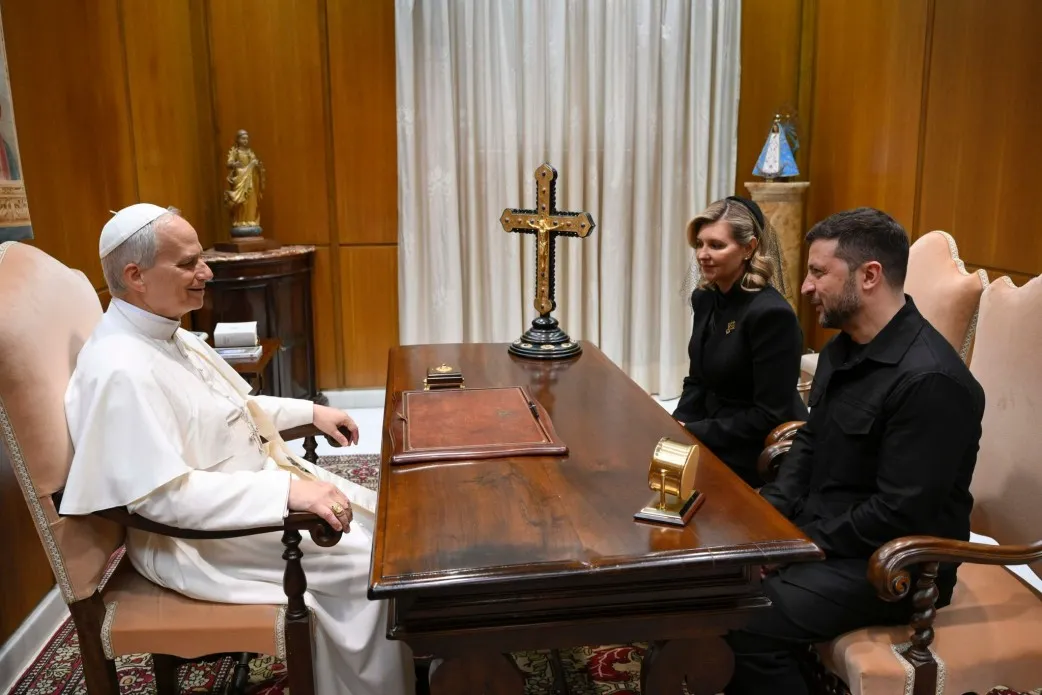
Moreover, Leo XIV did not limit himself to general wishes for peace. In December 2025, he quite sharply commented on the chaotic and unbalanced peace proposals of the United States , concerned about the possible weakening of the historical alliance between the United States and Europe. For the American pontiff, who at that time already had disagreements with the Trump administration, this was a rather loud signal. At the same time, the Pope confirmed that the Holy See continues its non-public work on the return of Ukrainian children from Russia, although he admitted that this process is progressing extremely slowly.
However, the most interesting thing was that the new Pope did not abandon the diplomatic mechanisms of his predecessor. The Vatican's main mediator in humanitarian issues remained Cardinal Matteo Zuppi , to whom Francis entrusted the relevant mission back in 2023.
In September 2026, Zuppi visited Moscow again, where he held negotiations regarding prisoners of war, deported children, and other humanitarian issues.
Matteo Zuppi at a meeting with the Minister of Foreign Affairs of Ukraine Andriy Sybiga / Photo of the Ministry of Foreign Affairs of Ukraine
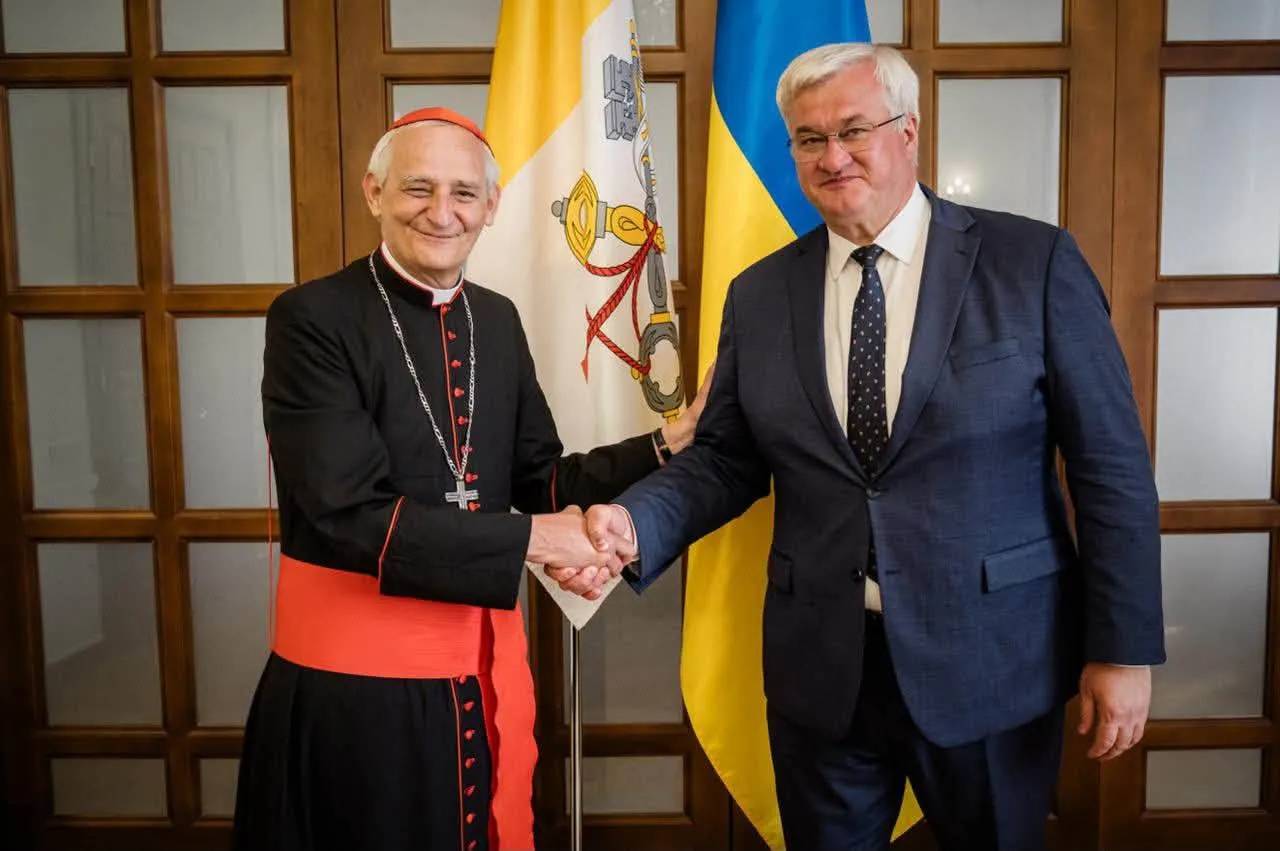
So, despite the obvious differences in public rhetoric, the foreign policy of the two pontiffs turned out to be much closer than it might have seemed at first. Leo XIV, like Pope Francis, tries to maintain contacts with both Ukraine and Russia , offers the Vatican as a platform for peace negotiations, and focuses primarily on humanitarian issues.
However, no matter how influential the Pope is in the Catholic world, this does not greatly impress the neo-Bolsheviks in Moscow. The Kremlin has still not agreed to Vatican mediation , and regular visits by church diplomats do not in themselves indicate Russia's readiness to stop the aggression, as Vladimir Putin even brutally ignored the Pope's proposed Easter truce.
Actually, the Pope is also aware of the limitations of his capabilities in this area. In December 2025, he confirmed his readiness to receive Ukrainian and Russian delegations for negotiations , but noted that the parties have not yet accepted the corresponding offer. Leo XIV was no less cautious about a possible visit to Ukraine, which Zelensky has repeatedly insisted on. The Pontiff did not reject such a prospect, but he has not yet named specific terms.
At the same time , Ukraine remains an important topic of his international speeches . In particular, on October 11, 2026, shortly before the operation, Leo XIV called for the creation of conditions for the safe transportation of Ukrainian grain across the Black Sea, recalling that the consequences of the Russian war are very acutely felt by the poorest countries in the world, dependent on Ukrainian food.
In conclusion, it is worth assessing Leo XIV's policy towards Ukraine without excessive admiration, although one should not underestimate his efforts. The Holy See has neither an army nor economic leverage capable of forcing Russia to make peace. On the other hand, the Vatican maintains diplomatic channels that are not available to every Western state, and the moral authority of the pontiff allows him to maintain the Ukrainian issue on the international agenda.
And although these capabilities have not yet brought a decisive breakthrough, they can be useful where the fate of specific people is at stake - prisoners of war, civilian hostages, and children separated from their families.
Ultimately, the main contradiction of Leo XIV's pontificate lies precisely in this. The Pope, who openly opposes power politics, leads the Church in a world where force is increasingly becoming the main argument in shaping international relations. He can argue with Donald Trump, call on Vladimir Putin to stop aggression and offer his own mediation, but unfortunately he is not yet able to make them listen to his appeals.