
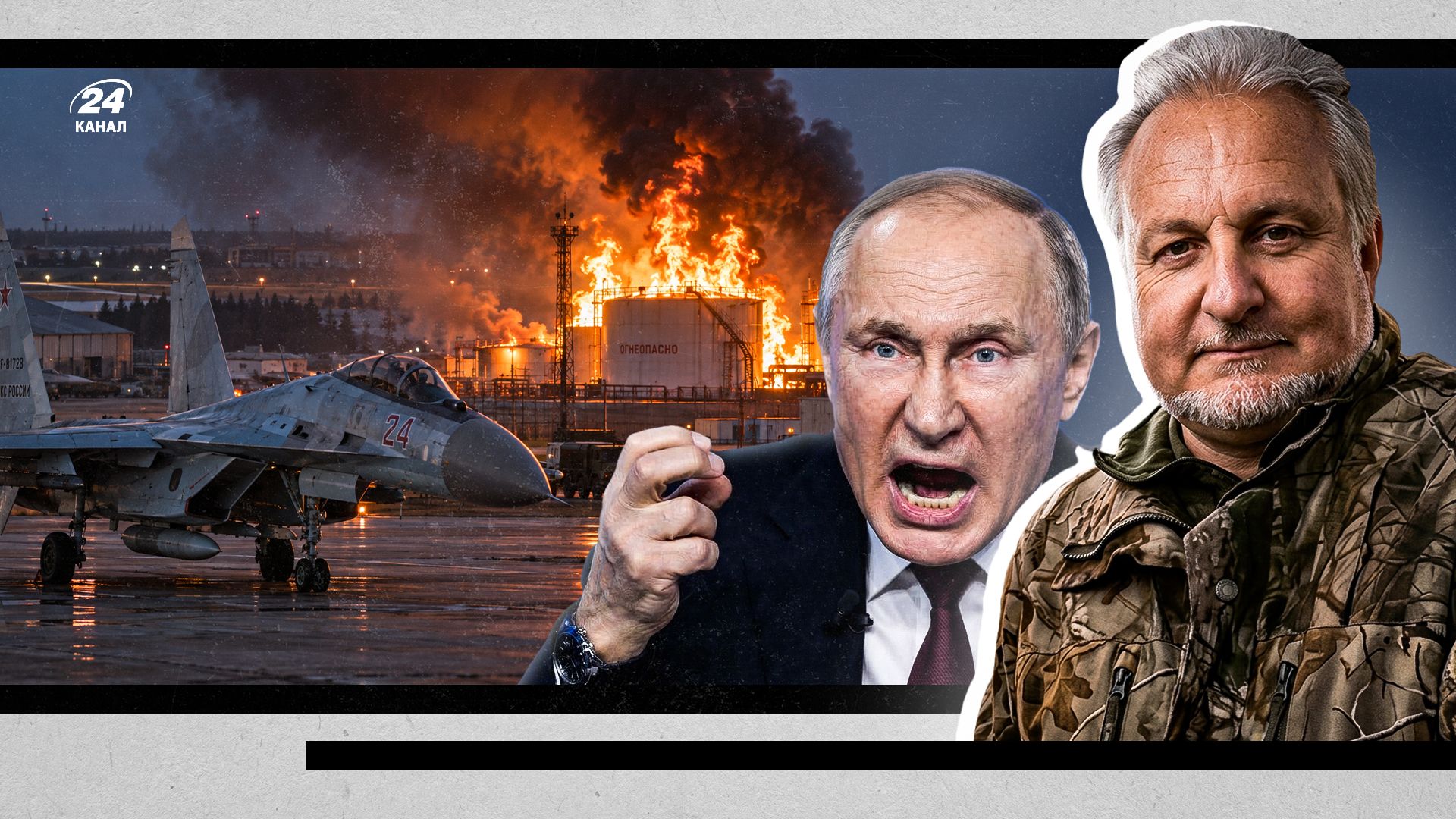


Ukrainian forces attacked the Russian airbase in Borisoglibsk, which the occupiers use to refuel combat aircraft before flights to the front lines. While the results of the strike are still being assessed, reports have emerged of the possible use of not only drones but also cruise missiles.
Aviation expert Kostyantyn Kryvolap explained in an exclusive interview with Channel 24 why striking this airfield could create serious problems for the Russians. He also analyzed the situation regarding Starlink restrictions, U.S. intelligence data, and the new British missiles that Ukraine is set to receive sooner than expected.
Borisoglibsk helps Russian aircraft reach the front lines
The Russian military previously used Borisoglibsk primarily for pilot training and preparation. However, this airfield now plays a much more important role, as Russia has withdrawn its aircraft to a distance of approximately 600–700 kilometers from the front lines following Ukrainian strikes on military airfields.
For Russian aircraft, this means they must cover significant distances to reach the Ukrainian front, effectively operating at the limit of their combat radius. To carry out combat missions, the occupiers use intermediate airfields, one of which is Borisoglibsk.
They land in Borisoglibsk, refuel, top off their fuel, and then fly toward us. From Borisoglibsk to us, if I’m not mistaken, it’s about 400–450 kilometers. That’s why this distance is considered quite safe for them, and they refuel there,
– Kryvolap explained.
Russian aircraft do not necessarily have to remain at this airfield at all times. The planes can make a stopover, refuel, and continue their flight toward Ukraine. This is precisely why the occupiers need a functional ground infrastructure that allows them to quickly prepare the aircraft for the next mission.
Therefore, when striking such facilities, it is not only the ability to destroy aircraft that is important. Damage to fuel depots and refueling systems can significantly hinder the use of the airfield, even if its runway remains operational.
The fact that all refueling capabilities there are being targeted – that is, the fuel and lubricant depots themselves and the centralized refueling system – is excellent news. This needs to be done because, in this way, they will have virtually nowhere to fly to in order to carry out such a sortie,
– the aviation expert emphasized.
Kryvolap considers the refueling infrastructure to be the most important target at this airfield. He speculated that the Ukrainian strike may have been aimed primarily at the Borisoglibsk fuel depot, although the exact results of the attack had not yet been confirmed at the time of the interview.
At the airbase, Russian military personnel operate various types of aircraft, including the Su-34, Su-35, Su-30SM, and Yak-130 combat trainers. There were also reports of the possible use of cruise missiles alongside drones during the attack, though no official information regarding the weapons used or the extent of the damage was available at that time.
Musk Explained Who Makes Decisions Regarding Starlink
Controversy surrounding U.S. support for Ukraine intensified following reports of restrictions on Starlink’s operation for Ukrainian drones and problems with the transmission of intelligence data. The White House insisted that it had not halted its support, but the Ukrainian military faced disruptions in satellite communications, and questions arose regarding timely warnings of Russian ballistic missile strikes.
In an interview with the Financial Times, Volodymyr Zelenskyy said that, at the request of the U.S., Ukraine had suspended attacks on Russian energy infrastructure for three days. However, Russia continued to shell Ukrainian energy facilities and the civilian population.
The Ukrainian president also stated that following this pause, problems arose with U.S. warnings about ballistic missile launches, and restrictions on Starlink complicated operations on the front lines and strikes against Russian military targets. According to him, U.S. officials threatened to stop sharing intelligence if Ukraine continued to attack Russian energy infrastructure.
Later, Zelenskyy reported that the restrictions on Ukrainian strikes had been lifted. At the same time, he did not rule out the possibility of a new agreement to halt the attacks, but only on the condition of receiving additional U.S. interceptor missiles for the Patriot systems.
The U.S. administration has several options for exerting immediate pressure on Ukraine. In addition to intelligence and satellite communications, Washington could raise the issue of arms sales; however, such a move would also affect the interests of U.S. defense companies.
The U.S. defense industry receives significant funding from contracts, and arms purchases for Ukraine – particularly through the PURL mechanism – generate additional profits for American manufacturers. Therefore, Kryvolap doubts that Trump would dare to impose long-term restrictions on arms sales, whereas the issues of Starlink and intelligence data allow for much swifter action.
This entire military-industrial complex, which sponsors either the Democratic or Republican Party, is all about money. PURL means big money. And if he tries to cut off or delay even 20 kopecks for anyone, they’ll simply run him out of town. But intelligence data and Starlink – those are real opportunities,
– Kryvolap explained.
Problems with Starlink began to surface when Ukrainian drones were operating at high speeds. Serhiy Sternenko reported that at speeds exceeding 160 kilometers per hour, the terminals began to lose connection, preventing the drones from carrying out their missions properly.
Later, representatives of the 7th Corps of the Airborne Assault Forces and Serhiy Beskrestnov, an advisor on unmanned systems, also reported difficulties. By then, signal interruptions were occurring at speeds of approximately 72 kilometers per hour. Problems were observed with both civilian Starlink terminals and military Starshield kits.
After these restrictions were introduced, Mykhailo Fedorov reached out to Elon Musk to ask about the reasons for the changes. The SpaceX CEO’s response was particularly interesting, as he explained that the company does not make final decisions regarding the capabilities provided to Ukraine.
Elon Musk quite correctly replied that SpaceX is merely providing the technical infrastructure. The actual decision-making authority lies entirely with the State Department and the Pentagon. Ultimately, the president himself decides what to do there. And if anything has changed, it has changed only on that side. I have nothing to do with it,
– Kryvolap quoted Musk’s response.
The aviation expert interpreted this explanation as an indication that the U.S. administration is responsible for any potential restrictions. In his view, Musk effectively shifted the question regarding Starlink’s operations to U.S. government agencies, specifically the Pentagon and the State Department.
Kryvolap believes that the owner of SpaceX has thus put Trump in an awkward position. After the explanations emerged, questions arose even among representatives of the U.S. political leadership, and some lawmakers wanted to find out exactly who had made the decision regarding the restrictions.
However, the expert does not claim to have seen a specific order from the U.S. president. Rather, this is based on his conclusion drawn from Musk’s response and the division of authority that Musk described.
Soon, the situation regarding connectivity began to change.
“As far as I know, all capabilities have now been restored, and the rules that were in place before are back in effect. In other words, we’re limiting Russians’ ability to fly with Starlink, while we ourselves have the ability to launch our drones along the front lines as needed,”
– the aviation expert noted.
However, the restoration of satellite communications has not dispelled questions regarding U.S. warnings about ballistic attacks. Following reports of delays in intelligence data, explanations emerged citing technical issues and adverse weather conditions that allegedly prevented the timely transmission of information to Ukraine.
Kryvolap questioned the credibility of such arguments. He compared the situation to hybrid warfare tactics associated with Russian Chief of the General Staff Valery Gerasimov, in which one side’s actions remain ambiguous, allowing it to avoid directly acknowledging responsibility.
I get the impression that Trump or someone in his inner circle has read about the hybrid warfare described by Gerasimov. Because these claims that ‘the weather was bad, so we couldn’t warn you’ – that sounds like complete nonsense,
– Kryvolap emphasized.
The aviation expert also sharply criticizes other decisions which, in his view, help Russia continue the war. First and foremost, he drew attention to China’s role in supporting Russian production of new jet-powered drones.
Moscow, according to Kryvolap, received from China the necessary components and networking equipment to manufacture large quantities of “Geran-4” and “Geran-5” drones. This equipment allows the Russians to establish communication between individual components of the drone systems.
Another decision that drew his criticism was Trump’s agreement on trade in Russian diesel fuel. Kryvolap believes that its significance extends far beyond the potential volume of fuel, as Washington is effectively demonstrating a willingness to engage in economic cooperation with Russia despite the ongoing war.
Trump did the second thing when he signed this diesel deal. It’s a lifeline for Russia, because diesel doesn’t matter there at all. It was simply a demonstration to the whole world: my business interests are far more important to me than what you can offer the world,
– said the aviation expert.
Kryvolap considers the current situation with Starlink to be temporarily resolved, but he doubts that the disagreements between Kyiv and Washington will end there. He describes the Trump administration’s future decisions – especially regarding economic agreements with Moscow – as difficult to predict.
British LMMs will help shoot down Russian jet drones
During Volodymyr Zelenskyy’s visit to the United Kingdom, Prime Minister Keir Starmer promised to increase and expedite the delivery of LMM missiles, also known as Martlets, to Ukraine. These are weapons for small anti-aircraft systems, intended to strengthen Ukraine’s air defense capabilities.
These missiles could be particularly important in countering new Russian drones. Russia is expanding its use of jet-powered drones, which require appropriate air defense systems capable of engaging high-speed targets.
This is primarily a countermeasure against all these jet-powered drones and, to a certain extent, cruise missiles. They are designed for small anti-aircraft systems. “This is a very good missile,”
– Kryvolap explained.
Speaking about the capabilities of such missiles, the aviation expert estimated the engagement altitude at up to 15 kilometers. At the same time, he cited this figure as an approximate estimate, without specifying the characteristics of a particular launch system.
Kryvolap cited the speed of its development as another important feature of the new weapon. According to him, it took the British about half a year, and the first deliveries to Ukraine may take place ahead of the initial schedule.
Initially, the missiles were expected to arrive in early 2027, but now the British side expects to deliver them within the coming months.
In this regard, the British have set a record, as the missile was developed in about half a year. It was expected to be ready in early 2027. But the British are now saying that they will most likely be able to deliver this missile by late November or early December,
the aviation expert noted.
Prototypes of these missiles, as Kryvolap explained, have already undergone combat testing and demonstrated good performance. The expert views the prospect of their earlier delivery to Ukraine positively, primarily to strengthen the countermeasures against Russian jet drones.
Kryvolap on the strike on Borisoglibsk: watch the video