


 3
3 Behind the scenes of the war, agreements may be reached that could influence not only the negotiations but also continued support for Ukraine. At the same time, Russia is looking for ways to preserve its oil revenues, while Ukraine must strengthen its capabilities to strike at the aggressor’s critical infrastructure.
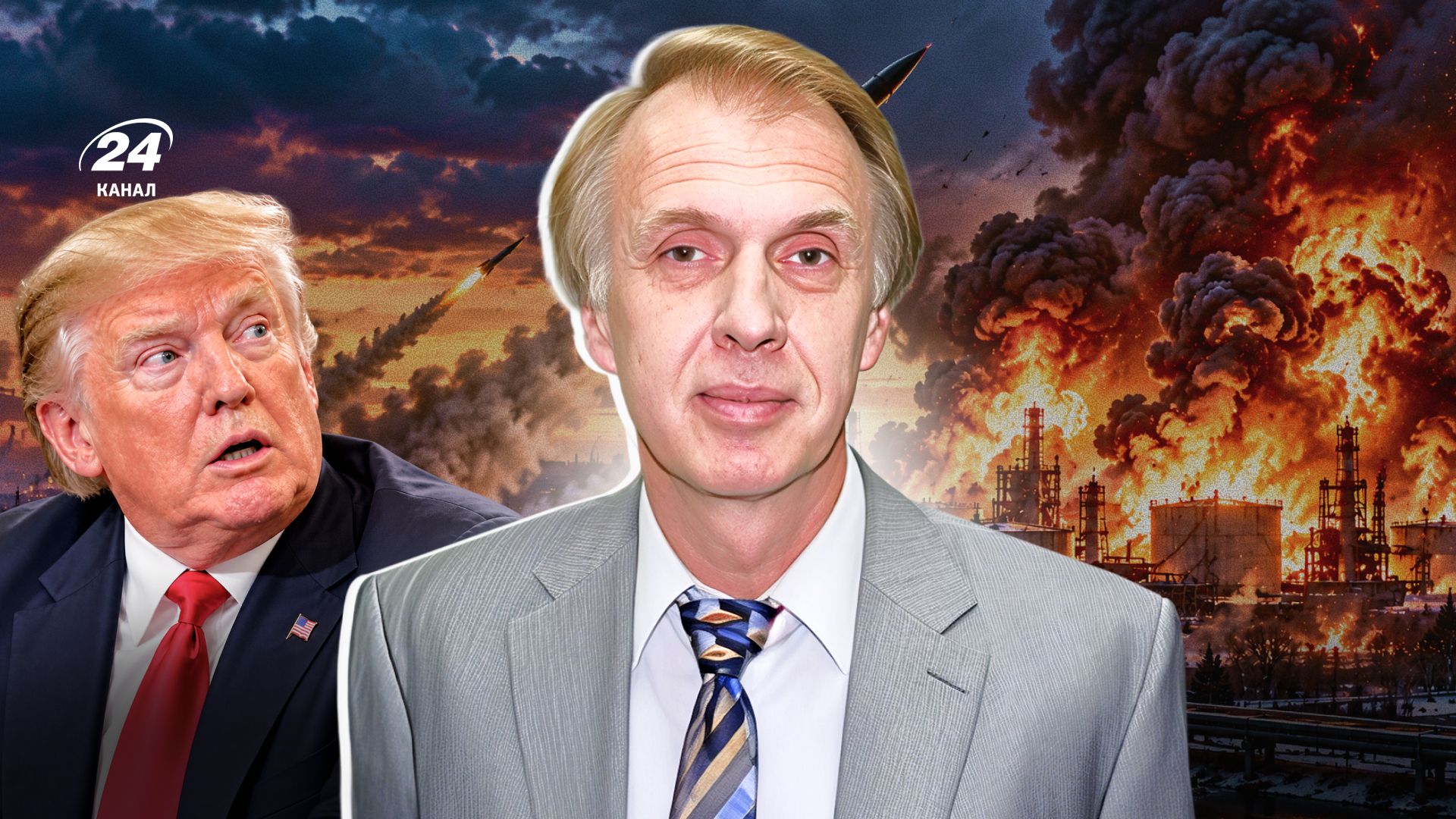
Volodymyr Ogryzko, a well-known Ukrainian diplomat and Ukraine’s Minister of Foreign Affairs from 2007 to 2009, spoke in an exclusive interview with Channel 24 about possible secret negotiations between the U.S. and Russia, a probable deal involving Russian oil, and explained why Ukraine needs to scale up production of its own ballistic missiles to strike Russian oil refineries.
"Lukoil" as a bribe: Why is Putin trying to bribe Trump?
Mr. Volodymyr, could the U.S.-Russia oil deal be linked to the business interests of Trump’s inner circle?
That’s exactly the case. Putin is a master at influencing his counterparts in various ways: through classic KGB tactics, intimidation, creating dependencies, and also through bribes. This isn’t the first time.
Then Trump's son receives a bribe from a gangster close to Putin. Now we’re finding out that, in reality, Witkoff and Kushner aren’t solving the problems of Russian aggression against Ukraine, but rather their own personal interests and those that benefit Trump.
Trump is a man without a conscience, dignity, or honor. He has only one concern – the dollar. Everything in his life revolves around that very dollar.
Lavrov just said at the General Assembly session that they reached an understanding in Anchorage to start their own economic relations at Ukraine’s expense, that Ukraine is getting in the Americans’ way, and therefore they want to resolve this so-called Ukrainian problem as quickly as possible by any means necessary so they can start making money.
Now, "Lukoil" is an obvious bribe. Putin understands that he won’t be able to reach an agreement with Trump any other way than by bribing him. Trump says with a big smile: “Yes, of course, we’ll take it.”
Nothing good will come of our dealings with the Americans in this context. But it’s hardly fair to generalize about the entire West. Friedrich Merz was here recently, and there will be further important visits by high-ranking Western politicians. They bring a specific amount of money with them.
We must finally come to the conclusion that we need to forge our own strong position, which may well be the only way to deal with Russia.
And how does this look from Putin’s perspective? Is he trying to draw Trump in and make him a hostage to these schemes?
Obviously. If you give someone a bribe, you’re already tying them to you, making them dependent on you.
The recipient of this bribe now has a vested interest. This means they’ll be much more accommodating in their stance on other issues, anticipating these multibillion-dollar handouts. It’s all very simple here.
Full interview with Volodymyr Ogryzko: watch the video
Is Trump facing investigations in the U.S.?
Could the situation change now? Could there be any investigations into this matter in the United States itself, especially given that all of this is coming to light on the eve of the election?
The expectations are very simple: that Trump will indeed lose. So far, it’s a sure thing that he’ll lose the first chamber, that is, the House of Representatives. But trends are already emerging that he’ll lose the Senate as well.
If that happens, then that’s it. There won’t be an impeachment, because too many conditions have to be met, but there’s no doubt whatsoever that he’ll be swamped by investigations.
And why isn’t Donald Trump reacting to the attacks on American companies on our territory, since American businesses are suffering just as much as Ukrainian ones?
That’s true, but the scale is simply different. Coca-Cola or McDonald’s was targeted. American businesses have suffered losses, but that’s minimal compared to what Putin is offering them.
The logic here is simple: I’ll make more money there, and I’ll personally profit as well. And McDonald’s has hundreds of thousands of locations worldwide. One less – they’ll manage somehow.
Strikes on Russian Oil Refineries and the Bet on Ukrainian Ballistics
Donald Trump has once again claimed that Ukraine is to blame for rising diesel prices in America because the Ukrainian Armed Forces continue to strike Russian oil refineries. Why is he deliberately lying to his voters and scapegoating Ukraine for the U.S.’s domestic problems?
He needs to find a scapegoat to pin all the blame on. In this sense, Ukraine is a perfect option for him. He hated us then, and he still hates us now.
He’s forced to play this game that helps Zelenskyy, even though deep down he’s on Russia’s side. His mind is set on multibillion-dollar deals with Russia and his own personal interests. That trumps everything else.
We continue to strike at oil refineries, and this is our response to Donald Fredovich. If you tolerate our people being killed, then we will not listen to your pseudo-peaceful proposals.
The Emergence of Ballistic Weapons in Ukraine – That is our future response. Putin is forced to admit that our strikes are causing damage to Russia. The Ministry of Defense reports that 51% of oil refining capacity has been destroyed. This is the Achilles’ heel we must strike and finish off. If Ukrainian ballistic missiles do this, nothing but a crater will remain of the refinery.
Will ballistic missiles really make a difference? Because it will take more than one ballistic missile for them to feel the impact. And Putin is standing his ground and isn’t ready to negotiate.
He simply has no options. The main question won’t be whether they can fly, but how many of them we’ll have.
I really hope that the common sense of our Western partners will prevail over selfishness. They’re allocating a billion euros to us, but keeping it in their own factories. Maybe we should allocate 200–300 million from that billion specifically for our ballistic missiles so we can scale up production as much as possible?
If we assume there are 7–8 key oil refineries left, each would require a maximum of five missiles. This means the Russian oil refining industry would come to a halt. No diesel for Russia means no diesel for the Russian army. How are they going to advance?
We need to translate all of this into very practical actions, building up our strength to deal a heavy blow to the Russian occupiers.
Statements about “compromises” with Russia and the hidden “Russian faction”
Against the backdrop of this fall-winter escalation, statements have emerged from our members of parliament – in particular, Danylo Getmantsev and Oleksiy Goncharenko – regarding the need for complex compromises in negotiations with Moscow. How can we explain this synchronization of statements from the government and the opposition? Is this a test of public sentiment or a leak of the actual demands of our Western partners?
Each of these possibilities may have some merit. But there is a fourth factor: the so-called “Russian party,” which has not disappeared from Ukraine and continues to operate underground.
This is actually a bad trend, because this hidden “Russian party” is simply testing today how society will react. It’s good that the president made a firm and clear statement.
You’d really have to be brain-dead to propose such things, or simply want to openly play into the enemy’s hands. We had a treaty in 1997 – so what? Russia said it had never recognized us as an independent country, and the war began.
The only language that works with Moscow is the language of force. Putin is proposing that we cede territory, make Ukraine neutral and non-nuclear, with a meager military, and only then begin negotiations. Can this be accepted as a platform?
Mr. Goncharenko outlined his peace plan and said, “Well, we can at least agree not to fire on schools or churches.” So is he directly saying that the Armed Forces of Ukraine are striking Russian schools?
It turns out that’s exactly what he’s saying. In other words, he’s equating Russia – and the terrorists who kill our people every day – with us, who are trying to survive and fight for our very existence.
We must make it clear: you are outliers who have been playing games with Ukrainian interests for far too long. It turns out that this is all just theater and a show for the public. In politics, one must be very cautious with so-called allies.
Could there be any other demands from Western partners?
I don’t think so. Unless there are fringe figures like Fico, Orbán, or Le Pen. But that’s not the official position of Berlin or Paris.
Those in power understand the extent of the threat perfectly well. Merz says: “We’re giving you money because we understand that we’ll be next.”
Mr. Danylo Getmantsev is a member of “Servant of the People.” It turns out that this faction isn’t listening to what the President of Ukraine is saying. Could this influence the opinion of Western countries, which might start harping on the election issue, saying, “You lack unity”?
It’s very good that the president clearly stated that this is the personal opinion of each individual lawmaker. But it would be logical to draw organizational conclusions regarding those who allow themselves to do such things.
If the team leader says to go right, and you say to go left, conclusions must be drawn. This is clearly playing into Moscow’s hands.
Germany’s Role, Merz’s Visit, and European Security
You mentioned German Chancellor Merz’s visit to Ukraine. Would it be fair to say that Germany will now play a key role in containing Russia?
Germany is reclaiming all the functions it voluntarily relinquished after World War II. Merz wants to demonstrate initiative and strength; he wants to be a European leader.
He brought not just verbal support, but one billion for defense and 350 million for energy. We are indeed establishing very serious ties with Germany right now.
Friedrich Merz on a visit to Kyiv on October 4 / Reuters
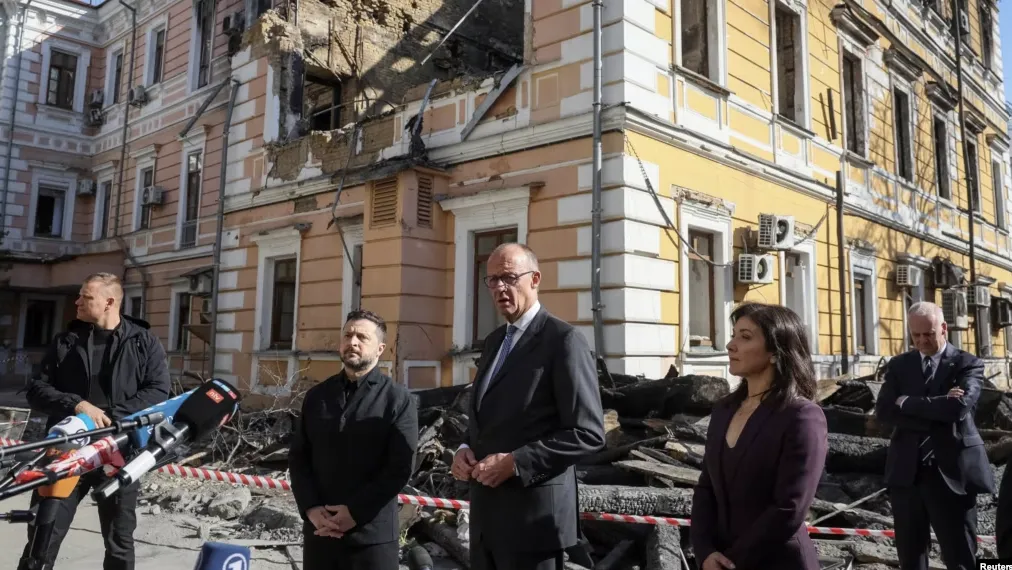
During Merz’s visit to the Academy of Sciences, an air raid alert went off, and they did not run for cover. Russian propaganda is portraying this as though Western partners were not previously targeted, but Merz was now specifically targeted.
This is not just a blow against Merz; it is a blow against Europe. When Witkoff and Kushner visit, we have our best air defense in place. When Europeans visit, Russia shows that it does not want to have anything to do with them.
Ukraine is part of Europe, and Europe today cannot imagine itself in terms of security without Ukraine. This fills Russia with catastrophic dread. That is why they strike Kyiv when European officials are here.
We need to propose a single negotiating team to the Europeans so that we have a unified European position.
A sort of military-political alliance is currently being formed under the auspices of the European Union. Merz proposed so-called “associated membership.” Can this truly play a key role in future security?
We cannot remain in a “gray zone” right now. A gray zone is a provocation for Russia to go to war. Zelenskyy has clearly stated that such a status does not suit us.
If Merz means that we’ll be given greater access to the European market today, or the opportunity to participate in European Council meetings without voting rights – just to observe and learn – these are technicalities that don’t cost us much.
But this is no substitute for us becoming members of the European Union. We have no alternative to this path.
What must Ukraine do right now to ensure that our ties survive any future German government?
The next German government will be just as pro-Ukrainian. Under any political scenario, the AfD will never form a government, because a democratic coalition will be formed.
The AfD will not be able to become the sole leader in Germany. That said, it is a troubling trend that an irresponsible right-wing populist force is gaining popularity.
I can’t help but ask about the so-called rally in Moscow, where 60 people were detained. They were Communists and members of Yabloko. Are these actions orchestrated by the Kremlin, or has the Kremlin even stopped being afraid to arrest its own people?
It’s all fiction, a sham, political madness. There were three thousand people at the rally – for the whole of Moscow. It’s a drop in the bucket.
But even under these circumstances, the election campaign has provided an opportunity to talk about something, and this is beginning to seep out little by little. Will this change anything? Not in the least.
But it’s a small sign of the unrest that’s starting to take shape anyway.
This interview has been condensed, corrected, and edited for better understanding by the audience.