



Following the Knesset elections, Israeli President Yitzhak Herzog tasked Prime Minister Benjamin Netanyahu’s main rival, Gadi Eisenkot, with leading and forming a new government. He has 28 days (and a little more) to complete this task.
A lieutenant general in the Israel Defense Forces, former Chief of the General Staff, and a man who has devoted his entire life to the military, Eisenkot decided to enter politics following a difficult personal loss in order to unite a divided Israeli society, restore trust in state institutions, and finally remove Netanyahu from power.
But will Gadi Eisenkot be able to take the prime minister’s seat and bring the Bibi era to an end? Will Israel turn a new page in its history, and what challenges await the politician in the future? 24 Channel explores these questions in an in-depth profile of the politician.
popular videos
Early Life and Background
Gadi Eisenkot was born on May 19, 1960, in Tiberias, in northern Israel; he was the second of four children born to Meir and Esther, Jewish immigrants from Morocco. His father was a miner who worked in the copper mines of the Timna Valley, and his mother was a homemaker.
Gadi’s childhood (an ancient Jewish name that can be translated as “happy”) was spent in Israel’s southernmost city and major seaport – Eilat. There, he attended school, where he chose a maritime track in high school, and grew up, in his own words, with a connection to the Negev Desert, far from Israel’s political circles and centers of power.
Eisenkot’s background and that of his parents are more than just a biographical detail. He belongs to the Mizrahi community – Jewish immigrants from the Middle East and North Africa who, for decades in Israel, have faced discrimination from the dominant Ashkenazi elite – descendants of Jews from Central and Eastern Europe (particularly Ukraine). If Gadi Eisenkot successfully forms a government, he will become the first Mizrahi prime minister in Israel’s history.
Another notable feature of Eisenkot is that he had neither wealth nor influential relatives. This sets him apart from many politicians (such as his main opponent, Netanyahu), who grew up in the capital’s elite circles or abroad and came from privileged backgrounds.
Second-grader Gadi Eisenkot / photo – the politician’s Facebook page
However, it was not his social status or his affiliation with the Mizrahi community that proved decisive for his subsequent rise and popularity. The key factor that ultimately shaped his political image was a decision he made at the age of 18. Immediately after graduating from high school, Eisenkot enlisted in the army – a move that would determine his fate for many years to come.
A Man of War
Gadi Eisenkot began his service in the IDF (Israel Defense Forces – 24 Channel) in 1978 as a private in the Golani Brigade. He spent 14 years there and rose through the ranks. He first became a squad leader, then a platoon leader, and during the First Lebanon War in 1982, he commanded an entire company.
A photograph of Gadi Eisenkot from the time he joined the Israel Defense Forces, 1978 / Photo – Wikimedia Commons
During the conflict in southern Lebanon, which took place in the Israeli-occupied territory of the Arab state, Eizenkot slowly but surely advanced through the ranks. After many years in the “Golan,” he took command of units such as “Carmeli” and “Ephraim,” but in 1997 he returned to his original brigade and took command of it.
In 1999, Eisenkot began to gain recognition in political circles and was appointed military secretary to Prime Minister and Defense Minister Ehud Barak. He subsequently commanded the 366th Division, then the “Judea and Samaria” Division, where he led the campaign against Palestinian armed resistance during the Second Intifada – mass protests by the Arab population that escalated into a full-scale uprising against Israel in the Gaza Strip and the West Bank.
Eisenkot (left) during the handover ceremony for command of the “Ephraim” Brigade, 1994 / Photo – Wikimedia Commons
In 2005, Gadi Eisenkot was appointed head of the Operations Directorate of the General Staff. In this role, he became the architect of the so-called “Dahiya Doctrine,” for which Eisenkot continues to face criticism today both in the West and in the Middle East.
The “Dahiya Doctrine” was employed by the IDF during the 2006 Second Lebanon War, the war in the Gaza Strip, and in southern Lebanon, where Israeli forces, in their fight against “Hezbollah,” razed entire villages to the ground.
“In every settlement from which fire is directed at Israel, we will use asymmetric force and inflict massive damage and destruction there.” “From our perspective, these are military bases,” Gadi Eizenkot said in a comment to the Israeli newspaper Yedioth Ahronoth when he took command of the Israeli Army’s Northern Command in 2008.
In 2013, he became deputy chief of the General Staff under Benny Gantz, and in November 2014, then-Defense Minister Moshe Ya’alon and Prime Minister Netanyahu appointed him as the next Chief of the General Staff of the IDF.
Newly appointed Chief of the General Staff of the Israel Defense Forces Gadi Eizenkot (right) with Prime Minister Benjamin Netanyahu, 2015 / Photo – Menahem Kahana / AFP
“The people of Israel trust you, the Israeli government trusts you, and, Gadi, I trust you,” Israeli Prime Minister Benjamin Netanyahu said in 2015 when Gadi Eizenkot took office as Chief of the General Staff. Ten years later, the two would become political rivals.
During his four years as Chief of the General Staff, Eisenkot carried out several important military reforms.
First, he shifted the focus back to ground forces – the infantry and tank units – and to combating the border tunnels that Hamas used to smuggle weapons and infiltrate sabotage teams into Israel.
Second, in April 2016, he approved the multi-year “Gideon” plan, which was intended to reduce organizational bloat, establish a cyber command, and develop a strategy centered on the rapid resolution of conflicts.
Third, he formalized the “Campaigns Between Wars” doctrine, which called for covert operations aimed at weakening Israel’s enemies.
There were also scandals. In 2016, in Hebron, Israeli soldier Elor Azaria shot and killed a seriously wounded Palestinian, Abdel-Fattah al-Sharif, who had attacked him with a knife. The case received widespread publicity and attracted media attention. Despite pressure from right-wing politicians and protesters, Eisenkot insisted on a military trial, arguing that the soldier had violated military discipline and the army’s code of ethics. The soldier was subsequently sentenced to 18 months.
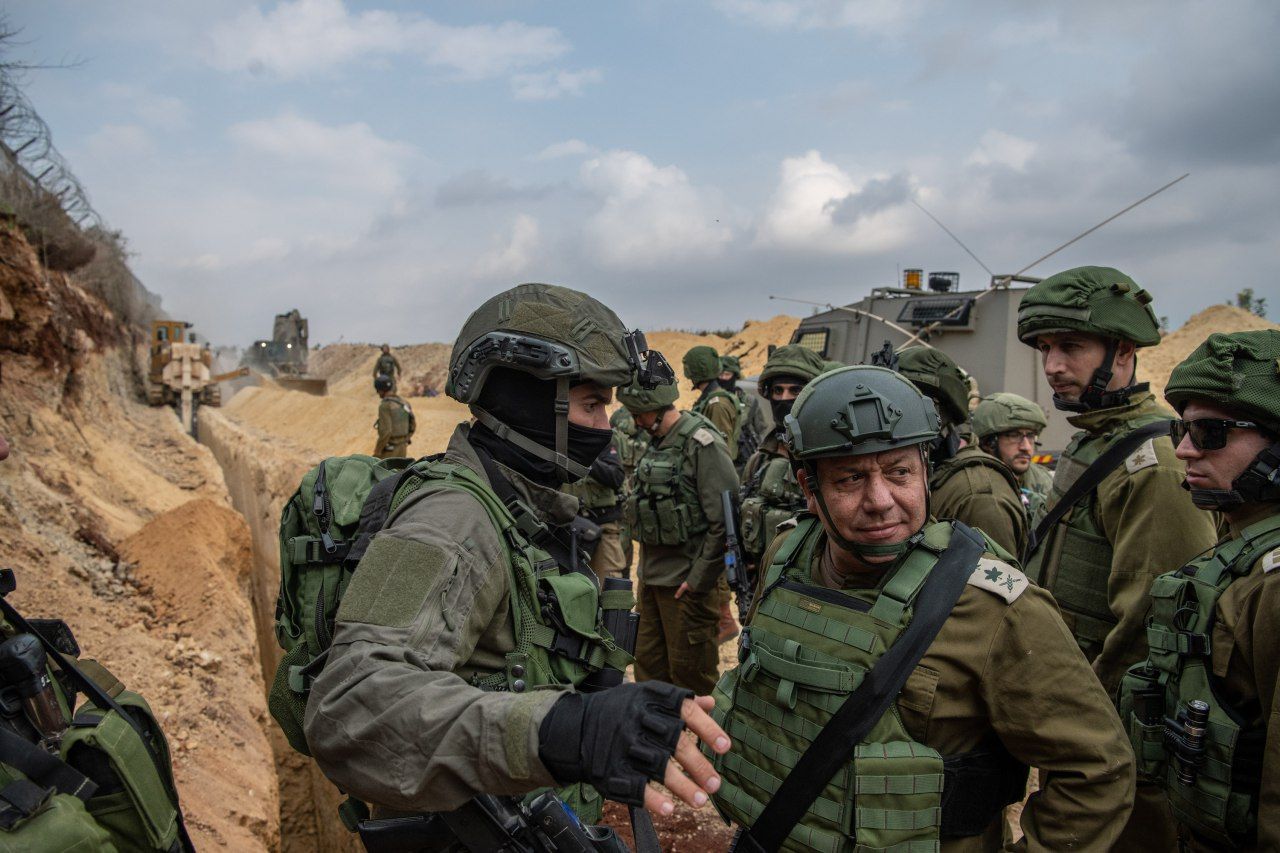
Eizenkot during an operation against Hezbollah militants, 2019 / Photo: IDF Spokesperson’s Unit
During a campaign of mass anti-Israeli protests by Palestinians in 2018 along the border between the Gaza Strip and Israel, IDF soldiers opened fire on demonstrators, resulting in, according to the UN, 189 protesters were killed and 6,000 were wounded. Tel Aviv claimed that the Palestinians provoked Israeli soldiers, threw stones and Molotov cocktails at them, attempted to cross the border, and that there were Hamas representatives among the demonstrators. Responsibility for these actions by the Israeli army fell on Gadi Eizenkot.
After serving in the army for four decades, he rose to the rank of Rav Aluf (Lieutenant General – 24 Channel), so after numerous achievements and a few scandals, Gadi Eizenkot announced his resignation as Chief of the General Staff in 2019 and decided to move into a new field for him – politics.
From the Trenches to Government Offices
After taking a three-year break, ahead of the 2022 parliamentary elections, Gadi Eizenkot joined the centrist “National Unity” bloc led by his former commander Benny Gantz and was elected to the Knesset.
However, Eisenkot’s respite from war was short-lived. On October 7, 2023, Hamas attacked Israel, and just a few days later, Benjamin Netanyahu invited him to join the military cabinet. Eisenkot was sworn in as a “minister without portfolio” – a government official who has the right to vote in meetings but does not head any ministry. There, by his own account, he advocated for two decisions: not to open a second front in Lebanon against Hezbollah until the situation in the Gaza Strip was resolved, and he insisted that an agreement on the release of hostages must be reached first, and only then should Hamas be defeated.
Netanyahu and Eizenkot’s positions diverged on this issue, because Bibi decided to launch a ground invasion of Gaza following a large-scale aerial bombardment of Hamas’s military infrastructure, believing that this would force the militants to surrender their positions and return the captives. After that, tensions within the military cabinet began to rise.
War and Family Tragedy
Two months later, the war reached his family as well. Eisenkot’s son, 25-year-old Gal, a student at Tel Aviv University and a combat medic, was killed during an operation to recover the bodies of two Israelis in the northern Gaza Strip (near the Jabalia refugee camp). The next day, the same fate befell his 19-year-old nephew, Maor Cohen-Eizenkot, and in November 2024, another nephew, Captain Yogev Paz, died in combat against Hamas fighters.
Gadi Eisenkot with his son Gal Meir / Photo: IDF
Gal Eisenkot’s funeral was broadcast on television, and Benjamin Netanyahu personally attended the ceremony. At that moment, the nation witnessed one of its most famous commanders delivering a eulogy in a trembling voice.
After three days of mourning, he returned to the War Cabinet.
The Break with Netanyahu and the Launch of His Own Political Project
As Eizenkot later recounted in an interview with TIME, for nearly a year after the deaths of his loved ones, he watched as Netanyahu’s approach to waging war turned Israel into a pariah state, trying to maintain his loyalty and hope for the best. But everything has its limits.
In early June 2024, Eisenkot asked Netanyahu about his plan to end the war. Receiving no answer other than assurances of a “complete victory,” Eisenkot took a book on diplomacy out of his briefcase and advised the prime minister to read it, emphasizing that military force alone would not bring lasting victory.
Following this conversation, Eisenkot, along with his colleague Benny Gantz, resigned from their posts. This effectively ended the “national unity government” in Israel and led to the dissolution of the War Cabinet.
A year later, Gadi Eisenkot resigned from his seat in the Knesset and announced his departure from “National Unity,” stating that the party lacked “deep democratization.” In September 2025, the former Chief of the General Staff announced the creation of his own party, “Yashar” (which translates from Hebrew as “straightforward” or “honest”), promising renewal, healing, and hope for Israeli society.
Eizenkot’s criticism of Prime Minister Netanyahu grew increasingly fierce. He has repeatedly accused Bibi of sabotaging negotiations with Hamas for his own interests, prioritizing his political survival over the state, and dragging Israel into wars he doesn’t even know how to end.
The image of a young man from a modest family who, through his own efforts, rose from soldier to lieutenant general and became a politician who knows what he’s talking about has become extremely popular among the Israeli public. And the death of his son and a personal tragedy in his family have brought Eisenkot closer to the people.
Gadi Eisenkot and candidates from the “Yashar” party on the eve of the October Knesset elections / Photo by Chaim Goldberg / Flash90
The “Yashar” party came in second on the parliamentary elections this October, trailing only “Likud” – Netanyahu’s party. Eizenkot was able to rally other Jewish political forces opposed to the incumbent prime minister around him and form the second-largest coalition in the Knesset. It was he who, on November 7, Israeli President Yitzhak Herzog has granted a mandate to form a new cabinet. However, this does not yet mean that Gadi Eisenkot will become the new prime minister.
28 Days That Will Decide Everything
Despite strong poll results, Eisenkot’s party failed to secure an absolute majority in the 120-seat Knesset – to form a government, a party must control at least 61 seats, while “Yashar” and its coalition partners secured only 48 seats.
The “Yashar” party celebrates its election victory / photo – Gadi Eisenkot’s Facebook page
Following negotiations with political parties, Israeli President Herzog announced that he would give the former Chief of the General Staff the first opportunity to form a government. Gadi Eizenkot received 67 recommendations for the position of prime minister, while Netanyahu received 46. Eizenkot was supported by some representatives of Arab parties, as well as some of Netanyahu’s allies.
Eisenkot now has 28 days to attempt to form a new government, with the possibility of a 14-day extension. However, he may face new obstacles along the way.
Yitzhak Herzog (right) expects Gadi Eizenkot to do everything possible to form a government that will serve all segments of the Israeli people / Screenshot from a Ynet video
In this year’s elections, Arab political forces won a record 19 seats in the Knesset. The “Joint List” and “Ra’am” parties, which represent Israel’s Arab citizens (about 20% of the population), did not join any political bloc. And to form a government, Gadi Eizenkot will need to secure their support. But to do so, he will have to make painful compromises.
Although Eizenkot has publicly ruled out the possibility of Arab parties participating in his government, he has not completely closed the door on forming an alliance in the Knesset to counter Netanyahu. Among Eisenkot’s supporters, there is a growing sentiment that it would be better to cooperate with the Arabs than to endure another term under Bibi.
Eisenkot faces a tense standoff with Netanyahu and his coalition / Photo – Abir Sultan/EPA
But we must not forget that Benjamin Netanyahu is a veteran of post-election maneuvering with thirty years of political experience, while Eizenkot is a political novice. Netanyahu has participated in 10 national elections as leader of the Likud party and has managed to form a coalition government six times, including in 2009, when his party actually won fewer seats than its main rival. So he won’t take the Israeli prime minister’s seat without a fight.
What to Expect from Eizenkot If He Becomes Prime Minister
Gadi Eizenkot’s key political promises are centered on security. In the 10-point plan developed by his party, “Yashar,” he calls for the creation of a state commission to investigate the failure of the Israeli operation in Gaza and the terrorist attacks carried out by Hamas on October 7, 2023.
Eisenkot also advocates for the implementation of mandatory military or national service for all citizens, including ultra-Orthodox Jews and the Arab population. In addition, he proposes a new defense doctrine based on strategic planning and aimed at making Israel the leading regional power.
Draft dodgers: Ultra-Orthodox Jews protesting conscription into the Israel Defense Forces, August 2026 / Photo – Avshalom Sassoni / Flash90
"Yashar" also proposes setting term limits for the prime minister and taking steps to revive the economy, stem the brain drain, and improve the personal safety of all citizens.
However, Eisenkot deliberately remained vague on many issues that are likely to define his premiership, particularly regarding the future of Palestine.
Gadi Eisenkot’s own comments indicate that he advocates maintaining Israeli control over parts of the occupied West Bank, while opposing direct annexation or the creation of Palestine as a separate state.
Gadi Eizenkot opposes the creation of a Palestinian state, but does not support the use of excessive violence / Photo – Getty Images
“I have never spoken of two states for two peoples, because I understand the depth of this religious, national, and social conflict, and anyone who talks about ‘peace now’ and a two-state solution does not understand the conflict,” Eisenkot said in an interview with the Israeli television channel N12.
At the same time, since 2019, he has referred to the violence committed by Jewish settlers and Israel Defense Forces soldiers against Palestinians in the West Bank as “terrorism.” Such behavior, he said, contradicts Jewish values, weakens Israeli society, damages Israel’s reputation abroad, and “actively undermines the operational missions of the security services.”
However, for some Palestinians, Gadi Eizenkot – who still wants to resolve the Israeli-Palestinian conflict through diplomatic means – is already a much better option than Benjamin Netanyahu, who believes that the only solution is the use of force and the complete occupation of the Gaza Strip.
Will Eizenkot influence Israel’s foreign policy?
Significant changes in Israel’s foreign relations with neighboring countries – particularly Syria, Lebanon, Jordan, and Egypt, as well as the Gulf states – are unlikely.
In Beirut’s political circles, it is believed that negotiating the disarmament of “Hezbollah” and the withdrawal of the Israeli army from southern Lebanon would be easier with Eisenkot than with Netanyahu and his far-right partners. The same view is held in Damascus, where officials believe that a security agreement between Syria and Israel would become more likely.
Eizenkot is also confident in Israel’s continued cooperation with the United States and Donald Trump, although the former general and his advisers were surprised when the American president did, in fact, actively support Netanyahu. In addition, Eisenkot expresses support for Trump’s 20-point peace plan to resolve the situation in Palestine.
There are very high expectations for the politician, which will not be easy to fulfill / photo – Gadi Eisenkot’s Facebook page
At the same time, one of Eisenkot’s initiatives calls for a gradual phasing out of U.S. defense support. In his view, the current dependence provokes political disputes with the U.S. and contradicts the basic principle of Zionism – the state’s ability to independently guarantee its own security.
On the issue of Iran, Eizenkot agrees with Netanyahu (and Trump): Tehran must not acquire nuclear weapons, and its proxy networks must be weakened. At the same time, he criticized the lack of a clear strategy in the recent conflict, emphasizing that any gains on the battlefield must be consolidated through diplomatic measures.
What is Gadi Eisenkot’s position on Ukraine? During the election campaign, Eisenkot refrained from making direct comments about the Russia-Ukraine war. Therefore, we should not expect any drastic changes in Israel’s foreign policy – any head of government will, first and foremost, be guided by the national interests of his country. However, unlike Netanyahu, with his long-standing ties to Putin, Eizenkot does not have a similar history of personal relations with the Kremlin.
FAQ
If you find an error on this page, select it and press Ctrl + Enter