


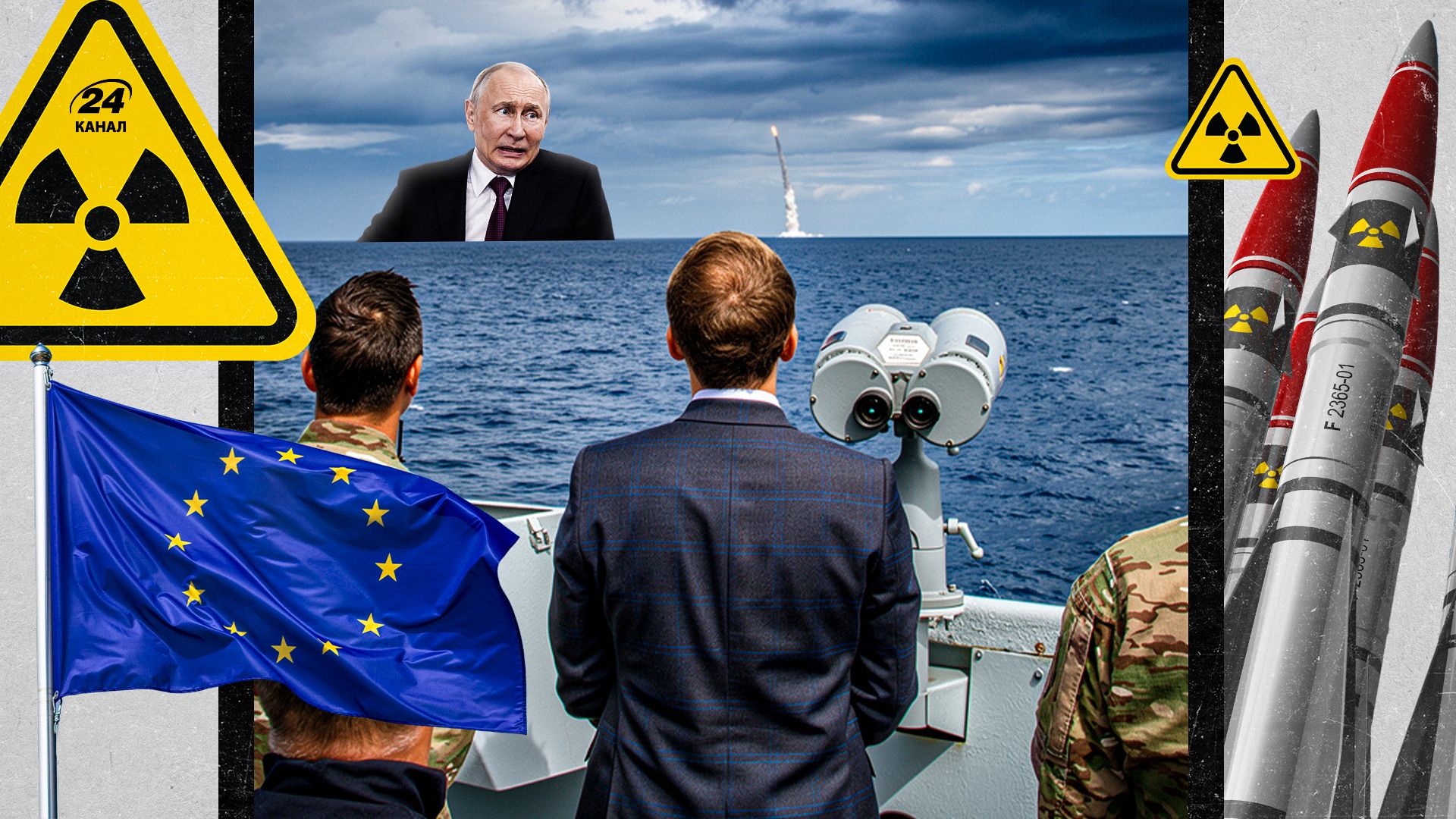


"To be free, you have to be fearsome. And to be fearsome, you have to be powerful," said French President Emmanuel Macron after France launched a new ballistic missile from a nuclear submarine.
But is Europe really that “fearsome”? And will that be enough to make Russia abandon its plans to attack?
Channel 24 sought answers to these questions together with Yuriy Bogdanov,a strategic communications specialist and political commentator .
Nuclear Capabilities and the Problem of Balance
First of all, it’s worth noting that the total The world's nuclear arsenal consists of about 12,000 warheads that could potentially be deployed. Of these, only about 2,000 are on constant combat alert.
These figures are only approximate, as no one will publicly disclose what is actually happening. So let’s at least use this as a starting point.
Much more interesting is the distribution of these missiles, since more than 80% of the ENTIRE global arsenal is still controlled by two countries – Russia (about 5,500 warheads) and the United States (about 5,000 warheads).
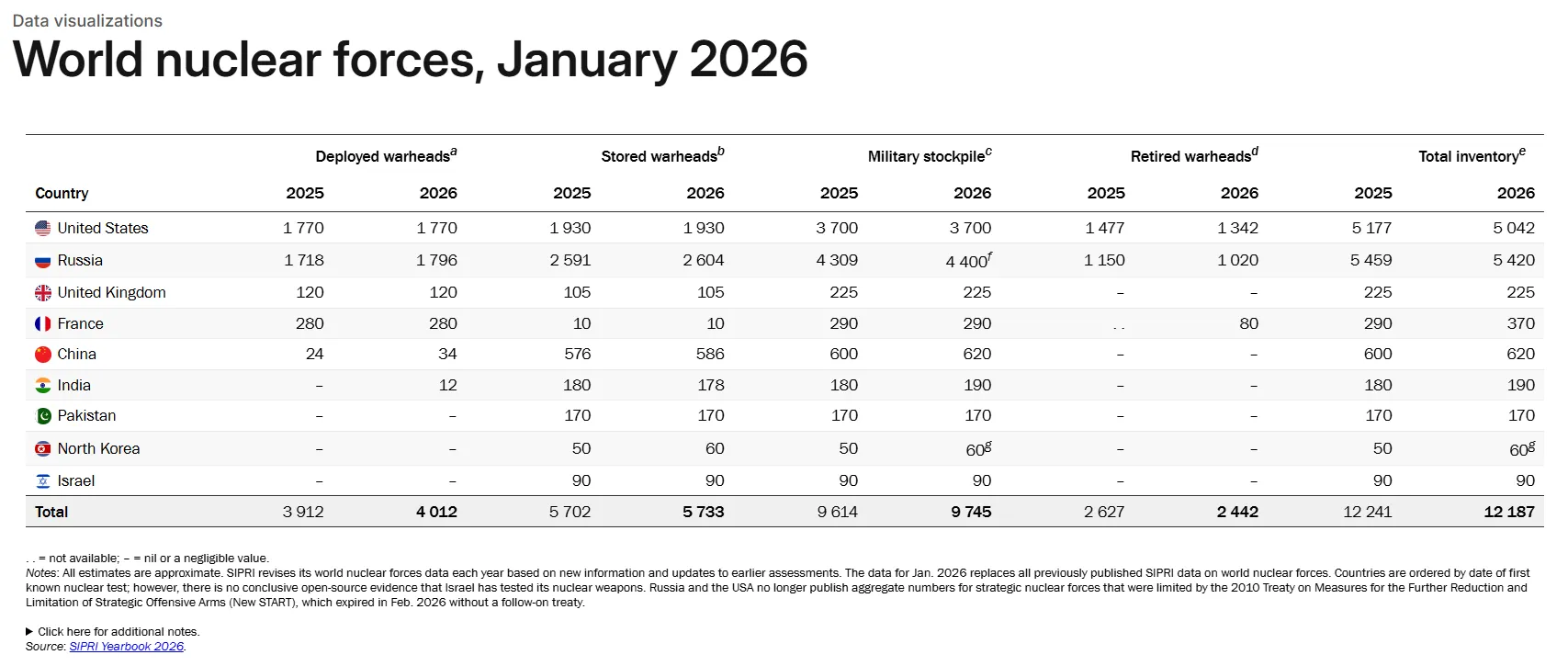
The World’s Nuclear Arsenals / Infographic – SIPRI
For a very long time, this was even convenient in a way, because these countries maintained strategic parity and a balance of power, and there was a clear understanding that the outbreak of a nuclear war would spell the end of everything. There would be no winners, and if nuclear weapons were used, a devastating response would surely follow. But what if that doesn’t happen? The current balance of power seems to be increasingly raising this question.
Europe’s Last Hope
For the first time since the Cold War, Putin directly and publicly threatened NATO has stated that he may use nuclear weapons if there is a threat or an attempt to isolate the Kaliningrad region.
Late last year, Russia allegedly deployed "Oreshnik" medium-range missiles on Belarusian territory with a range of up to 5,500 kilometers and the capability to carry a nuclear warhead.
In addition, Russia itself actively accuses Europe of nuclear escalation, as if seeking a casus belli – or, rather, a justification for its own actions. Just in case. For example, in early 2026, the Russians accused France of intending to transfer a TN75 nuclear warhead to Ukraine. And this was not done by just another Simonyan, but by an entire Russian intelligence agency.
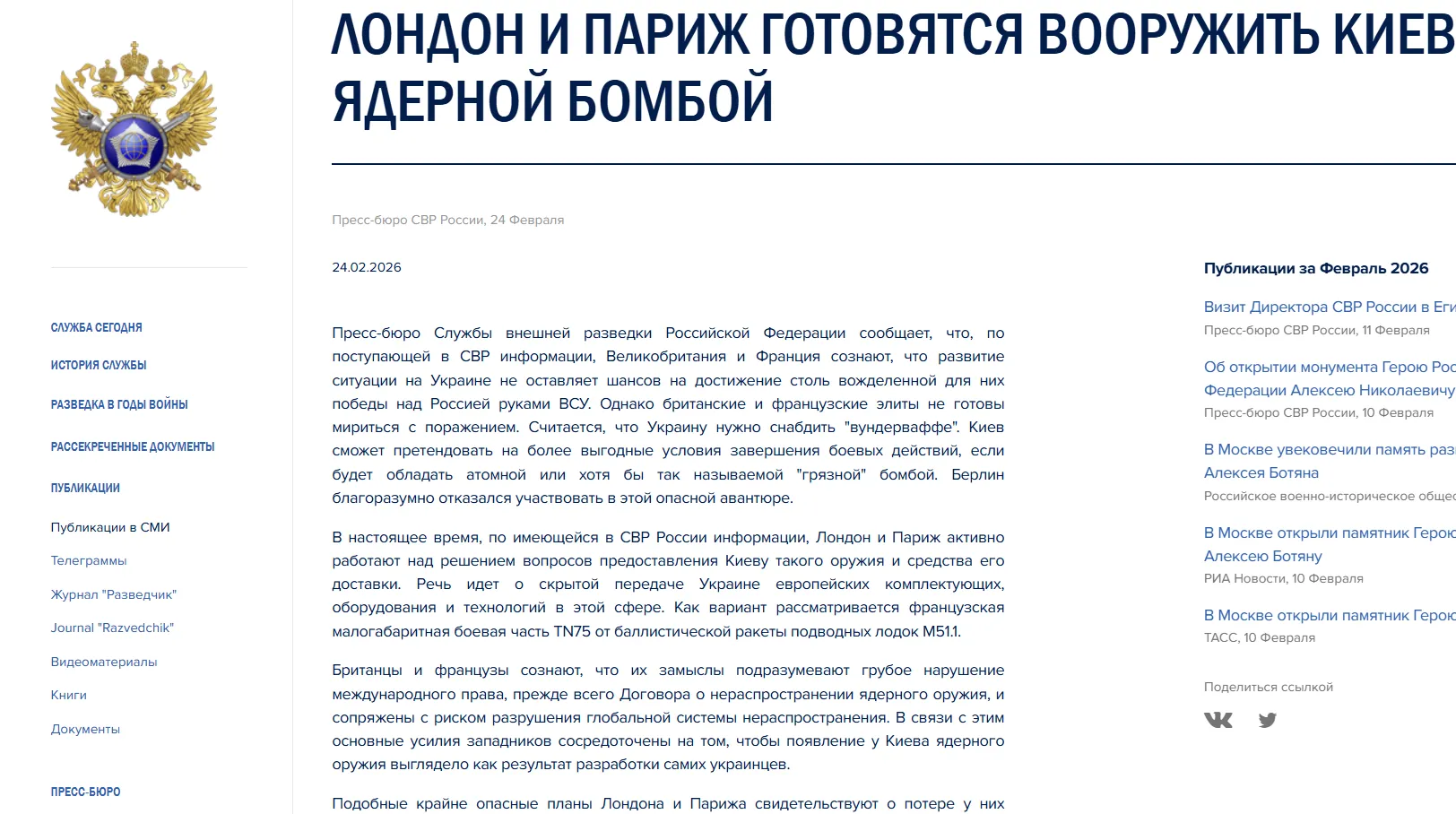
Russian intelligence has long been playing with fire / Screenshot from the official website of the Russian Foreign Intelligence Service
On paper, Russia cannot win a nuclear war against the U.S. But… what if Russia were to wage war not against the U.S., but only against Europe?
Unfortunately, this question is no longer an abstraction but a very real scenario, given all the changes in the U.S. that have taken place since Donald Trump’s return to the White House.
According to Yuriy Bogdanov, an expert on strategic communications, France and Britain are now the main hope for all of Europe.

Yuriy Bogdanov
Strategic Communications Specialist
France and Britain – two European countries with nuclear capabilities – cannot help but think about the continent’s security, while other countries cannot help but consider involving them in shaping a new security framework. Given that Russia uses nuclear weapons as a tool for blackmail and a means of managing escalation, countries that could fall victim to Russian aggression (the Baltic states, Scandinavia, Poland, and Germany), but do not possess nuclear weapons as a deterrent, are compelled and very eager to involve countries such as France and Britain in their own defense.Accordingly, given that Macron and other French politicians have the ambition to make France a leading European power, they are beginning to use this tool.
The United Kingdom and France together have about 400 deployed warheads, and about 600 in total. Compared to Russia’s nuclear arsenals, these are fairly limited nuclear forces, even relative to what existed during the Cold War.
According to publicly available information, the French nuclear arsenal consists of 240 TN75 warheads with a yield of 110 kilotons and new TNO warheads with a yield of 100 kilotons, as well as an additional 54 TNA warheads with yields ranging from 100 to 300 kilotons. As the French president stated, this should be sufficient for France to serve as a guarantor of security for all of Europe.
For its part, the United Kingdom has offered a “nuclear umbrella” to members of the “Joint Expeditionary Force” military coalition as part of a broader defense agreement. It could be deployed autonomously, without invoking NATO’s Article 5 on collective defense. The Joint Expeditionary Force includes the countries of Northern Europe, the Baltic states, the Netherlands, and the United Kingdom itself.
A very striking tweet from President Macron:
In other words, if Putin dares to attack Estonia, Latvia, or Lithuania, the UK will definitely respond. At least, on paper.
After all, the country conducted its last nuclear tests way back in the early 1990s. So, theoretically, the British are still a nuclear power, but the condition of these warheads and potential delivery systems over the past 30 years remains a mystery.
The most recent attempts to test missile launchers, conducted in 2024, ended in complete failure. The rocket’s boosters malfunctioned, and it fell into the sea not far from the launch site. The British Ministry of Defense confirmed at the time that an “anomaly” had occurred during the test, but stated that “the tests confirmed the effectiveness of the United Kingdom’s nuclear deterrent.”
That doesn’t sound very convincing, to put it mildly. But the paradox – and the main value – of nuclear weapons lies in the fact that no one wants to find out the hard way whether “something” is actually not working. In fact, Putin has exploited this principle and continues to do so, because the state of his nuclear arsenal is a story best described using Erwin Schrödinger’s famous thought experiment.
Yuriy Bogdanov asserts that despite all the uncertainties and problems, the British and French arsenals may be quite sufficient to deter Putin from his aggressive plans, since in Europe the infrastructure and population are sufficiently dispersed across the territory, whereas in Russia everything is literally concentrated in two or three locations.
Yuri Bogdanov
strategic communications specialist
The mere existence of nuclear weapons – whether in Britain or France – is already a serious deterrent.Yes, Russia has a significantly larger stockpile of warheads, but the point is that the Russian population, like all of its other facilities, is very densely concentrated. Consequently, if, hypothetically, destroying dozens or hundreds of cities were necessary to render Europe uninhabitable, in Russia it would be enough to destroy just two cities. Accordingly, any nuclear capability possessed by Russia’s adversaries is extremely dangerous.
Of course, all this deterrence works only if there is political will. And the very fact that such a discussion is taking place suggests that humanity has taken a wrong turn.
However, the fact that Europe is now doing everything in its power to demonstrate its strength and readiness is actually better than if it weren’t doing so at all. Because the Kremlin’s rhetoric hasn’t changed; Putin continues to speak of the nuclear triad, and the Russian prosecutor’s office keeps finding yet more “Nazis” in the Baltic states for Russian propaganda, hinting that Russia has no intention of abandoning its plans.
And where does the United States fit into this story?
The answer to this question is of interest to everyone, but it’s quite difficult to understand where that “hegemon” fits into this equation.
Donald Trump's policies are very unpredictableOn the one hand, it intends to modernize U.S. nuclear capabilities to deter adversaries. Washington asserts the need for a new nuclear control system that would simultaneously account for Russia, China, and other nuclear threats.
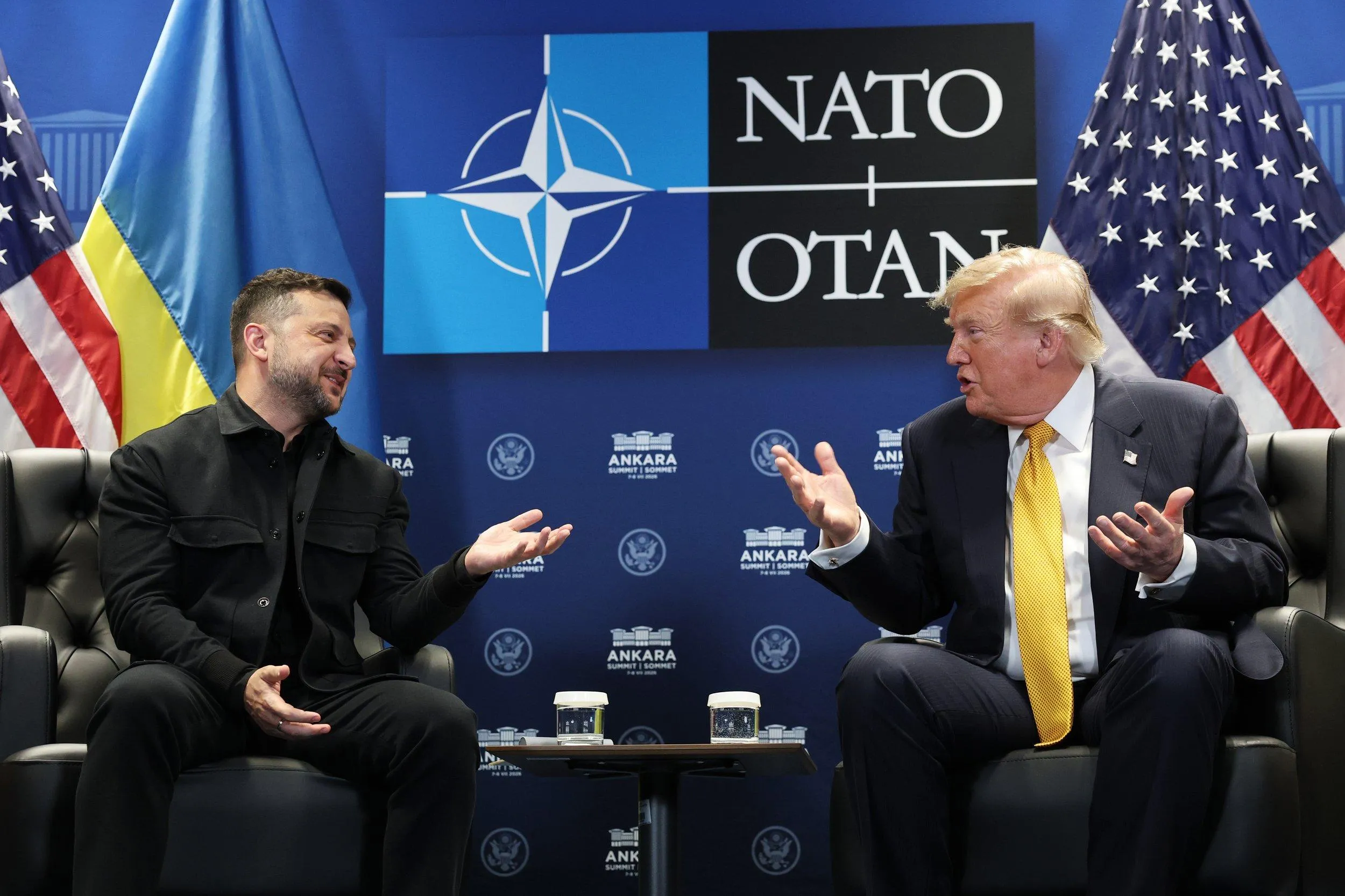
For Trump personally, NATO is something distant and alien / photo – Office of the President of Ukraine
On the other hand, there is no certainty that Trump would “fit in” at, say, Narva, which is located literally on the Russian-Estonian border. He has already soured relations with many countries and their leaders. For the past few years, he has demanded that Europe increase its defense spending, as if directly hinting that in the event of a threat, they would have to fend for themselves. At the same time, that same Trump is withdrawing U.S. troops from Europe and publicly humiliating allies.
Despite this, Yuriy Bogdanov believes in the strength of American institutions and is therefore convinced that they will not be able to leave Europe completely on its own. According to the expert, this is not part of the United States’ plans, as it also has its own interests regarding the presence of troops in Europe.
Yuriy Bogdanov
strategic communications specialist
Donald Trump isstill trying to somehow curb Vladimir Putin’s desire to take aggressive action against Europe, because right now too many processes in America – including security-related ones – are tied to Europe. In other words, we must also understand that this notion – that America will leave Europe on its own – is highly illusory. The U.S. would be unable to carry out any security or offensive operations – as was the case with Iran – without the support of European bases in Spain, Portugal, Germany, Greece, and Italy; this infrastructure is essential for America.
At the same time, it seems that a few years ago, when Joe Biden was in power in the U.S., no one would have found themselves in such a situation. His rhetoric was clear and unambiguous: to defend every centimeter of NATO territory, no matter where a threat arose. That was enough to ensure that no one would even think of testing the patience of Joseph Robinette Biden Jr. or Article 5 of the Washington Treaty. However, at that time, few in the so-called “collective West” appreciated that status quo. Moreover, they took it for granted and viewed it as something eternal. Today, those illusions have been dispelled.
Steps of Escalation
Of course, Putin has long adhered to a “stages of escalation” rhetoric of nuclear threats in his dealings. Now, however, he is trying to create the impression that “ Russia is trying to set a precedent for the use of nuclear weapons ” and to cause panic among the operators of the Doomsday Clock, which, as a reminder, currently stands at 85 seconds to nuclear midnight.
From a purely mathematical standpoint, Europe has almost no chance of defeating Russia in a nuclear war (assuming, of course, that there can even be winners in a nuclear war).
How events unfold depends on many factors and, in reality, on the political will of the leaders of the world’s leading nations. French President Macron is demonstrating this will, but he can afford to do so because he has nothing to lose and doesn’t have to worry about approval ratings – he can simply do what’s right. After all, he will be leaving the Élysée Palace this spring, and France will have a new president.
Whether Macron’s successor will continue his course or, under pressure from Russia’s nuclear blackmail, make concessions to the aggressor remains unknown.
The situation with the United Kingdom is clearer; there is a strong consensus there on the need to be strong and resolute (not even Farage can overturn this), but there are questions regarding the technical specifications of nuclear warheads. So London is forced to always look to the U.S., where everything depends on FIFA Peace Prize laureate (at least until the midterms).
In a situation where Russia is indeed planning military aggression against European countries and openly states that it is ready to move from “conventional” acts of sabotage – which are, in fact, already acts of war – to full-scale nuclear strikes, this approach leaves too many “buts.” Nevertheless, this is the world we live in today.